How To Run a Face Search That Returns Matches
Most people who land on FaceCheck.ID arrive with a single practical question: how do I actually find this person from a photo? A good How To guide answers that — not in theory, but in the specific clicks, image choices, and result-reading habits that determine whether a face search succeeds or wastes your time.
How to run a face search that actually returns matches
The single biggest factor in face-search success is the input image. A How To worth following will tell you to crop tightly to the face, use a front-facing shot when possible, and avoid heavy filters, sunglasses, or group photos where the engine has to guess which face you mean. Resolution matters less than people assume — a sharp 400×400 headshot often outperforms a blurry 4K image where the face takes up 80 pixels.
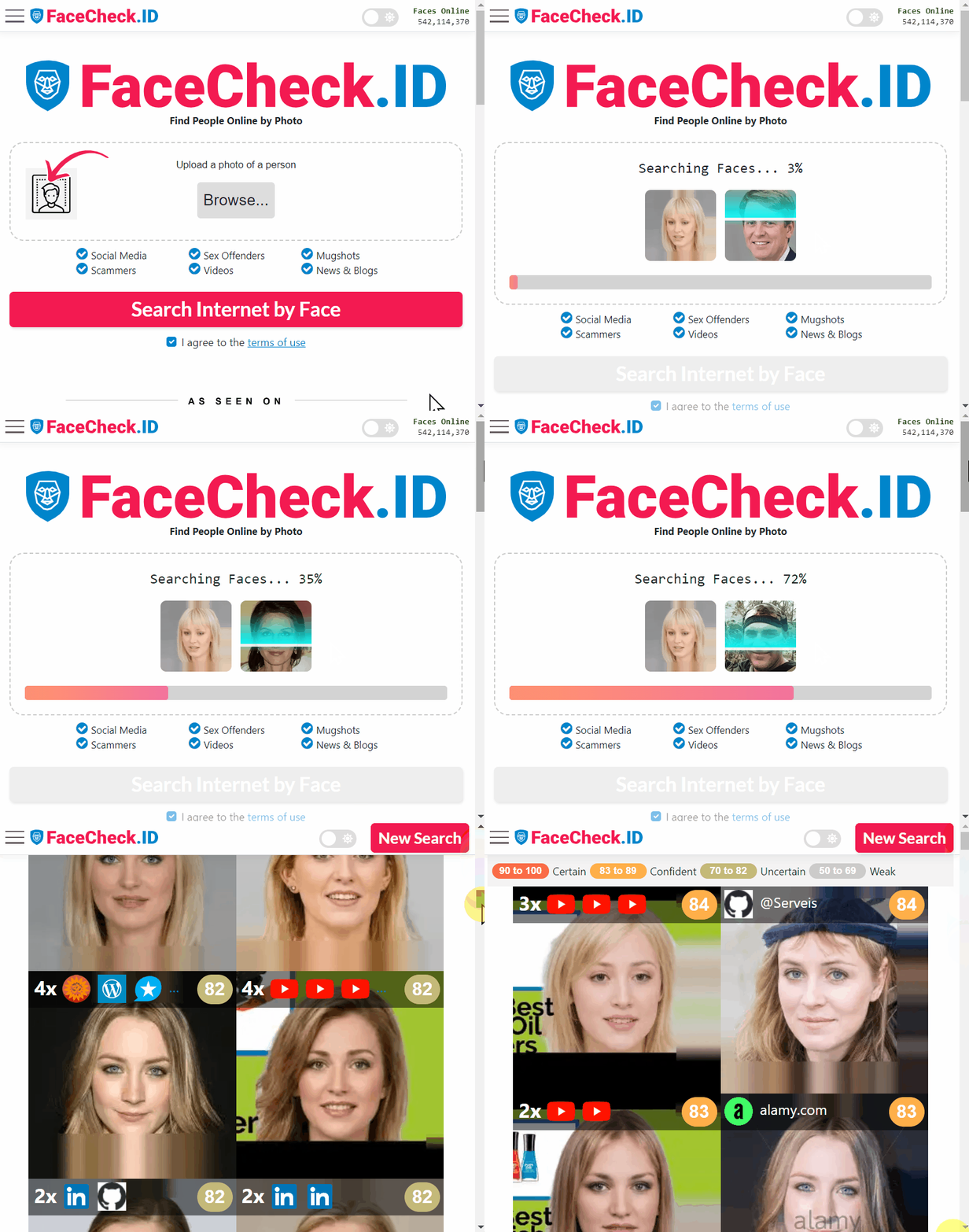
The mechanics are straightforward: upload a photo, wait for the engine to extract a face embedding, and review ranked results. The skill is in iteration. If your first search returns weak matches, try a different photo of the same person — a slightly different angle, lighting condition, or age can surface entirely new results because the underlying embeddings shift. People who run face searches regularly know that two photos of the same person can hit different corners of the indexed web.
How to read results without jumping to conclusions
Match confidence scores are not identity confirmations. A 90%+ score on FaceCheck.ID typically means the engine found a face that is very likely the same person, but "very likely" is not "definitely." Twins, siblings, and lookalikes routinely produce high scores. The right How To workflow treats a strong match as a lead, then confirms it with context: does the linked profile's location, age, name, or bio fit what you already know? Are there multiple independent pages — a LinkedIn, a news article, a forum post — all returning the same face?
Lower-confidence matches are not garbage either. They often surface older photos, heavily edited images, or partial-face matches that are still useful for catfish detection or scam investigation. Knowing how to weigh a 70% match against a 95% one is the difference between a careful investigator and someone who accuses the wrong person.
How to handle common scenarios
Face search shows up in a handful of recurring use cases, and each has its own approach:
- Verifying a dating-app match. Search the clearest profile photo. Look for the same face appearing under a different name, on escort directories, or attached to scam-warning forums.
- Checking for stolen photos. Run your own face. If results return profiles you do not control, you may be the victim of impersonation or romance-scam catfishing.
- Identifying someone in a news photo or screenshot. Crop to the face, run the search, and cross-reference any returned profiles against the event's date and location.
- Investigating a suspicious account. Compare returned matches across platforms — a real person usually leaves a consistent trail, while a fake identity often surfaces stolen images from unrelated sources.
What a How To guide cannot promise
No How To, however detailed, can guarantee a match. Face search engines only find what is publicly indexed. If a person keeps a small online footprint, uses heavy privacy settings, or only appears in photos behind logins, the engine has nothing to work with. A blank result is not proof someone does not exist online — it is proof they are not visible to this particular index.
A How To also cannot replace judgment. Following every step correctly will still produce false positives, missed matches, and ambiguous results. The guide gets you to the data; deciding what the data means, and whether acting on it is legal and ethical in your jurisdiction, is on you. Face recognition is a tool for narrowing possibilities, not for declaring identities.
FAQ
How to run a face recognition search safely without exposing sensitive personal data?
Use the minimum necessary photo (crop to the face, remove backgrounds), avoid uploading images of minors or private situations, and prefer images you have rights to use. If possible, use a device/network you trust, and review the provider’s privacy/retention terms before uploading.
How to refine face recognition search results when you get too many similar matches?
Try a higher-quality, front-facing photo with even lighting, then rerun the search with a different image of the same person (different day/angle). Crop tightly to the face, remove hats/sunglasses when possible, and compare matches using multiple reference points (age range, location clues, context on the source page) rather than relying on one image.
How to interpret a face search result before concluding it’s the same person?
Treat results as leads, not proof. Check for consistent features across multiple photos (ear shape, mole/scar placement, facial proportions), confirm context on the source sites (dates, names, locations), and look for several independent matches that agree. If only one weak or out-of-context result appears, assume uncertainty.
How to use FaceCheck.ID results responsibly when investigating identity or safety concerns?
Use FaceCheck.ID (or any face search tool) only to gather pointers, then verify through independent sources. Avoid doxxing or public accusations, do not use results as sole evidence, and document the URLs and context for each match. If the situation has legal or safety implications, consider involving appropriate authorities or professionals rather than acting on search results alone.
How to reduce the chance of false matches caused by edited, filtered, or AI-generated images?
Prefer unedited photos with natural lighting and sharp focus, and avoid screenshots with heavy compression. If you suspect editing or synthetic content, run searches using multiple authentic photos, compare results across different sources, and scrutinize the originating pages for signs of manipulation (inconsistent metadata, repeated patterns, or mismatched context).

Recommended Posts Related to how-to
-
How to Find Someone Using a Screenshot
How to reverse image search to find someone. How to reverse image search to find catfish. How to reverse image search to find social media.
-
How to Reverse Image Search a Screenshot with FaceCheck.ID
In this guide, we'll show you how to reverse image search a screenshot, introduce you to an innovative tool called FaceCheck.ID for looking up faces, and explain why Google Lens is the best choice for objects and products. How to capture a screenshot on Mac. How to take a screenshot on Windows.
-
How to Find an OnlyFans Profile by Photo Using a Reverse Image Search
Here is how to use it:. How to Find an OnlyFans Creator's Other Social Media Accounts. How To Find Someone On OnlyFans.
-
Is There a FREE Facial Recognition Site?
How to Use a Free Facial Recognition Site: If you're looking for a free facial recognition platform, FaceCheck.ID is a top choice. How to Reverse Image Search a Person. How to Understand the AI That Recognizes Faces: The AI behind FaceCheck.ID is rooted in deep learning algorithms.
-
Tackling Image Theft for Influencers, Actors, and Models: Protecting Your Online Image
Here's how to use them, and what to do when something turns up that shouldn't. In this video, I walk through my own run-ins with it and how to handle a company that lifts your work — especially when they're making money off it. How To Deal With Image Theft.