Online Dating Safety
Dating apps compress the early stages of trust into a few photos and a short bio, which is exactly the gap scammers and catfishers exploit. Online dating safety is the practical work of verifying who you are actually talking to, controlling what you reveal, and recognizing the patterns that signal a fake or harmful profile before you meet in person or send money.
Verifying identity before trust is earned
The single most useful step in dating safety is confirming that the person on the other end of the chat is who they claim to be. Profile photos are the easiest place to start, because scammers reuse them across many fake accounts and steal them from real people on Instagram, LinkedIn, modeling sites, and influencer pages.
A face search across the public web can surface:
- Other dating profiles using the same face under different names
- The original source of a stolen photo, often a public Instagram or modeling portfolio
- News articles, scam-reporter forums, or Reddit threads naming the photo as part of a known romance scam
- Social profiles that contradict the age, location, occupation, or marital status given in the dating app
Reverse image search by file is useful but limited, because scammers crop, mirror, filter, or lightly edit photos to bypass exact-match checks. Face recognition search compares the face itself rather than the pixels, so it tends to catch reused photos even when the background has been removed or the image has been re-saved through Snapchat or a screenshot.
Treat results as evidence, not proof. A face appearing on another dating profile under a different name is a strong red flag. A face appearing on a personal Instagram with the same name and city is corroboration, not certainty, since profiles can be impersonated too.
Reading the warning signs in conversation
Identity checks work best alongside behavioral checks. Romance scammers follow recognizable scripts because they run the same conversation across dozens of targets at once. Common patterns:
- Refusing or repeatedly cancelling video chats, or sending pre-recorded clips instead of live video
- Pushing to move off the dating app to WhatsApp, Telegram, or Google Chat within the first few messages
- Stories involving overseas military deployment, oil rigs, surgeons abroad, or stuck inheritance money
- Unusually polished photos paired with unusually generic conversation
- Any request for money, crypto, gift cards, or help "verifying" an account on a third-party site
If a profile passes a face search but the conversation hits several of these markers, the photo may belong to a real person whose images have been stolen for impersonation. The face matched. The identity behind the chat did not.
Controlling what your own profile reveals
Safety also means limiting what someone can learn about you from your own photos and bio. Background details give away more than people expect. Visible street signs, mail with addresses, gym logos, parking decals, school mascots, and recurring coffee-shop interiors can be enough for a determined stranger to find your neighborhood or daily routine.
Practical habits:
- Use photos that do not also appear on your LinkedIn, Facebook, or Instagram, since matching them links your dating profile to your full legal identity
- Strip metadata from images before uploading
- Keep last name, employer, and home area vague until video chat and a public meeting have happened
- Use the app's in-product calling and messaging until you are confident in who you are talking to
What safety checks cannot prove
Face search, video calls, and conversation analysis raise or lower confidence. They do not deliver a verdict. A clean reverse image search does not mean the person is honest, only that their photos have not been flagged elsewhere yet. A live video call rules out most low-effort catfishing but does not rule out someone misrepresenting their relationship status, finances, or intentions. Conversely, a face match on a suspicious account does not always mean the person you are chatting with is the scammer, since their photos may have been stolen too.
The goal is not certainty. The goal is to avoid the avoidable risks: the recycled scam photo, the unverified first meeting at your home, the gift card request that any reasonable check would have caught.
FAQ
How can face recognition search engines improve online dating safety without violating someone’s privacy?
Use face search only for personal safety checks (e.g., spotting obvious stolen photos), minimize data shared (use a cropped face image without extra identifiers), avoid uploading private images of third parties without consent where possible, and don’t publish or harass someone based on results. Treat findings as unverified leads and confirm through respectful, non-invasive steps (video call, consistent profiles, mutual references).
What are the biggest online dating safety risks of relying on face recognition search results?
The biggest risks are false matches (wrong person), overconfidence (treating a match as proof), and misinterpretation of context (reposts, memes, old photos, look-alikes). These can lead to false accusations, doxxing, or unsafe decisions. Use results only to guide further verification, not to confirm identity or wrongdoing.
If a face search shows the same photo used across many dating profiles, what should I do next for safety?
Assume a high likelihood of photo misuse and pause engagement. Ask for a real-time verification step (short live video call, a quick selfie with a specific gesture, or a photo holding a handwritten date/code), compare other profile details for consistency (age, location, timeline), and report suspicious accounts to the dating platform. If money, gifts, or urgent emergencies come up, treat it as a major scam indicator.
How should I interpret matches from face search tools when checking a new dating match’s photos (including tools like FaceCheck.ID)?
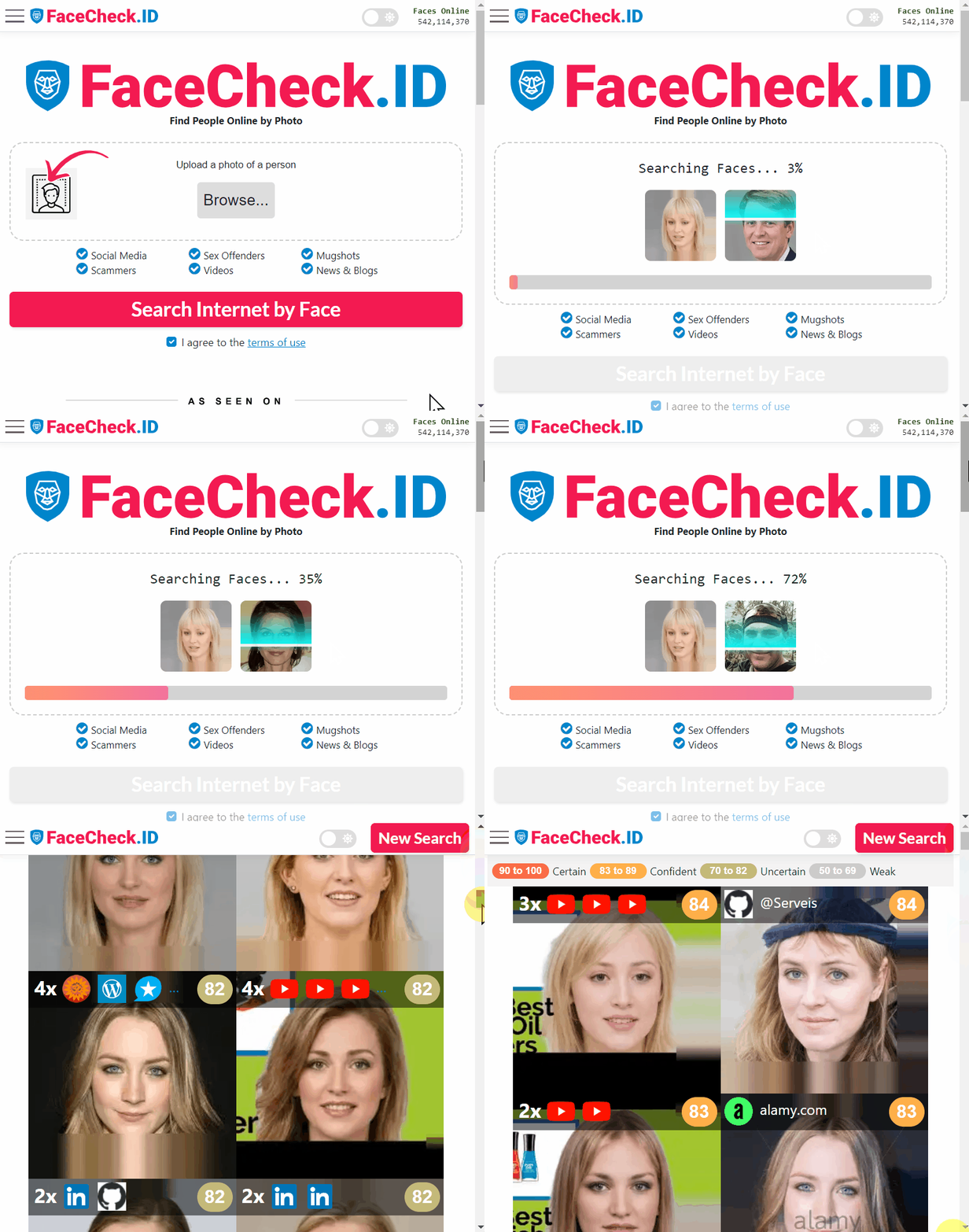
Interpret matches as pointers to webpages where similar-looking faces appear, not as identity confirmation. Check whether the linked pages are credible, whether the photos are clearly the same person across multiple angles and dates, and whether the timeline makes sense. With tools like FaceCheck.ID, use any grouping, similarity indicators, and source previews to prioritize verification, but still confirm via direct, consent-based checks (video call, consistent social profiles).
What should I do if a face recognition search links my dating match’s face to alarming content (e.g., mugshots, adult content, or “scam reports”)?
Don’t assume it’s the same person. First, verify the match quality (multiple photos, consistent facial features, not just one similar image). Then validate the source page context (is it a reputable site, is the content user-generated, is the photo reused or mislabeled). If uncertainty remains, prioritize personal safety: stop sharing personal details, avoid meeting alone, and consider ending contact. If you suspect impersonation or misuse of someone’s photos, report it to the platform rather than confronting aggressively.

Recommended Posts Related to online-dating-safety
-
Going on a Date? Lookup Child Sex Offenders by Photo
Online Dating Safety Measures: Proactive Steps for Single Mothers. Using FaceCheck.ID for Online Dating Safety. 5 IMPORTANT Online Dating Safety Tips – Take Precaution, Stay Safe!
-
How to Spot a Catfish Online in Under 60 Seconds with FaceCheck.ID
This freemium approach makes powerful online dating safety tools accessible to everyone.
-
How Do You Reverse Image Search on Dating Sites?
Used ethically, reverse search makes online dating safer for everyone.
-
Facial Recognition and Reverse Search on Facebook: A Deep Dive into FaceCheck
-
Top 4 Benefits of Facial Recognition in Online Dating with FaceCheck.ID
Increases online dating safety.