OSINT: Face Search as an Investigation Pivot
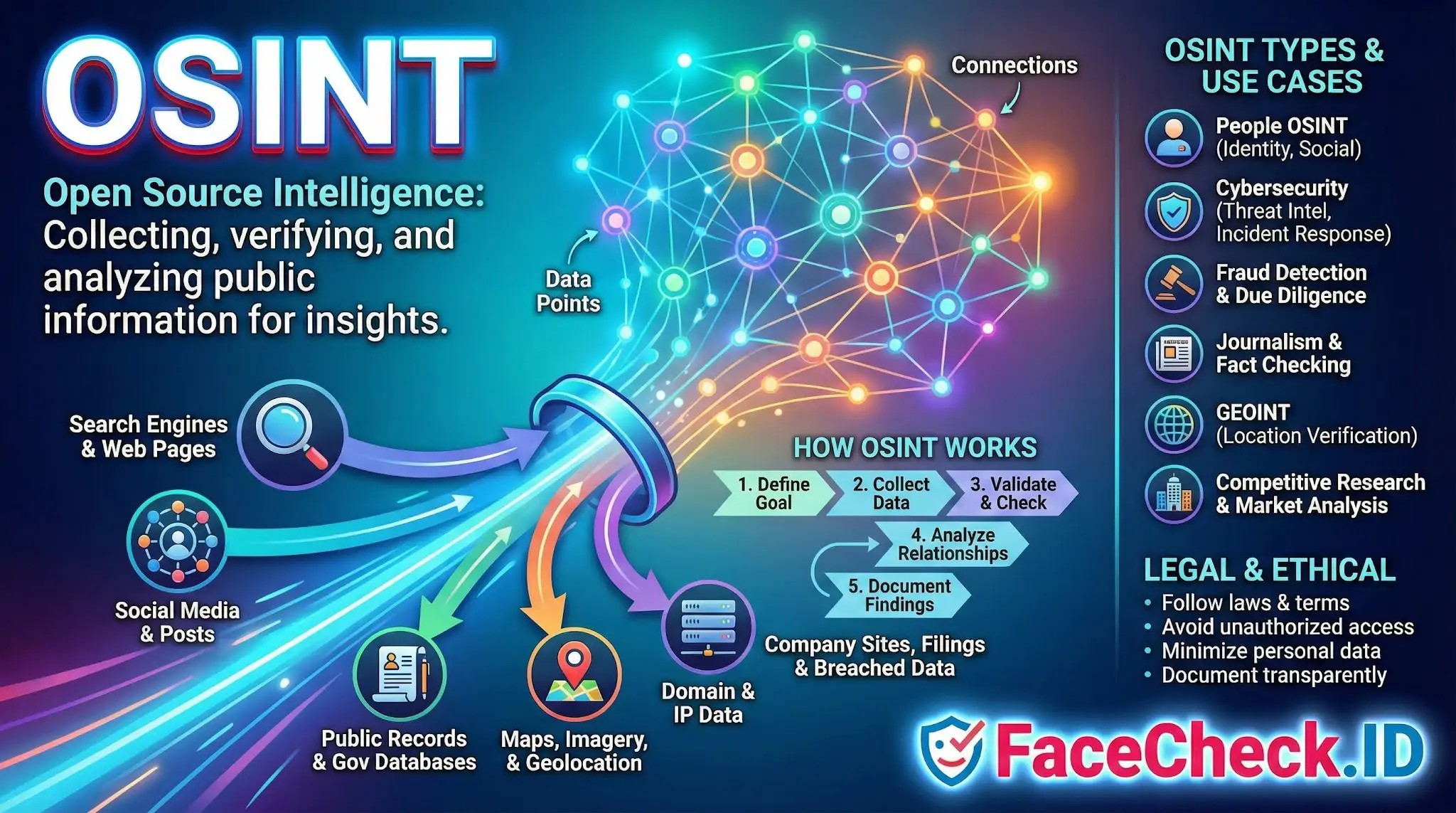
OSINT, or open source intelligence, is the practice of building a picture of a person, account, or event using only publicly accessible information. On FaceCheck.ID, a face is often the starting point of an OSINT trail, since a single photo can lead to social profiles, news mentions, archived pages, and other public traces that connect an online identity to a real one.
Where face search fits in an OSINT workflow
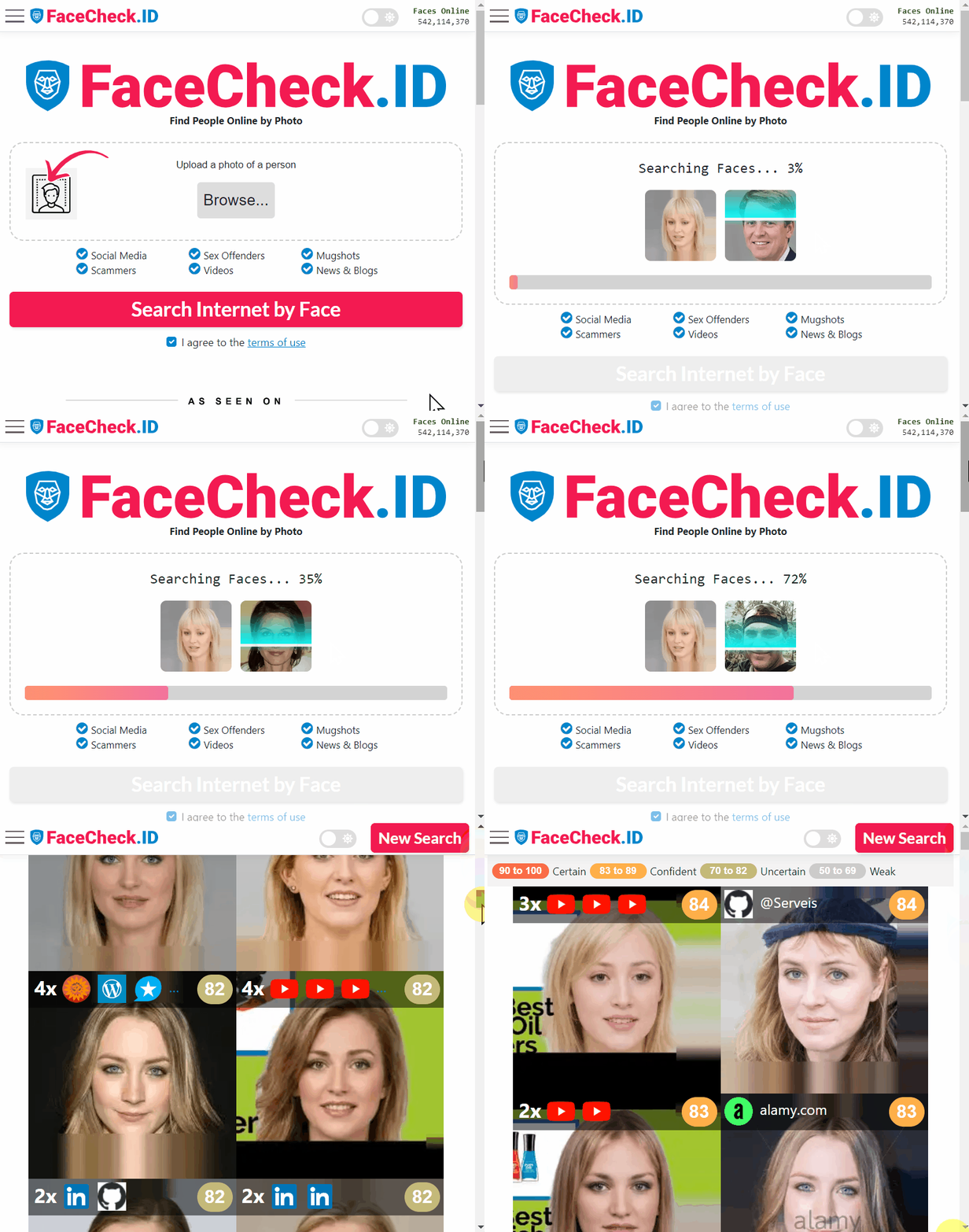
A reverse face search sits at the front of most modern people-focused OSINT investigations. Before usernames, email addresses, or phone numbers are checked, an investigator often runs the subject's photo through a face-recognition index to surface pages where that face already appears in public.
Typical inputs and outputs:
- Input: a profile picture from a dating app, a screenshot from a video call, a photo from a suspicious LinkedIn account, or a frame from a livestream.
- Output: links to other profiles, blog posts, news articles, conference pages, mugshot sites, or forum avatars showing the same face.
Each match becomes a new pivot. A LinkedIn hit gives a name and employer. A news article gives a context and date. A dating site under a different name suggests deception. The face is the anchor that ties these scattered records together.
Practical OSINT pivots from a face match
Once a face search produces results, the investigator's job is to verify and expand. The matches are leads, not conclusions. Useful pivots include:
- Cross-checking the name attached to one match against the name on another. A mismatch is a flag, not proof.
- Comparing photo upload dates across sites to estimate which platform the image originated on.
- Looking for the same image with different crops, filters, or watermarks, which often indicates reuse by a scammer or content scraper.
- Running the username, bio text, or unusual phrases from a matched profile through search engines to find related accounts that did not surface from the face alone.
- Checking the Wayback Machine for deleted versions of a matched page when an account has since been scrubbed.
Face matches pair well with traditional OSINT techniques: WHOIS lookups, breach data review, metadata inspection, and geolocation from background details in the photo itself.
Common scenarios where face-based OSINT matters
- Romance scam victims trying to confirm whether the person they have been talking to is using stolen photos.
- Recruiters and HR teams checking whether a candidate's headshot appears under a different name elsewhere.
- Journalists verifying that a source or subject is who they claim to be.
- Fraud and trust-and-safety teams investigating fake accounts on marketplaces, dating platforms, or crypto communities.
- Family members searching for missing or estranged relatives whose only known image is years old.
In each case, the face search is one signal among many. Stronger conclusions come from corroboration: matching biographical details, consistent timelines, and independent confirmation through other public records.
Limits of face-based OSINT
A reverse face search does not prove identity. It produces a ranked list of visually similar faces from indexed public pages, and the quality of that list depends on image angle, lighting, resolution, and how widely the face has been published online. Common pitfalls:
- Lookalikes and relatives can produce high-confidence matches that are still wrong.
- Heavily filtered, AI-generated, or low-resolution images degrade match quality and can pull in unrelated faces.
- A scammer who reuses a real person's photos will return matches for the victim, not the scammer. The face on screen is not always the person operating the account.
- Absence of matches does not mean the person is unknown. It often means their photos are not on indexed public pages, or have been posted only in closed communities.
OSINT done well treats face-search output as evidence to test, not a verdict to publish. Every match needs context, a second source, and a clear record of how it was found before it informs any decision about a real person.
FAQ
What does “OSINT” mean in the context of face recognition search engines?
OSINT (Open-Source Intelligence) means collecting and analyzing information from publicly available sources. In face recognition search engines, OSINT typically refers to using a face photo to discover where that face (or very similar faces) appears on the open web, then using the surrounding page context (captions, usernames, dates, locations, repost chains) to assess what the results actually mean.
What are legitimate OSINT use cases for face recognition search engines (and what should be avoided)?
Legitimate OSINT uses include checking whether a profile photo is stolen or reused (impersonation/catfishing checks), finding the earliest known source of a headshot, and corroborating claims using publicly visible pages. Avoid using face search to harass, stalk, dox, target protected groups, or make high-stakes accusations; face-search results should be treated as leads that require independent verification from reliable sources.
What OSINT steps help verify a face-search “hit” without misidentifying someone?
Use multiple corroborating signals: compare several photos across time (age, hairstyle, distinctive features), check whether the same face appears with consistent identifiers (same username, linked accounts, consistent bio details), review the page’s context and repost trail, and look for non-face evidence (unique tattoos, logos, event photos, geotags, timestamps). If the hit is high-risk (e.g., crime, adult content, scam reports), require stronger confirmation and assume false matches are possible.
How do OSINT analysts reduce bias and false confidence when using face recognition search results?
Reduce bias by actively seeking disconfirming evidence, documenting uncertainty, and cross-checking with alternative methods (reverse image search for duplicates, keyword searches, platform-native searches, and independent sources). Don’t infer identity from one strong-looking match; instead, build a chain of evidence and note that demographic performance differences, photo quality, and look-alikes can skew results.
How can FaceCheck.ID add value in an OSINT workflow, and what precautions should you take?
FaceCheck.ID can be used as one input to locate open-web pages where a face (or similar faces) appears, which may help analysts discover reposts, impersonation patterns, or additional source pages to review. Precautions: treat results as investigative leads (not proof of identity), verify using page context and independent corroboration, avoid sharing sensitive findings, and follow privacy/consent and local-law requirements—especially when results could harm someone’s reputation or safety.

Recommended Posts Related to osint
-
How to Find Anyone Online: A Guide to Internet Sleuthing
Below: the search engines, the social platforms, the public records, the slightly obscure OSINT tools that investigators actually use. OSINT — Open Source Intelligence — is just a serious-sounding name for "looking things up using stuff that's already public." Here are the tools worth knowing:. Free, fast, and the current favorite among OSINT folks who care about thoroughness.
-
Leveraging Facial Recognition Technology to Combat Human Trafficking
The Impact of Open-Source Intelligence (OSINT) on Human Trafficking Cases. Combining facial recognition with open-source intelligence (OSINT) significantly enhances the efficiency of investigations. OSINT involves analyzing large data sets to uncover patterns and connections that would be impossible to identify manually.
-
Search by Face to Find Social Media Profiles
Find social media profiles FAST with this OSINT tool! Find social media profiles FAST with this OSINT tool! OSINT: You can't hide // Your privacy is dead // Best resources to get started.
-
How-To Guide for Effective Face Lookup
Face Lookup by Facial Recognition - Image OSINT. Search for Photos by Facial Recognition (and more) | Image OSINT.
-
Yandex Image Search: Complete Guide to Finding Faces (2026)
Between 2018 and 2023, Yandex was the go-to recommendation in every OSINT community for face-based reverse image search. Users in OSINT forums have reported declining result quality for non-Russian subjects since mid-2024.