VK Face Search Matches

When a face-search result links to a profile on vk.com, you are usually looking at a page from VK (also written Vk or VKontakte), a Russian-built social network where photos, group memberships, and friend lists are often public enough to be indexed by reverse image and face-recognition tools. For anyone investigating an online identity, VK is one of the more productive sources of matches outside the Western platforms most people think of first.
Why VK matters in face search
VK has hundreds of millions of registered accounts and a long history of permissive default privacy settings. Profile photos, album uploads, and community posts are frequently visible without login, which means face-recognition crawlers can index them and surface them later as matches. A single VK profile may contain dozens of photos taken across years, which gives a face-search engine multiple angles, lighting conditions, and ages of the same person to work with.
This is useful in practical scenarios such as:
- Confirming whether a suspected catfish is reusing photos from a real VK user
- Tracing a dating-app picture back to an older VK album
- Identifying a person whose presence on Western platforms is minimal or scrubbed
- Cross-referencing a face that appears in scam reports against a VK community membership
VK URLs typically look like vk.com/username, vk.com/id123456, vk.com/public123456, or vk.com/club123456. The numeric id format often appears when a user has not set a custom handle, and it can persist even after the display name changes.
How to read a VK match
A face-search hit on a VK page is a starting point, not a verdict. Several patterns are worth checking before treating a match as the person's real identity:
- Photo reuse. Stolen photos circulate widely on VK, especially attractive headshots used in romance scams. The face you see on a VK profile may not be the account holder.
- Account age and activity. Profiles with years of mundane posts, tagged friends, and consistent photos are harder to fake than thin pages with three uploads from the same week.
- Friend graph. Real accounts tend to have friends who interact across many years. Scam and impersonation accounts often have flat, disconnected friend lists.
- Community memberships. The groups a profile belongs to can confirm location, language, school, or workplace claims that appear elsewhere in your investigation.
- Cross-platform consistency. If the same face appears on VK, Telegram, OK.ru, and a dating site with conflicting names, you are probably looking at recycled images.
The image quality on VK is mixed. Older uploads can be heavily compressed, and group cover photos sometimes crop faces tightly enough to confuse a matcher. Treat low-confidence VK matches the same way you would treat any borderline result and look for a second independent source.
VK in scam and impersonation cases
Face-search investigators often encounter VK in two opposite roles. Sometimes a VK profile is the original source of photos that were later stolen and used on Tinder, Instagram, or WhatsApp by a scammer pretending to be someone else. Other times a VK account is itself the fake, built with stock photos or images scraped from a different person's social media. Determining which side you are on requires checking which version of the photos appeared first, whether metadata or watermarks survive, and whether the surrounding profile activity is internally consistent.
What a VK match does not prove
A face-search result pointing to VK confirms that a similar or identical face is present on that page. It does not confirm that the person in the photo controls the account, that the displayed name is real, or that the profile reflects current information. VK profiles can be inactive for years, run by someone other than the person pictured, or built entirely from stolen images. False positives also occur with lookalikes, siblings, and heavily filtered photos. A VK link should be treated as one data point in a larger identity check, not as proof of who someone is.
FAQ
What does “VK” (Vk) usually refer to in face recognition search engine results?
In face recognition search engine results, “VK” or “Vk” typically refers to VKontakte (vk.com), a social network where profile photos, reposts, and group/community images may be indexed and returned as potential matches.
Does a vk.com match in a face recognition search engine prove the person has a VK account?
No. A vk.com result only indicates the face (or a very similar-looking face) appears on a VK page that the search engine found. The image could be reposted, mirrored, or uploaded by someone else, so it should be treated as a lead—not proof of account ownership or identity.
Why do VK links in face-search results sometimes require login or show limited information?
VK pages and photo viewers may restrict access based on privacy settings, region, or whether you are logged in. If the content is not publicly viewable, a face recognition search engine may still show the link it discovered, but you might not be able to confirm details directly from VK without appropriate access.
What do common VK URL patterns (like id123, club123, public123, photo123\_456) indicate about a result?
These patterns often hint at the type of VK page: “id###” commonly points to an individual profile, “club###” or “public###” commonly points to a community/group/public page, and “photo###_###” commonly points to a specific photo object. This can help you judge whether the image likely comes from a personal profile, a repost-heavy community, or a standalone photo page.
How can I safely verify a VK result from a face recognition tool (including FaceCheck.ID) before acting on it?
Use it as a starting point: open the VK page and look for corroborating context (same username across platforms, consistent biography/location/timestamps, multiple photos of the same person, and original upload indications rather than reposts). Compare several images (not just one) and cross-check with other sources. Avoid treating a single VK hit or similarity score (including from FaceCheck.ID) as confirmation of identity.

Recommended Posts Related to vk
-
How to Find People on VK.com by Photo
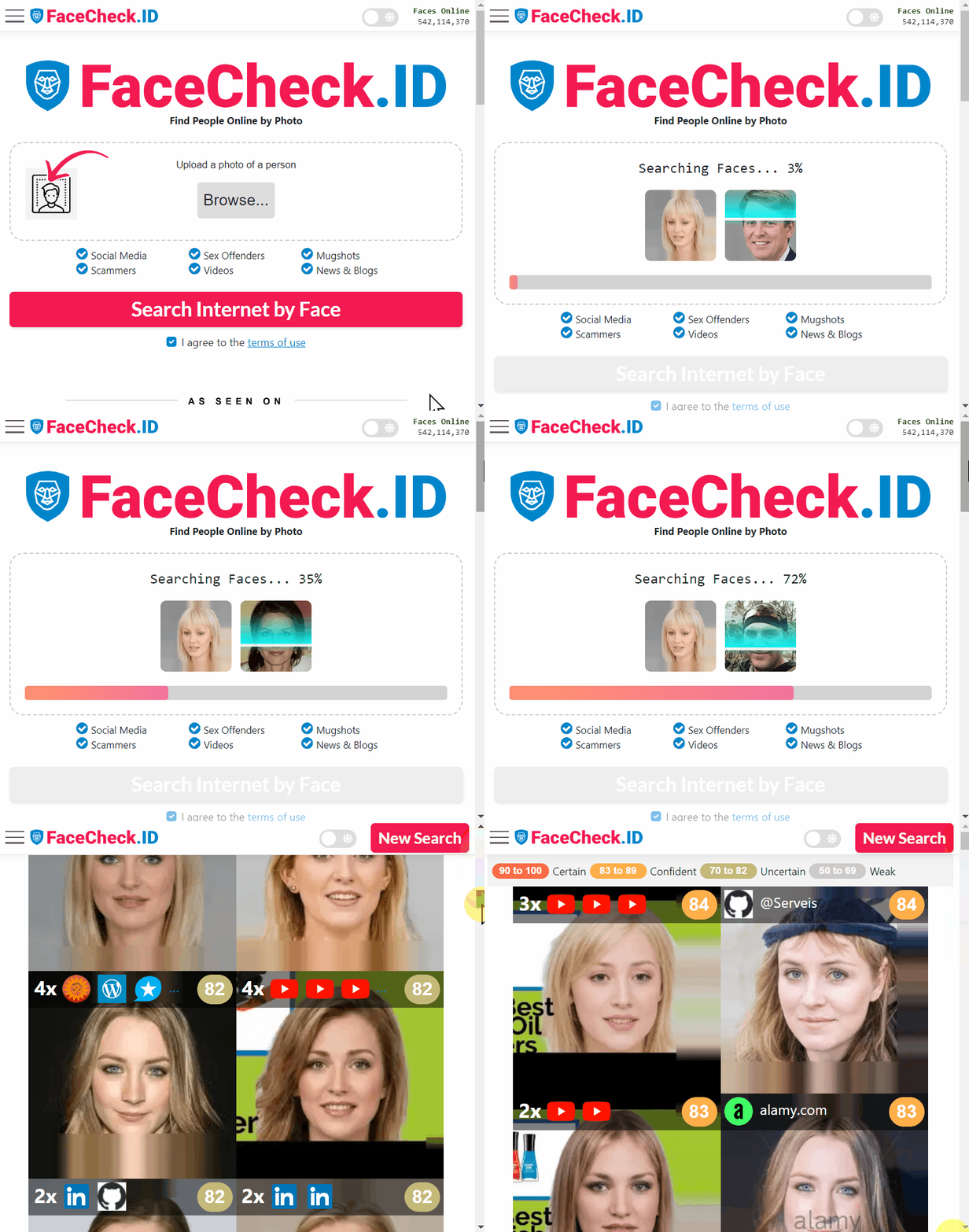
Reconnecting on VK.com Made Simple. This guide will walk you through the process of using FaceCheck.ID to find people on VK.com using just their picture. FaceCheck.ID is a search engine that uses facial recognition technology to match photos with public profiles on various social media platforms, including VK.com.
-
Yandex Image Search: Complete Guide to Finding Faces (2026)
Upload a dating profile photo, and Yandex would often find that same person's VK profile, Instagram, or other social media accounts. Massive VK indexing. VK (Russia's Facebook equivalent) has over 100 million users, and Yandex indexed their profile and uploaded photos aggressively.
-
Social Media Lookup: Find Anyone's Profiles by Photo
High coverage: Instagram (public profiles), Facebook (public profiles), Twitter/X, LinkedIn, YouTube, VK, dating sites with public photos, news and blog sites.
-
How to Find Anyone Online: A Guide to Internet Sleuthing
Vkontakte (VK): The Facebook of Russia and Eastern Europe. unless you use region-specific tools like Infobel, VK, or Xing.