How can I find a person with just a picture?
Unraveling a Family Mystery: Using FaceCheck.ID to Identify People from Photos
I was holding a photograph from the 1990s. The woman in it had one of those smiles that doesn't really age, and according to my grandmother — who delivered this information the way grandmothers always do, in a single offhand sentence between two completely unrelated ones — she was a distant relative from Taiwan. That's all I had. A face, a country, and the suspicion that we shared some fraction of DNA. So I went looking, and eventually I ended up at a face recognition search engine called FaceCheck.ID.
In this article, we're going to discuss
- Find a Person with a Picture
- The Irony of the Digital Age: Identifying People in a Sea of Images
- Traditional Methods vs. Digital Age Challenges: My Search for a Face from the Past
- Discovering FaceCheck.ID: A Leap into Digital Face Recognition
- Exploring the Capabilities of FaceCheck.ID: Bridging Technology and History
- Respecting Privacy with FaceCheck.ID: Ethical Considerations in Digital Searches
- A Surprising Discovery: Connecting with Family Through FaceCheck.ID
- Easy to Use: My Experience with FaceCheck.ID
- How Fast and Accurate FaceCheck.ID Is
- Tips for Getting the Best Results with FaceCheck.ID
- Being Responsible with Face Recognition Technology
- The Impact of Face Recognition on Finding Family
- The Future of Finding People with Technology
- How to find a person with just a photo
- Alternative Websites for Finding Someone with Just a Picture
Find a Person with a Picture
Search millions of photos of people
The Irony of the Digital Age: Identifying People in a Sea of Images
We take more photos in a single weekend than our grandparents took in a decade. Every phone is a camera; every camera is online. And yet, hand someone a single printed photo of a stranger and ask "who is this?" — and you're suddenly back in 1962, squinting at the back of the print for a name in pencil.
An old photograph led me on an incredible journey, unlocking secrets of my family's past and turning a curiosity into a heartwarming discovery
Traditional Methods vs. Digital Age Challenges: My Search for a Face from the Past
First I did what everyone does. I scrolled through social media looking for cheekbones I recognized. I texted relatives the photo. I considered, briefly and expensively, hiring a professional genealogist. None of it worked. The conventional methods are basically asking the internet politely if it happens to know your cousin, and the internet, politely, does not.
Discovering FaceCheck.ID: A Leap into Digital Face Recognition
A face recognition search engine sounded, at first, like the kind of thing that either doesn't work at all or works a little too well. I went in skeptical. But I had a face and no other leads, and skepticism wasn't going to identify anyone.
Exploring the Capabilities of FaceCheck.ID: Bridging Technology and History
The pitch is straightforward: you give it a photo, it scans through an enormous index of faces from the public web, and it tells you where else that face appears. That's the whole magic trick. In practice, it meant a 30-year-old photograph in my hand could be cross-referenced against the internet in a way that, ten years ago, would have required a federal agency and a lot of paperwork.
Respecting Privacy with FaceCheck.ID: Ethical Considerations in Digital Searches
The thing that made me actually willing to use it was the privacy framing. FaceCheck.ID indexes public images and is built around the idea that the tool exists to help you find someone, not to surveil them. That distinction mattered to me. I wasn't trying to build a dossier; I was trying to identify a relative.
A Surprising Discovery: Connecting with Family Through FaceCheck.ID
Uploading the photo felt slightly absurd — like dropping a message in a bottle into a server farm. Then the results came back. The woman in the photograph was a distant cousin. A real, locatable, currently-alive person whose name I now knew. Not a "face without a story" anymore, which is how I'd been thinking of her for months. Finding her cracked open a branch of the family tree I didn't know existed, and gave me a much clearer sense of where, exactly, half of my relatives had ended up.
Easy to Use: My Experience with FaceCheck.ID
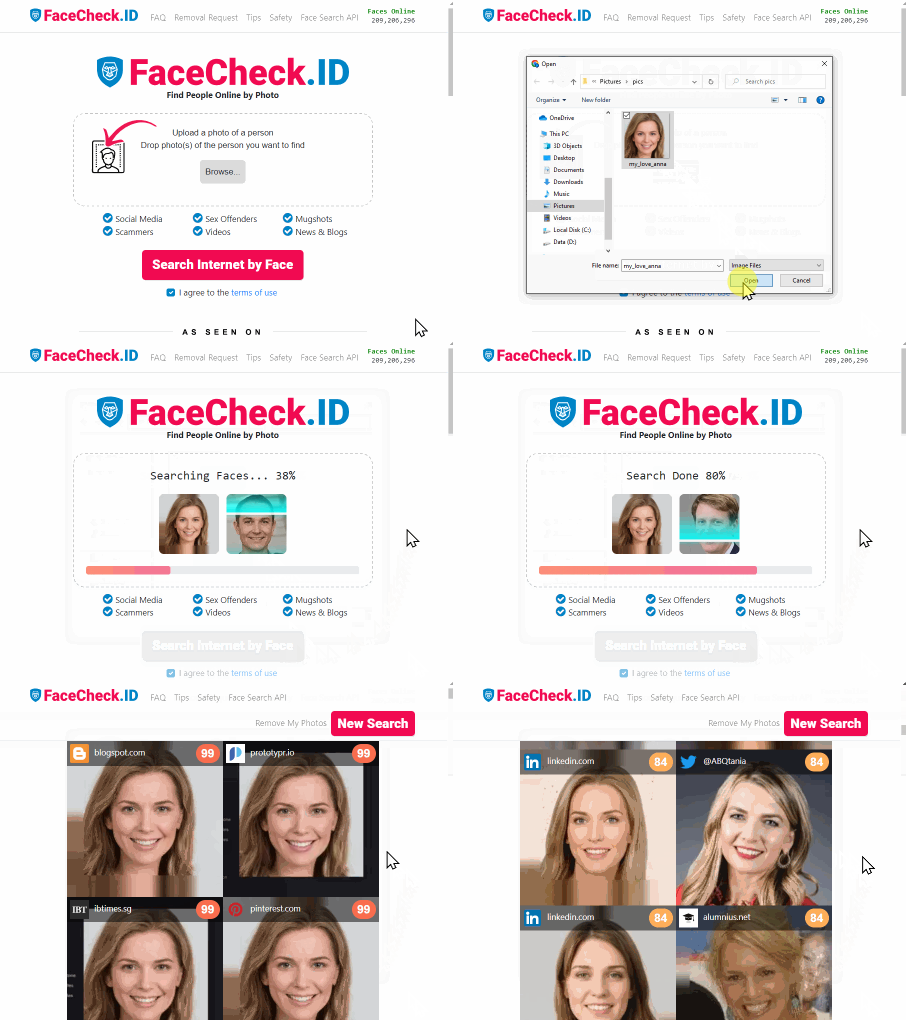
The interface is unfussy. Upload photo, hit search, wait. I'm not particularly good with new software — I am the person who calls a niece to set up a printer — and I had no trouble.
Thanks to FaceCheck.ID, I found a cousin I never knew I had, all from just an old family photo
How Fast and Accurate FaceCheck.ID Is
About 20 seconds. That's how long it took to process the photo and surface accurate matches. For something that's effectively scanning millions of faces, that's genuinely fast.
Tips for Getting the Best Results with FaceCheck.ID
A few things help. Use a clear, well-lit photo. Faces pointed roughly at the camera work better than dramatic profile shots. And keep your expectations honest — it's a powerful tool, not a wizard. If your photo is a blurry thumbnail of someone in sunglasses at a 1987 wedding, manage your hopes accordingly.
Being Responsible with Face Recognition Technology
The flip side of "this works" is "this works." Face recognition is a serious tool, and it's worth pausing before every search to ask whether you actually have a good reason to identify the person in question. Reconnecting with a missing relative is one reason. There are worse ones. The platform's privacy stance helps, but the judgment is still yours.
The Impact of Face Recognition on Finding Family
The interesting part isn't the name attached to the face. It's everything that comes after — the conversations, the records you suddenly know to look for, the family group chats that get drastically more populated. Face recognition is a starting point for genealogy in a way nothing else really was before.
The Future of Finding People with Technology
My search ended with a cousin. But the broader thing — the use of face recognition to reconnect people across decades and continents — is clearly still early. FaceCheck.ID is one of the first tools to make that kind of search accessible to a regular person with a regular photograph. It probably won't be the last.
How to find a person with just a photo
Alternative Websites for Finding Someone with Just a Picture
Face recognition is one approach. Traditional genealogy sites are another, and the two work well together — once you have a name, these are where you go to fill in the rest of the story. Records, family trees, photo archives, the occasional distant cousin who has been meticulously documenting your shared great-grandfather since 2004.
- Ancestry.com: One of the largest genealogy databases out there. Historical records, family trees, and a lot of user-uploaded photos attached to public trees.
- MyHeritage: Similar in scope to Ancestry, with strong international coverage. It also has an AI feature that colorizes and sharpens old photos, which is either genuinely useful or mildly haunting depending on the photo.
- FamilySearch: Run by The Church of Jesus Christ of Latter-day Saints, free to use, and home to an enormous shared family tree. You can attach photos to individuals in the tree.
- Findmypast: Strongest on UK and Irish records, with a growing US collection. Good if your search is pointing across the Atlantic.
- Geneanet: A community-driven site, especially popular in Europe. Useful for finding distant relatives who already have photos and notes about ancestors you share.
FAQ
Can face recognition identify someone from a photo that's 20 or 30 years old?
Yes, often. Face recognition tools like FaceCheck.ID match facial geometry — the relative positions of eyes, nose, and mouth — which stay largely consistent from a person's twenties into their fifties. The match works best when the old photo is sharp and the subject is currently active online with public photos. Childhood photos and photos of people with minimal online presence are the hardest cases, regardless of age gap.
What kind of photo gives the best search results?
A clear, front-facing photo with even lighting and the face taking up a meaningful portion of the frame. Sunglasses, heavy shadows, profile angles, and group shots where the face is small all reduce match quality significantly. If you have multiple photos of the same person, run them separately — different lighting and angles surface different matches across the index.
What happens if the person isn't on social media or the public web at all?
You'll likely get no useful match. Face recognition search engines can only find faces that appear somewhere in their indexed sources — typically social media profiles, news articles, professional sites, blogs, and public image archives. Someone who avoids posting photos, has locked-down privacy settings, or only appears in private family albums is effectively invisible to these tools. In that case, traditional genealogy through DNA testing or records is your better path.
How is FaceCheck.ID different from a Google reverse image search?
Google reverse image search looks for copies of the same image file or visually similar pictures; it doesn't match the same face across different photos. FaceCheck.ID is built specifically for facial matching, so it can connect a 1990s photo to a 2023 LinkedIn headshot of the same person despite zero pixel overlap. For identifying a person rather than tracking an image, the difference is significant.
Is using a face search engine to identify a relative legal?
In most jurisdictions, yes, when you're searching publicly indexed images for a legitimate personal reason like genealogy. The legal picture is more complicated in places with strict biometric laws — Illinois (BIPA), the EU under GDPR, and a few other regions place restrictions on biometric processing. Even where it's legal, contacting the person you find should be handled like any cold outreach: politely, with context, and accepting that they may not respond.
Why didn't my search return any matches when I can clearly see the person on Facebook?
Locked or private Facebook profiles aren't indexed, and Facebook actively blocks face-scraping, so a profile photo you can see while logged in often isn't visible to search crawlers. The platform's images sit behind authentication walls that public-web indexes can't cross. If the person's photos appear only on Facebook or Instagram with strict privacy settings, a face search engine genuinely cannot reach them.
How accurate are the matches, and how do I know it's actually the same person?
Match confidence scores typically range from rough resemblance to near-certain identity, and the top results aren't always correct — siblings, parents, and unrelated lookalikes can surface. Treat any match as a lead, not a conclusion. Verify by checking whether the matched profile's other details (location, age, family names, time period) line up with what you already know. For genealogy specifically, a DNA test through Ancestry or MyHeritage is the definitive confirmation step.
Can I use this to find someone who doesn't want to be found?
You shouldn't, and this is the question worth pausing on. Face recognition can locate people who deliberately avoid an ex, family member, or stalker, and using it that way causes real harm. Legitimate uses — identifying unknown relatives, verifying someone you're dating, finding the source of a catfish photo — are different from tracking someone who's made a clear choice to be unreachable. The tool doesn't enforce that line; you do.
Should I pair a face search with DNA testing for genealogy?
Yes — they solve different halves of the problem. Face recognition gives you a name and current location from a photo; DNA testing through Ancestry, 23andMe, or MyHeritage confirms biological relationship and quantifies how closely related you are. A face match might suggest a second cousin; a DNA match tells you it's actually a half-uncle. Used together, you go from "unknown face" to "documented relative" much faster than either method alone.

Learn More...
How Do You Reverse Image Search on Dating Sites?
Romance scams cost victims $1.3 billion in 2024, and fraudsters are getting smarter with AI-generated photos and stolen identities. Before you fall for that charming profile, learn how to check if the face behind those flirty messages is real or just a carefully crafted trap.
On the subject in other languages
 Como posso encontrar uma pessoa apenas com uma foto?
 我如何仅凭一张照片找到一个人?
 Jak mohu najít osobu pouze podle obrázku?
 Wie finde ich eine Person nur mit einem Bild?
 ¿Cómo puedo encontrar a una persona solo con una foto?
 Comment puis-je trouver une personne avec juste une photo?
 Come posso trovare una persona con solo una foto?
 写真だけで人を見つける方法は?
 사진 하나로 어떻게 사람을 찾을 수 있을까요?
 Jak mogę znaleźć osobę tylko na podstawie zdjęcia?
 Как я могу найти человека, имея только его фотографию?
 كيف يمكنني العثور على شخص بالصورة فقط؟
 Sadece bir resimle bir kişiyi nasıl bulabilirim?
Popular Topics
Face Recognition Search Engine Face Recognition Search Face Search Engine Identity Social Media Image Search Facial Recognition How To Facebook Instagram Facial Recognition Technology Social Media Profiles Find Someone LinkedIn Catfishing Biometric Image Search Google Reverse Image Search Google Face Search Face MatchFaceCheck and PimEyes: Expert Review and Test Scores