Deepfake
Deepfakes complicate face search in ways that matter to anyone trying to verify an online identity. When the same face can be generated, swapped, or animated on demand, the question shifts from "is this person real?" to "is this image of a real person, and is it being used honestly?"
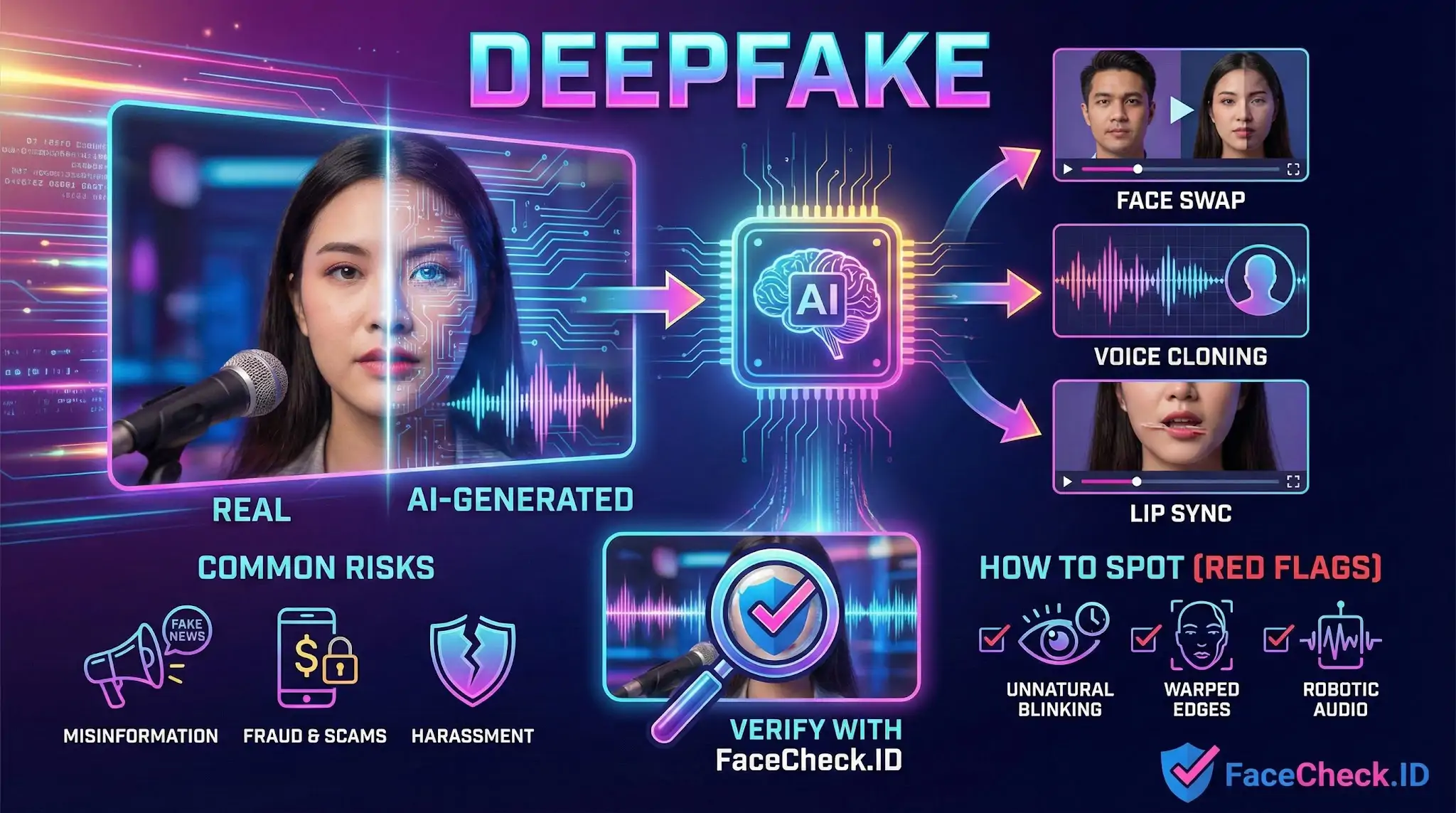
A deepfake is AI-generated or AI-manipulated media that replaces or alters a person's face, voice, or movements in a video, image, or audio clip. The models behind them are trained on real footage of a target, then produce new content that mimics how that person looks or sounds. For reverse image search, that creates two distinct problems: synthetic faces that belong to no one, and real faces being placed where they do not belong.
How deepfakes change reverse image search
A face-search engine indexes faces it can find on public web pages. Deepfakes pollute that index in predictable ways.
- Synthetic profile photos: GAN-generated faces (often from sites like thispersondoesnotexist) appear on fake LinkedIn, dating, and crypto-promotion accounts. They produce few or no matches because the face has no real-world history of being photographed.
- Face-swapped videos: a real victim's face is grafted onto another body, often in explicit or political content. Reverse search may surface both the original source clip and the manipulated version, which is useful for proving the swap.
- Stolen-and-altered photos: a scammer takes a real person's selfie, runs it through a face-aging or expression-editing model, and posts it as their own. Search results may still link back to the true owner if the underlying face geometry is preserved.
- Reenactment clips: lip-synced speeches or fake "interviews" where a public figure appears to say something they never said. Indexed thumbnails may match the person's real face even though the moment is fabricated.
Reading face-search results when deepfakes are involved
Match confidence reflects facial similarity, not authenticity of the source. A high-confidence hit on a politician's face inside a hoax video means the face is a strong match, not that the politician actually appeared in that footage. Treat each result as a pointer to a page that needs separate evaluation.
Useful habits when reviewing matches:
- Check whether the earliest indexed appearance of the face is years older than the suspect content. A long, consistent history across LinkedIn, news photos, and tagged event pictures suggests a real person whose image is being reused or manipulated.
- Look for clusters of recently created accounts sharing one face. This pattern often signals a single operator running multiple personas, sometimes with a stolen real photo, sometimes with a synthetic one.
- Compare lighting, pose, and background between the questionable image and the older matches. Deepfakes often preserve the face but break continuity with the surrounding scene.
- Watch for warped jawlines, mismatched skin texture between face and neck, irregular earrings or glasses, and teeth that change shape between frames.
Synthetic faces versus stolen real faces
These two categories behave very differently in a face-search context.
A fully synthetic face usually returns sparse results: maybe one or two scam-bait pages and nothing resembling a normal digital footprint. That absence is itself a signal. Real people who use the internet leave traces, even small ones.
A stolen real face returns the opposite pattern. Searches surface a legitimate owner, often a model, fitness influencer, military service member, or someone whose photos were scraped from public profiles, alongside the impostor account. Romance scams and "pig butchering" operations rely heavily on this pattern, sometimes layering deepfake video calls on top of stolen still photos.
Limits of face search against deepfakes
Reverse image search is good at finding where a face has appeared online. It is not a deepfake detector. It will not tell you whether a specific frame was generated, whether audio was cloned, or whether a video was edited. It can show you that a face was scraped from a real person's Instagram three years before it ended up on a Telegram scam channel, which is often more useful than a forensic verdict.
Synthetic faces with no online history will produce empty searches, which can be misread as "this person is private" rather than "this person does not exist." And legitimate uses of face synthesis, such as consensual visual effects work or anonymized stand-ins, can trigger the same red flags as malicious ones. Face-search evidence narrows the question but rarely closes it on its own.
FAQ
What does “Deepfake” mean in the context of face recognition search engines?
In face recognition search, a “deepfake” is a synthetic or manipulated image/video where a person’s face is generated or swapped to look real. This matters because the face in the file may not belong to a real event, a real source, or even the real person you think you’re searching for—so results should be treated as investigative leads, not proof of identity.
Can deepfakes cause false matches or wrong-person results in face recognition search engines?
Yes. A deepfake can push a face search engine toward matching the “target-like” face (the person the deepfake is imitating) or toward matching the “source” face (the face used to generate the deepfake), depending on how the manipulation was created and how the model encodes facial features. Heavy edits, filters, compression, and frame grabs from video can also distort features and increase look-alike (wrong-person) matches.
If I upload a screenshot from a deepfake video, what results should I expect from a face search tool (including FaceCheck.ID)?
Expect mixed outcomes: (1) matches to the real person being impersonated (if the deepfake resembles them strongly), (2) matches to unrelated look-alikes, or (3) few/no results if artifacts (blur, motion, compression) weaken the facial signal. With tools like FaceCheck.ID, you should test multiple frames (best-lit, most frontal), compare several top results, and validate via the source pages rather than trusting a single match.
How can I tell whether a face-search match is linked to a deepfake rather than an authentic photo?
Check the result’s source context: look for the original upload date, uploader/channel credibility, and whether the same face appears across unrelated sites with conflicting names or stories. Red flags include watermarks from AI tools, unnatural skin/teeth/eye reflections, inconsistent earrings/hairlines between frames, and pages that label content as “AI,” “swap,” “face change,” or “parody.” When possible, cross-check with reverse image search for exact frames and look for the earliest credible publication.
What are safe steps to reduce harm when deepfakes might be involved in face recognition search results?
Treat matches as unverified leads, avoid sharing accusations, and do not use a face-search hit alone to identify, report, or confront someone. Verify using multiple independent signals (original source pages, consistent biographical details, multiple images from the same account, and corroboration from reputable sites). If you suspect impersonation or harassment, document URLs/screenshots, report the content to the hosting platform, and use removal/opt-out channels where available.

Recommended Posts Related to deepfake
-
Yilong Ma: Elon Musk's Doppelgänger or a Deepfake Masterpiece?
However, his sudden rise to fame has sparked debates about whether he is a real person or a product of deepfake technology. Despite the ongoing debate, no concrete evidence has been presented to confirm that Yilong Ma is a deepfake. If Ma's face was indeed artificially altered to resemble Musk's, it would represent a significant advancement in deepfake technology.
-
How to Find and Remove Nude Deepfakes With FaceCheck.ID
Nude deepfakes have become a widespread problem. A recent report found that 98% of deepfake videos online are pornographic, with 99% of the victims being women. Thousands of people discover they're victims of nude deepfakes daily.
-
How to Find and Remove Nude Deepfakes With FaceCheck.ID: A Step-by-Step Guide
Caught in a deepfake nightmare? Find Your Deepfakes. We'll use FaceCheck.ID to find deepfake images.
-
Why Google Images Fails at Face Searches
FaceCheck.ID is specifically built to find your face across the internet, even in manipulated images like non-consensual deepfakes. If you're trying to check if more manipulated photos of you are out there—especially concerning content like deepfake nudes or AI-generated explicit images—Google Images leaves you vulnerable and without answers. Protection From Deepfakes: In an era where AI can create convincing fake explicit content, FaceCheck.ID helps you discover if non-consensual deepfake pornography featuring your face exists online, giving you the power to take action.
-
Celebrity Romance Scams 2026: How Scammers Use AI Deepfakes and Stolen Photos to Steal Millions
Warning: Romance scammers are using AI-generated images, deepfakes, and celebrity impersonations to target victims in 2026. In 2026, romance scams have reached alarming new heights, fueled by AI technology that creates convincing deepfakes and fake images. A Florida woman lost $160,000; scammers used deepfake video chats and later laundered money through her account.