Investigative Journalism: Face Search in Reporting
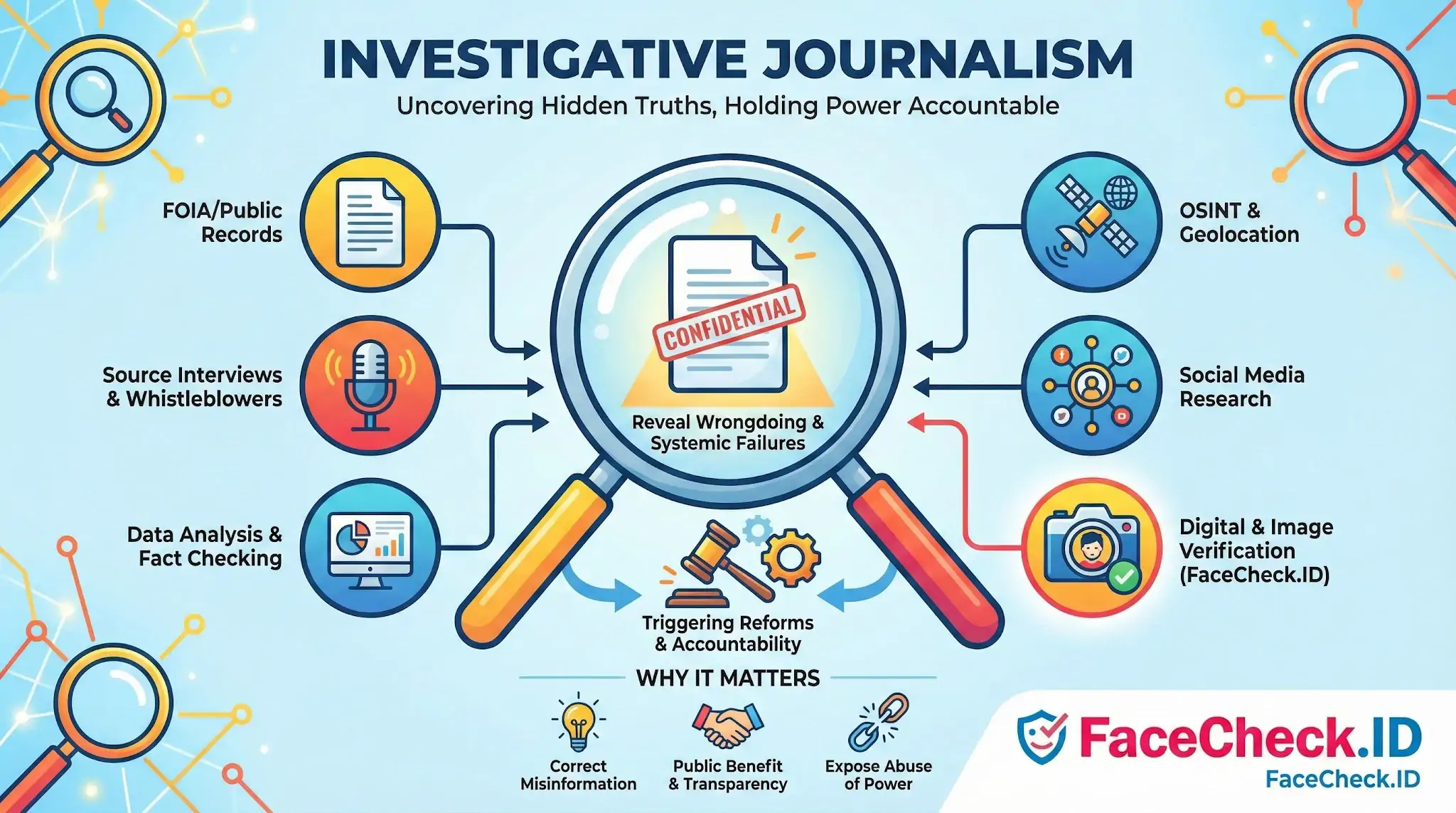
Investigative journalism increasingly runs on the same toolkit that powers face-search platforms: reverse image lookups, public-record digging, and patient verification of who someone actually is online. Reporters working on corruption, trafficking, fraud, and disinformation stories now treat a face photo as a starting point for an entire identity trail rather than a single piece of evidence.
How face search fits into investigative reporting
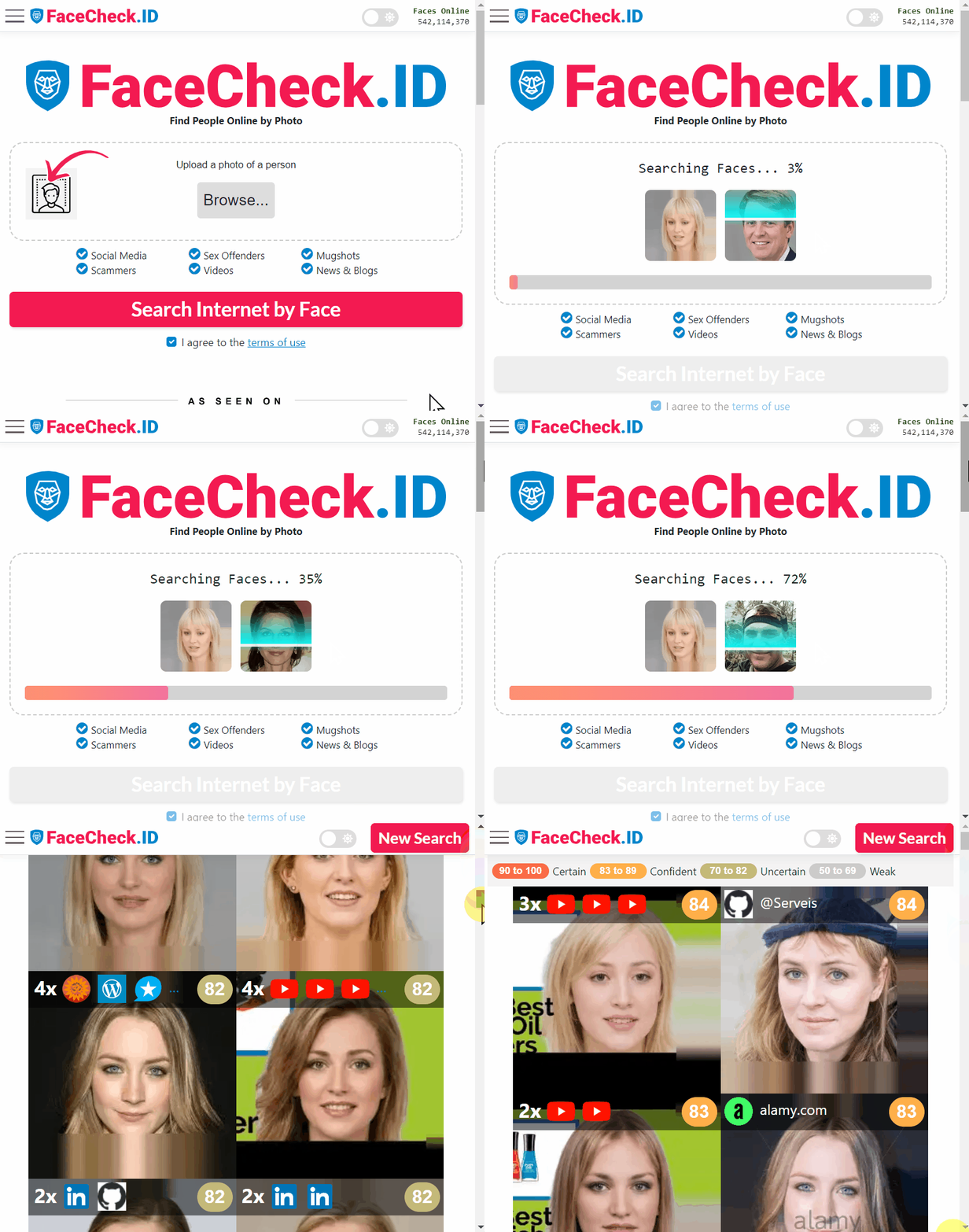
When a reporter has a photo but no confirmed name, face search is often the fastest way to surface leads. A still pulled from a leaked video, a protest photo, a dating-app screenshot, or a corporate event gallery can be run through a face-recognition search to find other indexed pages where the same face appears. Those pages often include LinkedIn profiles, company bios, conference speaker lists, old blog posts, news coverage, and social accounts the subject may have forgotten about.
This matters in several recurring story types:
- Identifying anonymous figures in extremist or scam networks who use throwaway handles but reuse the same headshot across accounts
- Connecting a shell-company director to other businesses where they appear under a slightly different name
- Verifying whether a self-described expert, charity founder, or political operative has the background they claim
- Tracing romance-scam rings by finding every dating profile that recycles the same stolen face photos
- Confirming that a person named in a leaked document is the same person photographed at a specific event
A face-search hit is rarely the story by itself. It is a thread the reporter then pulls using interviews, court records, corporate filings, and direct outreach.
Verifying matches before publishing
Investigative standards are stricter than what a casual face-search user needs. A high-confidence match on a reverse image search engine is a lead, not proof. Before a name appears in print, reporters typically corroborate identity through at least two independent paths: matching biographical details across sources, locating the same person in official records, or confirming the photo's provenance with the person who took it.
The common failure modes are the same ones that trip up any face-search workflow:
- Lookalikes producing false positives, especially with low-resolution or partially obscured faces
- Stock photos and stolen images creating apparent matches that lead to the wrong person entirely
- Reused profile pictures across siblings, twins, or family members
- AI-generated faces designed specifically to defeat naive image lookups
- Old photos that match a current subject but belong to someone with a different identity history
A responsible investigation documents the chain: where the original photo came from, what the search returned, which matches were corroborated, and which were ruled out.
Ethical limits on face-search reporting
Just because a face can be searched does not mean every match belongs in a published story. Investigative outlets generally weigh public interest against harm: exposing a corrupt official is not the same as outing a private person who happens to appear in a sensitive image. Newsroom policies often restrict face-search use to subjects who hold power, are credibly accused of wrongdoing, or have voluntarily entered public life.
Bystanders identified in photos, victims of crimes, and minors typically warrant protection even when their faces are technically findable. Some jurisdictions also impose legal limits on biometric processing that reporters need to factor in before relying on face-recognition tools.
What face search can and cannot prove for a story
Face search can show that the same face appears on multiple indexed pages. It cannot, on its own, prove that the person in those photos is who the captions claim, that the accounts belong to a single individual, or that the photos were posted with consent. It also cannot recover content that was never indexed, posted privately, or scrubbed before crawlers reached it.
Treated as one investigative input alongside documents, interviews, and physical evidence, face-recognition search shortens the path from an unknown photo to a verifiable identity. Treated as a standalone answer, it produces the same misidentifications that have already led to wrongful accusations in both journalism and law enforcement.
FAQ
What does “Investigative Journalism” mean when using face recognition search engines?
In this context, investigative journalism means using face recognition search engines as a reporting aid to generate leads about where a person’s image appears online (e.g., reposts, aliases, networks, or prior appearances), then independently verifying those leads through traditional reporting (documents, interviews, corroboration, and context). A face-search result is a starting point for investigation, not a conclusion.
When is it appropriate for investigative journalists to use face recognition search engines in a story?
Commonly appropriate scenarios include verifying whether a profile photo is reused across accounts, checking for impersonation or coordinated scams, locating original sources of widely shared images, or mapping a subject’s public footprint when there is a clear public-interest justification. Journalists should set a narrow purpose, minimize collection of irrelevant data, and avoid “fishing expeditions,” especially involving private individuals.
How can investigative journalists validate a face-match lead before publication?
Use multiple independent corroboration steps: compare several photos across time and contexts (not just one image), confirm with non-face identifiers (username history, linked accounts, timestamps, geolocation clues, unique tattoos/clothing, known associates), consult primary sources (court records, corporate filings, direct statements), and seek comment from the subject when appropriate. Treat similarity scores or “strong match” labels as imperfect indicators and document the full verification trail.
What operational security (OPSEC) and source-protection practices matter when using face recognition search engines for investigations?
Investigative teams should assume uploads and search logs may be sensitive. Best practices include: removing unnecessary metadata from images, using the minimum-resolution crop needed for the face, avoiding uploading images that reveal a confidential source’s identity unless essential, separating research accounts/devices from personal ones, and following newsroom legal/security review for high-risk cases. Also consider whether using a third-party service could expose the investigation’s target, angle, or sources through billing, browser history, or account identifiers.
How might FaceCheck.ID add value to investigative journalism workflows—and what are the limits?
A tool like FaceCheck.ID can add value by quickly surfacing potential open-web occurrences of a face that investigators can then cross-check for impersonation, stolen photos, or repeated use across sites. The limits are that results can include look-alikes, reposts without context, or misleading associations (e.g., scraped pages, mirrors, or miscaptioned content). Investigative use requires careful verification, cautious language in reporting, and avoiding claims of identity based solely on a face-search result.

Recommended Posts Related to investigative-journalism
-
New Search-by-Face Tool for Investigative Journalists
The Evolution of Investigative Journalism. Investigative Journalism in the Modern Age. Predicting the Future: FaceCheck.ID and Investigative Journalism.