Advanced Facial Recognition
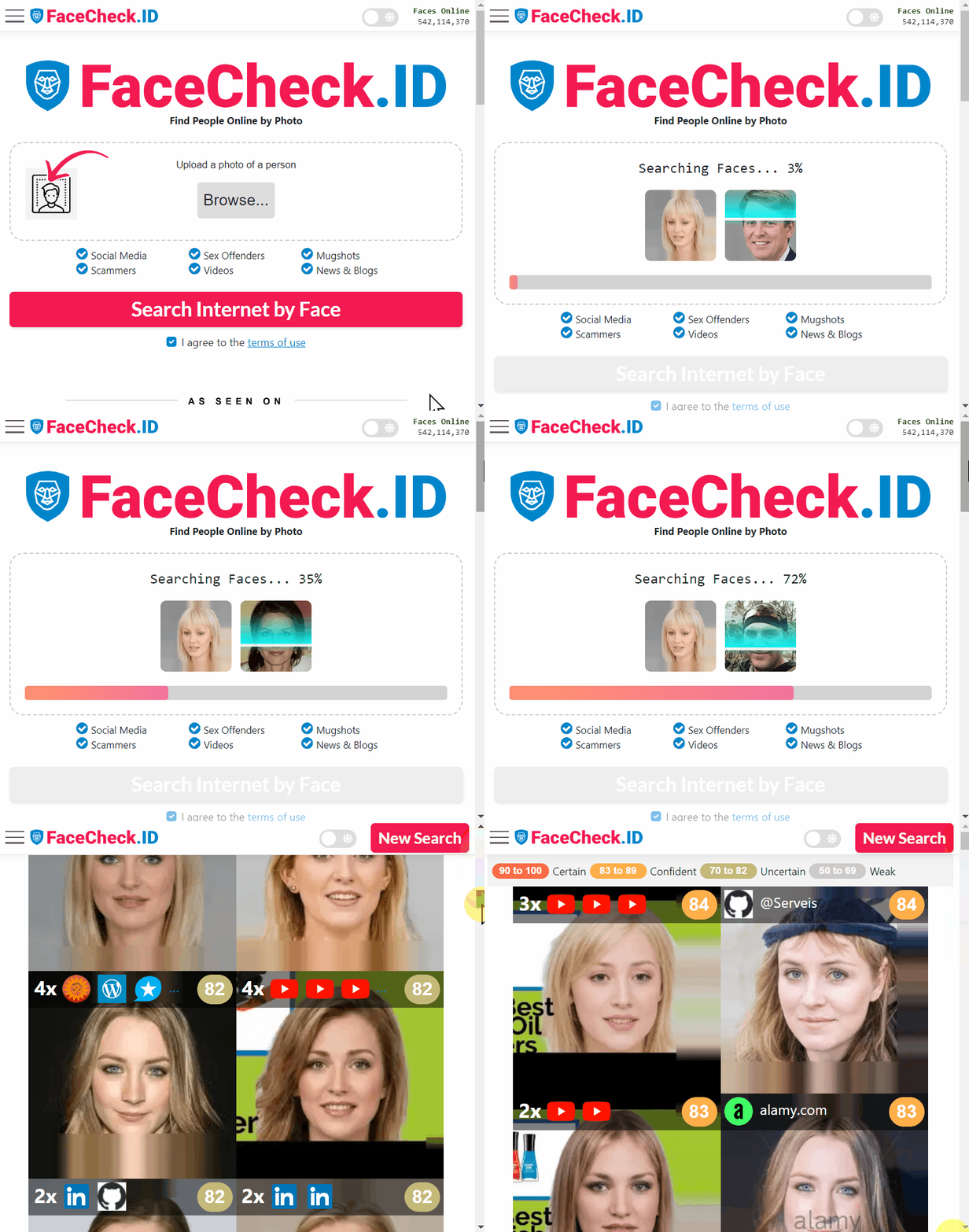
When you upload a photo to FaceCheck.ID and get back a list of pages where that face appears, advanced facial recognition is the engine doing the work. It is the difference between a system that simply finds a face in a picture and one that can match that face to thousands of indexed images scraped from public profiles, news stories, dating sites, and scam reports.
How advanced facial recognition powers reverse face search
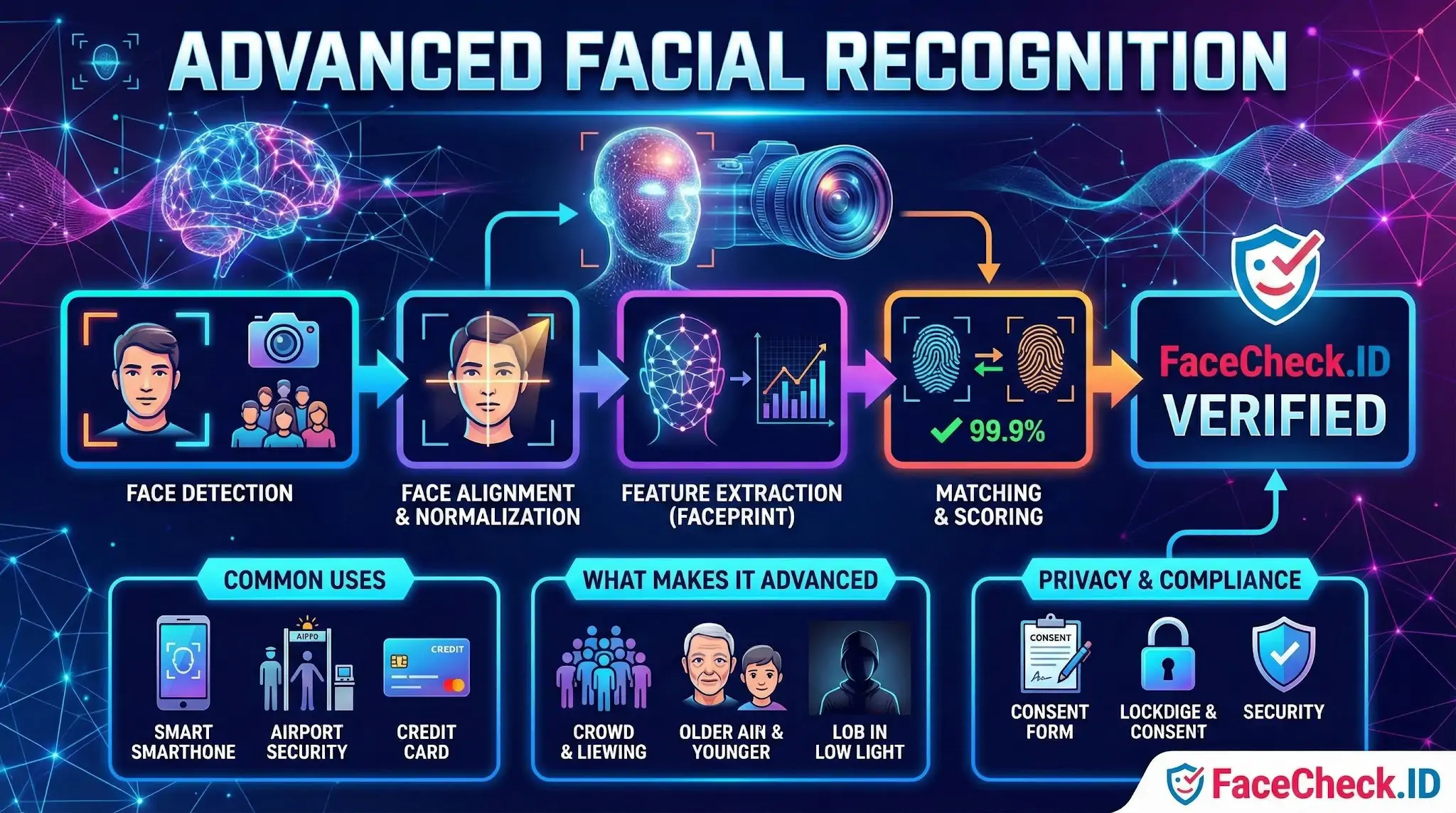
A reverse face search engine has to do far more than recognize one person against a small enrolled database. It has to scan a query photo, isolate the face, and compare it against millions of indexed faces pulled from the open web. The pipeline usually runs in this order:
- Detection. The system locates the face in your uploaded image, ignoring background, other people, or partial faces in the frame.
- Alignment. The face gets rotated and normalized so a tilted selfie can be compared against a straight-on profile photo.
- Embedding. A neural network converts the face into a high-dimensional vector, often called a faceprint. This vector encodes geometric and textural features that survive changes in lighting, expression, and modest aging.
- Vector search. The query embedding is compared against the index using similarity scoring. Results come back ranked by confidence.
The advanced part is in the embedding model and the index. Older recognition systems failed badly on profile shots, low resolution, or off-angle faces. Modern models trained on large, diverse face datasets can match a casual party photo to a corporate headshot of the same person taken five years apart.
What "advanced" actually changes for face-search results
For someone running a search on FaceCheck.ID, advanced recognition affects what shows up and what gets missed.
- Aging tolerance. A 2015 LinkedIn photo can match a 2024 Instagram post because the model focuses on stable structural features rather than surface details.
- Pose flexibility. A three-quarter view from a wedding photo can match a frontal mugshot. Older systems treated these as different faces.
- Lighting and resolution recovery. A cropped, compressed Telegram avatar can still produce useful matches, although confidence drops.
- Occlusion handling. Sunglasses, hats, and partial masks reduce accuracy but rarely eliminate matches outright if enough of the eye region and face shape remain visible.
- Lookalike separation. Better embeddings push genuine lookalikes apart in vector space, which reduces noise in the result list but never eliminates it.
This matters in practical investigation work. A scam victim trying to identify a catfisher often has only one low-quality photo pulled from a chat. A recruiter checking a candidate may only have a single headshot. The quality of the embedding model decides whether those single inputs return useful matches or a wall of false positives.
Reading match scores without overinterpreting them
Advanced facial recognition returns a similarity score, not a verdict. A high score means the two faces are mathematically close in the embedding space. It does not mean the two photos are the same person.
Several situations regularly produce misleading results:
- Identical or near-identical twins. Even strong models struggle here.
- Heavily filtered photos. Beauty filters reshape geometry and can either inflate or destroy matches.
- AI-generated faces. Synthetic portraits sometimes cluster near real people in vector space.
- Reused stock photos. A face that appears on dozens of unrelated profiles usually indicates a stolen photo, not a real identity.
A search result with a strong match on a verified news article carries different weight than the same score on an anonymous forum avatar. Source context matters as much as the number itself.
What advanced facial recognition does not prove
A face match is a lead, not an identification. It tells you that two images likely show the same person, given the model's training data and the quality of both photos. It does not confirm a name, prove ownership of an account, or establish that a person did anything shown in the linked page. Profiles get hijacked, photos get reused by scammers, and lookalikes exist in any large population.
Treat results as evidence to investigate further, not as conclusions. Cross-check matched pages against other signals like usernames, posting history, location clues, and timeline consistency before drawing any firm conclusion about identity.
FAQ
What does “Advanced Facial Recognition” mean in the context of face recognition search engines?
In face recognition search engines, “Advanced Facial Recognition” usually means newer face-matching methods that create more robust facial embeddings (face vectors) and can match the same person across different photos despite changes in pose, lighting, camera quality, partial occlusion, or time gaps.
How is advanced facial recognition different from basic face matching in a face search tool?
Basic face matching often struggles when the photo quality changes (angle, blur, heavy makeup, masks, aging). Advanced facial recognition typically uses stronger models, better face alignment/landmarking, and improved feature representations to keep matches consistent across varied real-world images—reducing missed matches and some look-alike errors.
Does advanced facial recognition mean a face search engine can identify someone by name?
Not necessarily. Advanced facial recognition improves visual matching between faces, but it does not automatically provide a verified legal name. A face search engine generally returns web pages where similar faces appear; any name on those pages may be incorrect, incomplete, or unrelated, so results should be treated as leads rather than proof.
What new risks can come with “advanced” face recognition in open-web face search?
More capable matching can increase privacy impact (easier discovery of where someone’s face appears online) and can amplify harm if a false match is treated as fact. Even with advanced methods, errors still happen—especially with low-quality images, strong edits/filters, AI-generated faces, twins/look-alikes, or misleading context on the source page.
How can I use advanced face recognition search results (including FaceCheck.ID) more safely?
Use results as investigative pointers, not identity confirmation. Open multiple top results, compare distinct facial features across several photos (not just one), check whether the surrounding context matches (location, time, usernames, cross-links), and avoid making accusations or sharing sensitive claims based on a single hit. If using a tool like FaceCheck.ID, focus on corroborating evidence across independent sources before acting.

Recommended Posts Related to advanced-facial-recognition
-
How to Find Someone Using a Screenshot
FaceCheck has the most advanced facial recognition technology and is made specially to find people online by a picture of a face. FaceCheck has the most advanced facial recognition technology and is made specially to find people by a picture of a face.
-
How to Find Stolen Images on the Internet
It utilizes advanced face recognition technology to detect where your photos are being used, so that you can manage your digital footprint proactively.
-
How to Find Someone Online
FaceCheck is made especially to find people by a picture of their face, and it's the most advanced facial recognition technology available.
-
Find Criminals by Face Pic
With its advanced facial recognition, you can quickly verify if the person you're talking to is real or fake or is on the list of known scammers.Internet Scammers: You know those pesky fraudsters who send you emails promising millions if you give them your bank details?
-
How to Spot a Catfish Online in Under 60 Seconds with FaceCheck.ID
FaceCheck.ID is purpose-built for identity verification: advanced facial recognition that handles real-world image variations, combined with integrated AI-generated image detection to flag synthetic faces instantly.