Face Match: How Reverse Face Search Scores Work
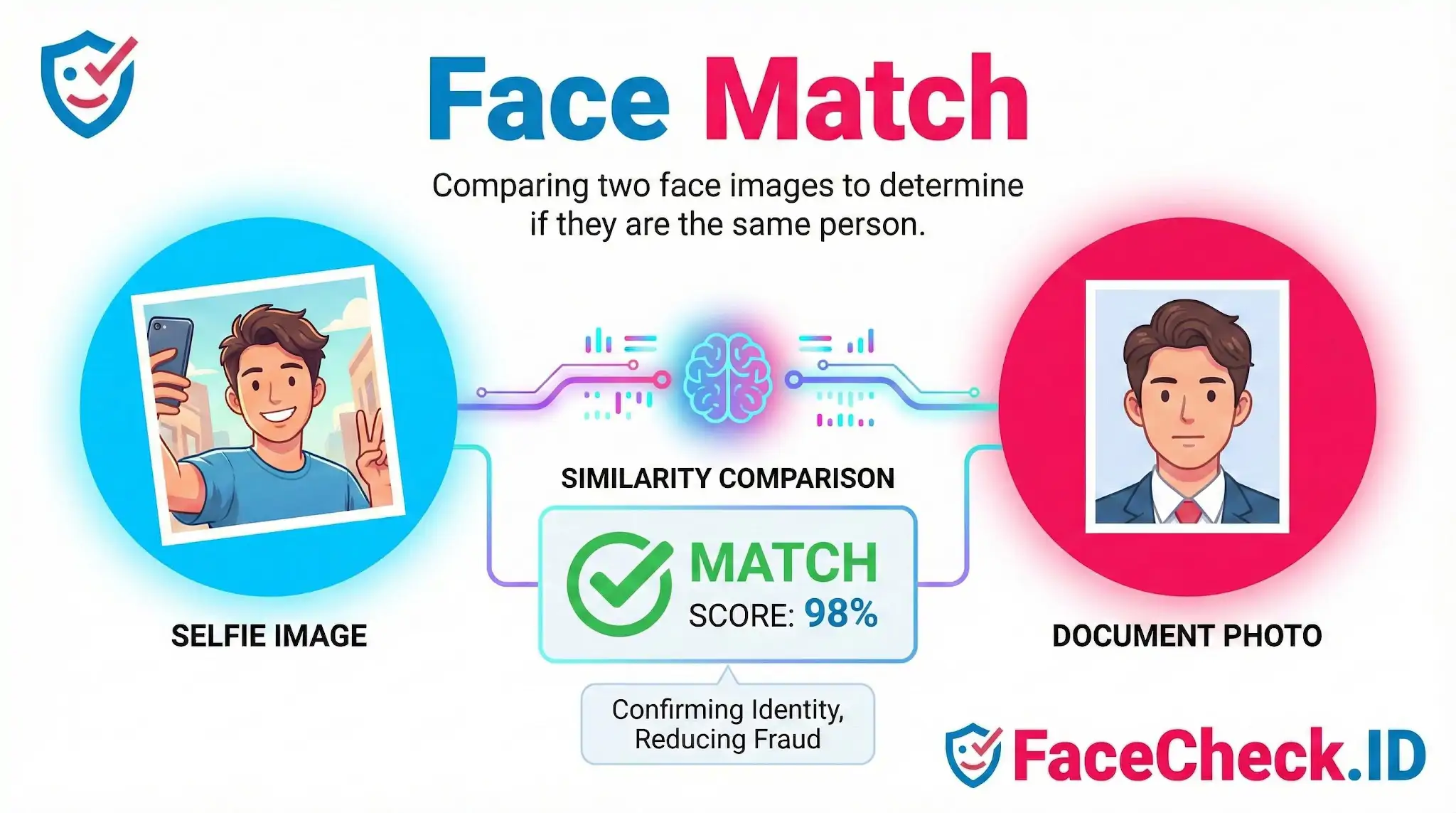
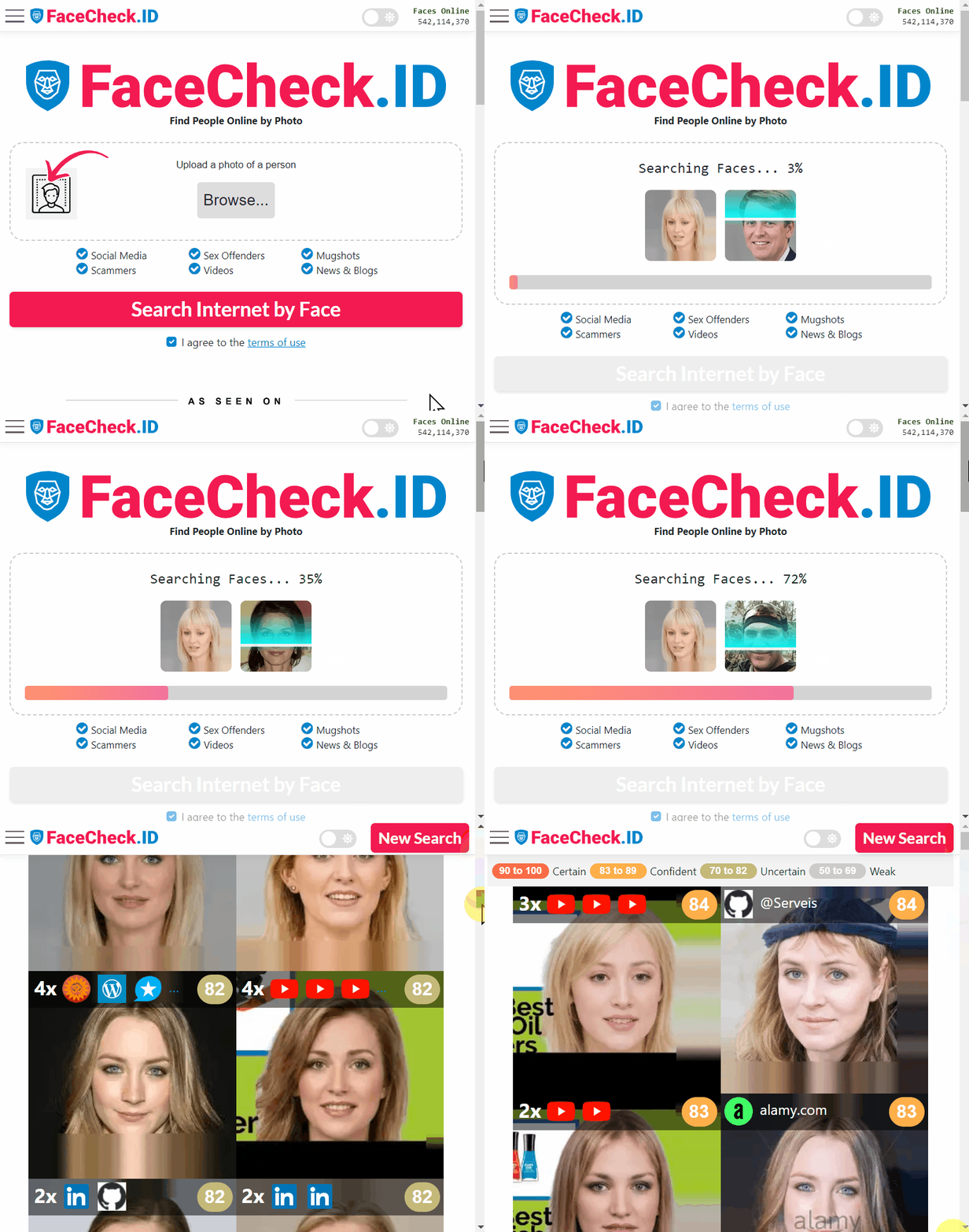
When you upload a photo to FaceCheck.ID, the engine is performing face match at scale: comparing the face in your image against faces it has indexed across the public web. Whether the goal is finding a scammer's real profile, checking if a date is who they claim to be, or tracing where a photo has been reused, every result depends on how face match is performed and how its scores are interpreted.
How face match works inside a reverse face search
A face-search engine like FaceCheck.ID does not store full photos for comparison. Instead, it converts each detected face into a numerical vector, often called a face embedding. The embedding captures the geometry of the face, eye spacing, nose shape, jaw contour, in a form that can be compared mathematically.
When you submit a query image, the system extracts an embedding from your photo and measures its distance to embeddings already indexed from public pages. The closer two embeddings sit in vector space, the higher the similarity score. Results are ranked by that score, and a threshold separates probable matches from background noise.
This is one-to-many matching, which is harder than the one-to-one comparison used in passport gates or phone unlock. A single query is checked against a very large pool of faces, which means lookalikes, siblings, and people with similar features can surface alongside the actual subject.
What the match score actually tells you
Most face-search results display a confidence percentage. Treating that number as a probability of identity is a common mistake. The score reflects how similar two face embeddings are, not whether the two photos are the same person beyond doubt.
A few practical patterns to keep in mind:
- High scores on front-facing, well-lit photos are usually reliable, especially when the matched page shows the same person from multiple angles.
- Mid-range scores often indicate a strong lookalike, a relative, or the same person under different lighting, age, or expression.
- Low scores can still be correct when the indexed photo is heavily cropped, low resolution, or taken years apart from the query.
A LinkedIn headshot tends to match cleanly because professional photos are reused across speaker pages, company bios, and conference sites. A blurry Tinder selfie taken in a dim bar is far more likely to produce ambiguous results, even when the same person is in the index.
Why image conditions change the outcome
Face match accuracy is sensitive to the same things that make photos hard for humans to read:
- Pose and angle, particularly profile shots and steep tilts
- Occlusions like sunglasses, masks, heavy beards, or hair across the face
- Compression artifacts from screenshots, social media re-uploads, or messaging apps
- Age gap between the query image and the indexed photo
- Filters, beauty smoothing, and AI retouching that alter facial geometry
Scammers often exploit this. A catfish account may use cropped, filtered, or mirrored versions of a stolen photo to slip past simple comparisons. A good face-search system handles many of these transformations, but extreme edits, heavy filters, or deepfake-generated faces can defeat or distort matching.
Where face match alone is not enough
A face match result is a lead, not a verdict. Even a strong visual match does not prove that the person on the indexed page is the person who sent you the photo. Common failure modes include:
- Identical twins or close family members producing very high scores
- Stock photo models appearing on hundreds of unrelated pages
- Stolen photos reused across scam profiles, where the matched identity is the victim, not the scammer
- AI-generated faces that resemble real people by coincidence
The right way to use face match is as the first step in an investigation. Confirm with context: usernames, posting history, mutual connections, location clues, time stamps, and the consistency of the surrounding pages. When face match results conflict with someone's claimed identity, that mismatch is useful evidence. When they appear to confirm an identity, treat the conclusion as probable rather than proven until other signals line up.
FAQ
What does “Face Match” mean in a face recognition search engine?
“Face Match” usually means the system found one or more images whose detected face is visually similar to the face in your query photo. Depending on the engine, a “match” can mean either the same person or a look-alike, so it should be treated as a lead to investigate—not definitive identification.
What’s the difference between a face match and an exact (duplicate) image match?
An exact image match looks for the same (or near-duplicate) picture file—often identical composition, crop, or watermark. A face match looks for the same (or similar) face even when the photo is different (different camera, angle, lighting, background, or time). Face matches can surface images that would never appear in a traditional duplicate-image search.
Why can a “Face Match” be the wrong person even when the faces look very similar?
Wrong-person matches can happen when different people share similar facial features, when the query image is low quality, when the face is partially occluded, or when heavy edits/filters/AI enhancements distort facial details. These factors can make two different people appear close to the system, so you should verify using additional evidence beyond the face alone.
What are practical steps to validate a face match before I act on it?
Validate by checking multiple photos of the person (not just one), looking for consistent non-face cues (tattoos, scars, ears, hairline, age range), verifying the source page context (who posted it, when, and why), and comparing across different sites. If possible, run searches using more than one clear photo of the same person to see whether results converge on the same set of pages.
How should I interpret face match results from tools like FaceCheck.ID without misidentifying someone?
Treat results as pointers to webpages, not proof of identity. Open the linked pages, check whether the surrounding content actually refers to the same individual, and avoid sharing or escalating claims based solely on a match list. If a result seems harmful, incorrect, or privacy-invasive, use the tool’s available reporting, correction, or opt-out/removal pathways (for example, if FaceCheck.ID provides such controls) and avoid amplifying the link while you verify.

Recommended Posts Related to face-match
-
Yandex Image Search: Complete Guide to Finding Faces (2026)
Returns visually similar results, with face matches weighted heavily. Similar images (visually related, this is where face matches appear). Reduced face-matching accuracy.
-
How to Find Someone on Instagram by Photo (2026)
Google removed face-matching from its image search years ago over privacy concerns. It finds exact image copies, not face matches. Yandex is more aggressive with face matching than Google.
-
How to Find Someone on TikTok by Photo (2026)
Google Lens is good at landmarks and products, but it deliberately limits face matching for private individuals. If you already have a name, a handle from another platform, or a face match on another site, you can walk it back to TikTok:. In every case, treat a face match as a lead and confirm it with a second source: a matching video on another platform, a consistent handle, or a bio that links back.
-
Face Recognition Online: What Actually Works in 2026
The problem: Google explicitly blocks face matching. Face matching is computationally expensive. Any tool offering unlimited free face recognition is either subsidized by something else (your data, usually) or isn't doing real face matching at all.
-
How to Search for a Person Online by Photo
You need a tool built specifically for face matching, and there are only a handful that exist. Pricier than FaceCheck.id and in my experience slower and less accurate for pure face matching.