Facebook Face Search Signals

For a face-search engine, Facebook is one of the largest pools of human faces ever assembled — billions of profile photos, tagged group shots, event albums, and Marketplace seller images, much of it publicly visible or leaked into the broader indexed web. When someone runs a reverse face search, Facebook-derived images are often the difference between identifying a stranger and hitting a dead end.
Why Facebook images dominate face-search results
Profile pictures on Facebook are public by default, even on otherwise locked-down accounts. That single design choice has shaped how face recognition tools see the platform: profile and cover photos remain reachable through indirect indexing, scraped datasets, and historical archives, even when the rest of a profile is private. The result is that a face-search hit on a Facebook image often points to a real legal name, a hometown, a workplace, and a network of tagged friends — far more identifying context than a Twitter or TikTok handle alone.
Facebook photos also tend to match well technically. Profile shots are usually framed close, well-lit, and front-facing, which is close to ideal for the embeddings most face-recognition systems generate. Older tagged albums add variation — different ages, angles, lighting, and expressions — that can help confirm a match when a single image is ambiguous.
How face search interacts with Facebook in practice
A reverse face search typically surfaces Facebook content in a few recognizable patterns:
- A direct profile photo match, which often resolves identity in one click.
- A tagged photo from someone else's album, useful when the target's own profile is locked.
- A Marketplace listing photo, which is harder to lock down because sellers must show themselves or their goods.
- A public Group post — local buy/sell groups, hobby communities, alumni groups — where members often post identifying photos without realizing those posts are world-readable.
- Event photos and live stream thumbnails, which leak faces into search even when the event is small.
Investigators, journalists, and people trying to verify online dates rely heavily on these patterns. If someone claims to be a 32-year-old engineer in Denver but their face surfaces on a Facebook profile under a different name with a wife and kids in Manila, the platform's breadth makes the deception visible.
Catfishing, stolen photos, and impersonation
Facebook is also the primary source of stolen photos used in romance scams and impersonation. Scammers harvest attractive profile pictures — often from real people who never consented — and recycle them across dating apps, WhatsApp, Instagram, and fake Facebook accounts. A reverse face search can flip this: instead of trusting the name on the account, you check whether that face appears under multiple names, or on a profile that predates the one currently messaging you. Older accounts with consistent friends, tagged history, and check-ins are far harder to fake than a six-month-old profile with five photos and no tagged interactions.
This is also why face-search results on Facebook should be read carefully. Multiple matches don't always mean multiple identities — they sometimes mean one real person whose photos were stolen and reposted on impersonator accounts. Distinguishing the original from the copies usually requires looking at account age, posting history, and whether the face is tagged by other real users.
What a Facebook face-match does and does not prove
A high-confidence match between an uploaded photo and a Facebook profile shows that the same face appears on that account. It does not prove the account is currently controlled by that person, that the displayed name is real, or that the photo was uploaded by the subject. Accounts get hacked, sold, memorialized, abandoned, and impersonated. Profile photos get reused by family members, fan pages, and scammers.
Treat Facebook hits as strong leads, not verdicts. The platform's value in face search comes from corroboration — matching a face across a profile photo, a tagged group shot from 2014, a Marketplace listing, and a comment in a local Group is far more convincing than any single image on its own.
FAQ
What does “Facebook” mean in the context of face recognition search engines?
In face recognition search, “Facebook” usually refers to the social network as a potential source of publicly accessible profile photos, reposts, and mirrored content. It does not automatically mean an engine can search all Facebook content—visibility depends on what is publicly available on the web and what the engine has indexed.
Can a face recognition search engine search Facebook directly?
Typically, no. Most face search tools can only return results from pages and images that are publicly reachable and indexable; they generally cannot access private profiles, restricted groups, or content behind login walls. Some results may still point to Facebook if a photo is public or has been reposted elsewhere.
Why might my Facebook profile photo show up in face search results even if I didn’t share it widely?
Common reasons include: your profile picture is public, the image was reposted or copied to other sites, the same photo appears on multiple platforms, or third-party pages (e.g., preview cards, cached copies, or scraped pages) made the image accessible to indexing. Face search engines may find any of those public copies and link back to Facebook or another host.
If a tool like FaceCheck.ID returns a Facebook link as a match, does that confirm the person’s identity?
No. A Facebook-linked result indicates a facial similarity between the query photo and an image found on or associated with a Facebook page, but it does not prove the page owner’s identity. Verify using multiple independent signals (consistent name, mutual context, additional photos across time, cross-platform corroboration) and treat look-alike or reused images as a possibility.
How can I reduce the chance that my photos from Facebook are found via face recognition search engines?
Limit the audience of profile photos and albums, avoid using a clear front-facing headshot as a public profile picture, remove old public images, and check for reposts of your photos on other sites. If a specific engine provides an opt-out or removal process (some services like FaceCheck.ID may offer a removal request workflow), use it for any results you want delisted.

Recommended Posts Related to facebook
-
Image Search to Find Facebook Profiles by Photo using Face Search Engine
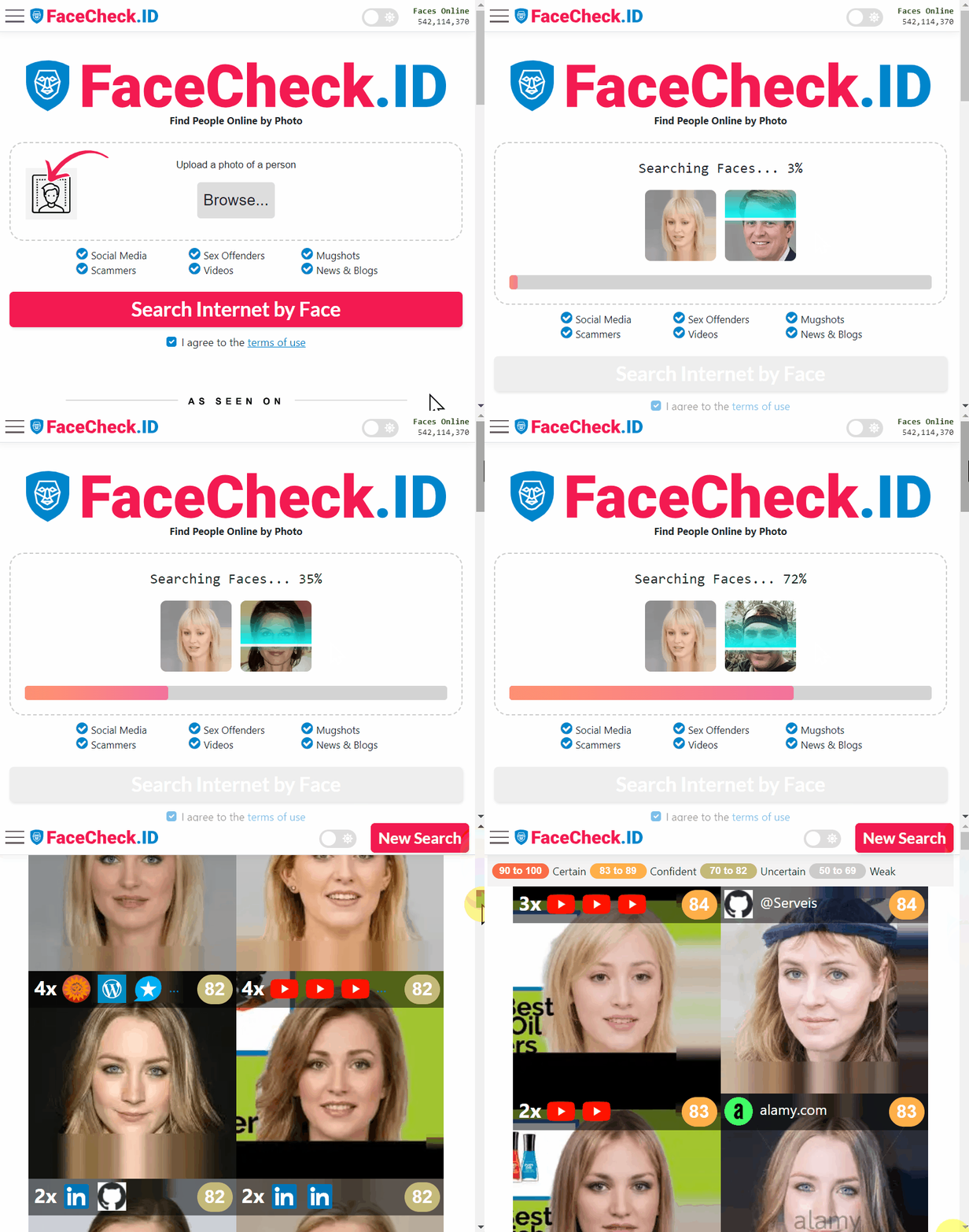
But what about using Facebook's image search? Can we find a profile on Facebook if we have a picture? The short answer is: Yes, you can find a person's profile on Facebook given just a photo with a 3rd party face search engine called FaceCheck.ID.
-
Facebook Face Search: Find People by Photo (2026)
You have a photo of someone and you want to find their Facebook profile. Whatever the reason, your first instinct is probably to search Facebook directly. Here's the problem: Facebook made that nearly impossible.
-
How to Search Facebook by Photo
Want to Find Someone on Facebook? Facebook is one of the most popular social media platforms worldwide, with over 2.7 billion monthly active users. But, it's nearly imposible to find someone's Facebook profile using only their photo.
-
Facial Recognition and Reverse Search on Facebook: A Deep Dive into FaceCheck
Find Anyone on Facebook: Lost Friends, Verify Identities, and Unmask Fake Facebook Profiles. Hello, Facebook aficionados! In this in-depth guide, we'll show you how to use FaceCheck.ID, a fantastic tool that harnesses facial recognition technology to reverse search Facebook profiles.
-
How to Find Someone by Doing Reverse Face Search
Google Images, Yandex, PimEyes, and Facebook are just a few options. Facebook. Facebook does not have a reverse face search tool, so you can't search for profiles by face using a single image.