Image Search Engine for Face Lookup
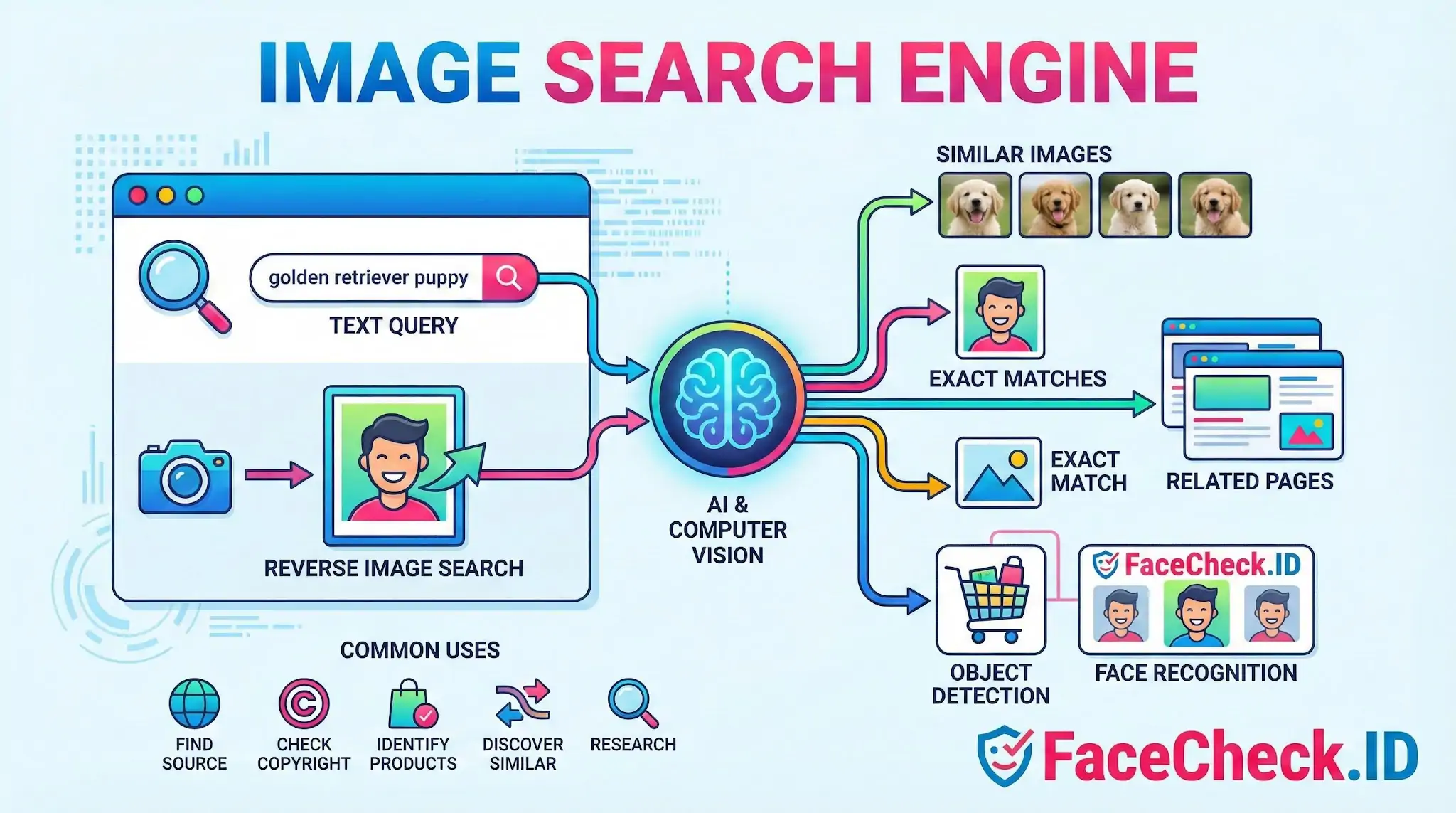
An image search engine is the foundation that makes face search possible. Without large-scale image indexing, visual matching, and reverse lookup, there would be no way to take a single photo of someone and find where else that face appears across the public web.
How face-focused image search differs from generic image search
A standard image search engine like Google Images or Bing Visual Search is built around general visual similarity. It will match a sunset photo to other sunsets, a sneaker to similar sneakers, and a face photo to images that look broadly similar in color and composition. That is not the same as identifying a person.
A face-focused engine like FaceCheck.ID works differently. Instead of comparing pixels or general visual features, it extracts a numerical representation of the facial geometry, eye spacing, jawline, and other stable features, then searches an index for faces whose embeddings are close to that vector. The result is matches based on who the face belongs to, not what the photo looks like overall. This is why a cropped, low-resolution social media avatar can still match a high-resolution headshot of the same person taken years apart.
The tradeoff is scope. Generic image search covers everything visual on the indexed web. Face search is narrower by design and skips images without detectable faces, which keeps the index focused and the false-positive rate manageable.
What a reverse image search returns versus a face search
Both use an uploaded image as the query, but the results answer different questions.
- A reverse image search on a generic engine answers: where else has this exact image, or a near-duplicate, been posted? It is good for tracing stolen photos, checking whether a profile picture was scraped from a stock site, or finding the original source of a meme.
- A face search answers: where else does this person appear, even in completely different photos? It can surface a LinkedIn headshot, a tagged party photo, a news article, and a dating profile that share nothing in common except the person in them.
For investigators looking into a suspected catfish, both tools are useful. Reverse image search confirms whether the photo was lifted from someone else, since scammers often reuse images from public Instagram or modeling portfolios. Face search then helps identify who the person in the photo actually is, which is the harder question.
Where image indexing shapes the results you see
The quality of any image search engine depends on what it has indexed. Public-facing pages, image hosts, news archives, blog galleries, forum posts, and open social profiles tend to be reachable by crawlers. Private accounts, closed groups, paywalled content, and deleted pages are not. This is why two people with similar online footprints can produce very different face-search results, and why a profile that was scrubbed last week may still appear if cached copies persist on third-party mirrors.
Image quality at index time also matters. Front-facing, well-lit photos with the full face visible produce stronger embeddings than profile shots, group photos, heavy filters, or images where the subject is wearing sunglasses. Search results often favor photos that were originally captured cleanly, which is one reason professional headshots and selfie-style social posts dominate the top matches for many queries.
Limits and where interpretation goes wrong
An image search engine returns probabilities, not identities. A high-confidence match suggests two faces likely belong to the same person, but it does not prove it. Identical twins, close siblings, and unrelated lookalikes can produce strong matches, particularly when source images are low quality.
Other common pitfalls:
- A reused photo on multiple profiles does not mean those profiles belong to the same person. Scammers and impersonators copy images from real users.
- Absence of results does not mean someone has no online presence. It often means their photos are on private accounts, behind logins, or not yet indexed.
- Visual similarity in a generic image search is not identity. Two different people in similar lighting and pose can rank as closer matches than two photos of the same person taken under different conditions.
Image search engines are tools for generating leads. Confirming who someone is still requires corroborating evidence such as matching usernames, consistent biographical details, or direct contact through a verified channel.
FAQ
How does an image search engine build an index for face recognition search?
A face-focused image search engine typically crawls or ingests publicly available images, detects faces, extracts a numeric “embedding” (a compact representation of facial features), and stores it in a searchable index linked to the source URL and page context. When you search, your uploaded face is converted to an embedding and compared against the indexed embeddings to retrieve the closest matches.
What’s the difference between searching by face and searching by the whole image in an image search engine?
Searching by face aims to match the person across different photos even when the background, clothing, or crop changes. Searching by the whole image (traditional reverse image search) is more likely to find exact duplicates or near-duplicates based on overall visual similarity, which can miss the same person in different scenes.
How can an image search engine help detect impersonation or stolen profile photos?
A face recognition image search can surface other pages where the same face appears, helping you spot reused photos across multiple accounts or websites. Tools such as FaceCheck.ID may be used to find where a face photo appears online, but results should be treated as leads and verified through additional signals (account history, cross-platform consistency, and direct verification) before making accusations.
What page or source clues can help validate a face match found by an image search engine?
Useful validation clues include the originating domain’s credibility, the page’s publication date, accompanying name/username consistency, captions and surrounding text, repeated appearances of the same person on the same site, and whether multiple independent sources point to the same identity. Always confirm via more than one source because a visual match alone does not prove identity.
How do image search engines handle duplicates, crops, and resized versions in face recognition search?
Face-based indexing is generally resilient to resizing and moderate cropping as long as key facial features remain visible; it compares facial embeddings rather than pixel-perfect copies. However, extreme crops, heavy compression, strong filters, or occlusions (masks, sunglasses) can reduce match quality, and duplicates across sites may appear as multiple results pointing to different URLs.

Recommended Posts Related to image-search-engine
-
Top 7 Reverse Image Search Engines for Face Search Compared
There are a few image search engines available, but which one is the best for finding people online? To help you decide, we've compared the top seven reverse image search engines. FaceCheck.ID is a reverse image search engine that has the most advanced facial recognition technology.
-
How to Search Facebook by Photo
Fortunately, reverse image search engines can help you easily find Facebook profiles using a photo of a person. Upload the Image to a Reverse Image Search Engine. Reverse image search engines, such as Google Images, TinEye, Social Catfish, and FaceCheck.ID are great.
-
How to Find Someone Online
Find Someone Using Image Search Engines. You can also use image search engines to find someone online by using specific attributes of the image. Some image search engines also allow you to narrow down your search to specific locations or countries.
-
How to Find Someone Using a Screenshot
If you want to find someone by taking a screenshot from a video or website, the most effective reverse image search engine to find someone by a screenshot image is FaceCheck.id. The best reverse image search engine to find someone by photo is FaceCheck.id. The best reverse image search engine to find someone by photo is FaceCheck.id.
-
Search Instagram by Photo with Reverse Image Instagram Search Engine
First go to FaceCheck.ID Instagram Reverse Image Search Engine. Upload the Image to a Reverse Image Search Engine. There are several reverse image search engines available, including Google Images, TinEye, Social Catfish and FaceCheck.ID.