LinkedIn Face Match Signals
LinkedIn is one of the most useful sources in face-based identity research because professional headshots are designed to be recognizable. When a face search returns a LinkedIn match, it often gives you a real name, employer, and location anchored to a verified professional context, which is harder to fake than a casual social profile.
Why LinkedIn headshots produce strong face-match results
LinkedIn profile photos tend to be ideal inputs and outputs for face recognition. They are usually front-facing, evenly lit, taken at close range, and show a neutral expression with the full face visible. That combination produces high-quality facial embeddings, which is why a LinkedIn photo is often the cleanest match in a result set even when the search image came from a blurry social snapshot or a screenshot.
A few patterns make LinkedIn especially valuable in reverse face search:
- The same headshot is often reused across personal websites, conference bios, Crunchbase, GitHub, Medium, and company About pages, creating multiple corroborating hits for one person.
- Professional photographers shoot many people against similar backgrounds, so the face itself, not the setting, drives the match.
- Profiles tend to be public by default, which means search engines and image crawlers can index them.
When a face appears in face-search results with a LinkedIn match plus two or three secondary professional pages reusing the same image, that cluster is much stronger evidence of identity than any single hit.
Using LinkedIn matches in identity verification and scam checks
LinkedIn is a common reference point in romance scam, recruiter scam, and catfishing investigations. People running these scams frequently steal photos from real LinkedIn profiles to build fake personas elsewhere, including on dating apps, WhatsApp, Telegram, and crypto investment groups.
A reverse face search can flip that script. If someone you met on a dating app shows up under a completely different name on LinkedIn, with a coherent work history and mutual connections, that is a signal. If the LinkedIn profile in the results has only a handful of connections, no posts, and a generic job title at a real company, that is a different kind of signal, often pointing to a fake profile built to support a scam.
Common scenarios where a LinkedIn hit changes the conclusion:
- A recruiter contacting you over email or Telegram is matched to a LinkedIn profile with a different name or no recruiting role.
- A dating profile photo matches a LinkedIn account belonging to someone in another country with a long, established career.
- An investor or executive sending DMs is matched to a LinkedIn page that was created within the last few months.
Limits of LinkedIn as identity evidence
A LinkedIn match is a lead, not a verdict. Several issues can mislead an investigator who treats it as definitive.
LinkedIn has a real fake-profile problem. Synthetic accounts built around stolen headshots, AI-generated faces, and copied job histories are common, particularly in sales, recruiting, and crypto roles. A face search that returns a LinkedIn profile does not prove the LinkedIn profile is the original or authentic source of the image.
Lookalikes also matter. Two people with similar bone structure, hairstyle, and lighting can produce a high-confidence match in face-search systems, especially when the source image is low resolution. Comparing a single feature like the eyes or jawline by hand is not reliable, and confidence scores below the strong-match threshold should be treated as candidates, not identifications.
Photos age. A LinkedIn headshot from ten years ago may not match a current image well, and a current headshot may not match older photos found elsewhere on the web. Heavy retouching, filters, and AI enhancement on either side of the comparison can also degrade match accuracy.
Finally, even a correct LinkedIn match only tells you that a face is associated with a professional identity. It does not confirm that the person behind a chat, email, or dating profile is the same person who controls the LinkedIn account. Account takeover, impersonation, and image theft mean the face, the name, and the person sending the message are three separate things that all need to be verified before drawing conclusions.
FAQ
What is LinkedIn, and why might it appear in face recognition search engine results?
LinkedIn is a professional social network where users commonly post headshots on public profile pages. A face recognition search engine may surface a LinkedIn page when that profile photo (or a repost/copy of it) is publicly accessible and has been indexed from the open web.
Can face recognition search engines find a LinkedIn profile from a headshot?
They may be able to, but only when the LinkedIn image or profile page is publicly viewable and discoverable on the web. If the photo is not accessible to non-logged-in users, is blocked from crawling, or has never been exposed publicly, it is less likely to appear in results.
If a face search result links to LinkedIn, does that confirm the person’s identity?
No. A LinkedIn link is a lead, not proof of identity. Photos can be reused, copied, or attached to fake profiles, and look-alike matches can occur. Treat the result as a starting point and verify using multiple cues (work history consistency, mutual connections, corroborating official pages, and cross-source confirmation).
Why might a LinkedIn headshot be returned even when I never posted that exact photo elsewhere?
A LinkedIn headshot can spread beyond LinkedIn through public previews, company team pages, press releases, speaking-event listings, recruiting posts, data aggregators, or someone copying the image. A face recognition engine may match your face to any of those reposted or derived versions, not only the original upload.
What should I do if FaceCheck.ID (or a similar tool) shows a LinkedIn match that seems wrong or risky?
First, open the source page and compare multiple photos and profile details rather than relying on the face match alone. Check for signs of impersonation (new account, thin history, inconsistent job timeline, mismatched location, duplicated text). If it appears to misuse your image, document the URLs/screenshots and report the profile to LinkedIn, and use the search tool’s removal/opt-out process if available.

Recommended Posts Related to linkedin
-
LinkedIn Reverse Image Search to Find LinkedIn Profiles by Photo Using Facial Recognition
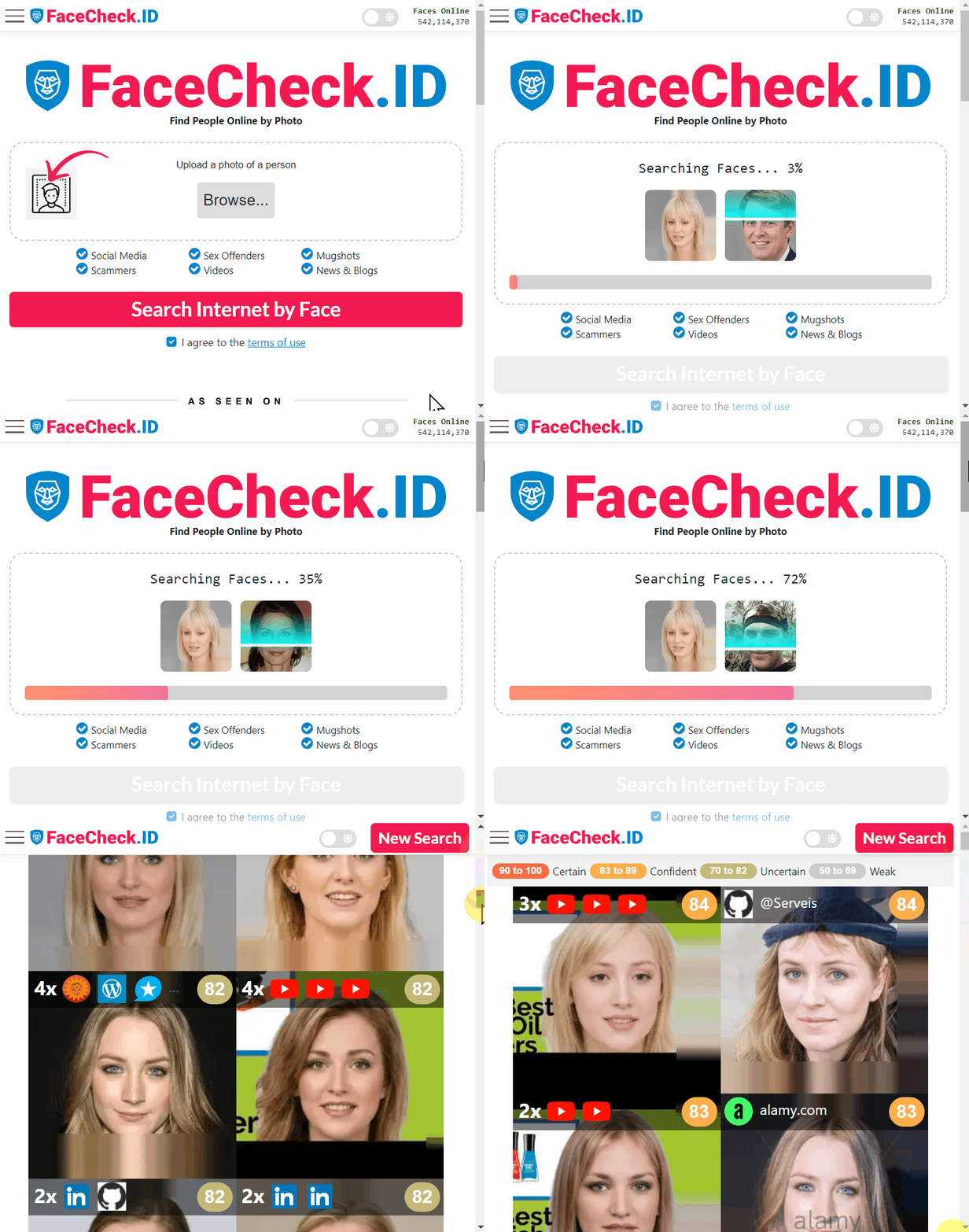
Have you ever seen a photo of someone and wondered how to find their profile on LinkedIn? With the new face search engine FaceCheck.ID, you can search for LinkedIn profiles by photo using the latest facial recognition technology. FaceCheck.ID will then do a deep search and show you all LinkedIn profiles matching the person on the photo.
-
How to Use Reverse Image Search to Find LinkedIn Profiles by a Photo
FaceCheck.ID lets you find LinkedIn profiles by photo. You'd like to find them on LinkedIn. You don't have a name, a company, or really anything else to go on — which is exactly the situation LinkedIn's search bar was not built for.
-
How to Detect Fake Remote IT Workers with Facial Recognition (2026 Guide)
LinkedIn public profile photos. Duplicate faces linked to multiple aliases. Save the candidate's LinkedIn, GitHub, or résumé photo.
-
How to Find Anyone Online: A Guide to Internet Sleuthing
The site: operator searches within a single domain (site:linkedin.com "John Smith"). A LinkedIn detail confirms a city, which confirms a Facebook profile, which surfaces a username that turns up on Reddit. Xing: LinkedIn, but for German-speaking Europe.
-
Can you reverse image search a person?
Useful when you want to confirm a LinkedIn headshot isn't lifted from a stock photo site, when you're trying to find where a meme actually came from, or when a journalist needs to know if their source is who they say they are. Most major platforms (Instagram, Facebook, Tinder, LinkedIn) have impersonation report forms that resolve within 1–7 days if you can show the original photo with earlier timestamps. Any public profile photo on LinkedIn, Twitter/X, or an unlocked Instagram is fair game for anyone with a facial recognition tool.