LinkedIn Profile Picture Viewer: See the Photo Full Size and Check Who It Is
The simplest LinkedIn profile picture viewer is LinkedIn itself: click the round photo on a profile and it opens a larger copy. Online viewers fetch the same public copy from a profile URL. LinkedIn never alerts anyone that you opened or screenshotted their photo, but a logged-in profile visit can show up in their viewer list.
- Open the profile and click the round photo to load the large version.
- Right-click it and choose Open image in new tab to see the file on its own, or take a screenshot on your phone.
- To stay out of the owner's viewer list, switch to private mode first or open the public profile logged out.
- To find out who is really in the picture, upload it to a face search such as FaceCheck.ID and read the match scores.
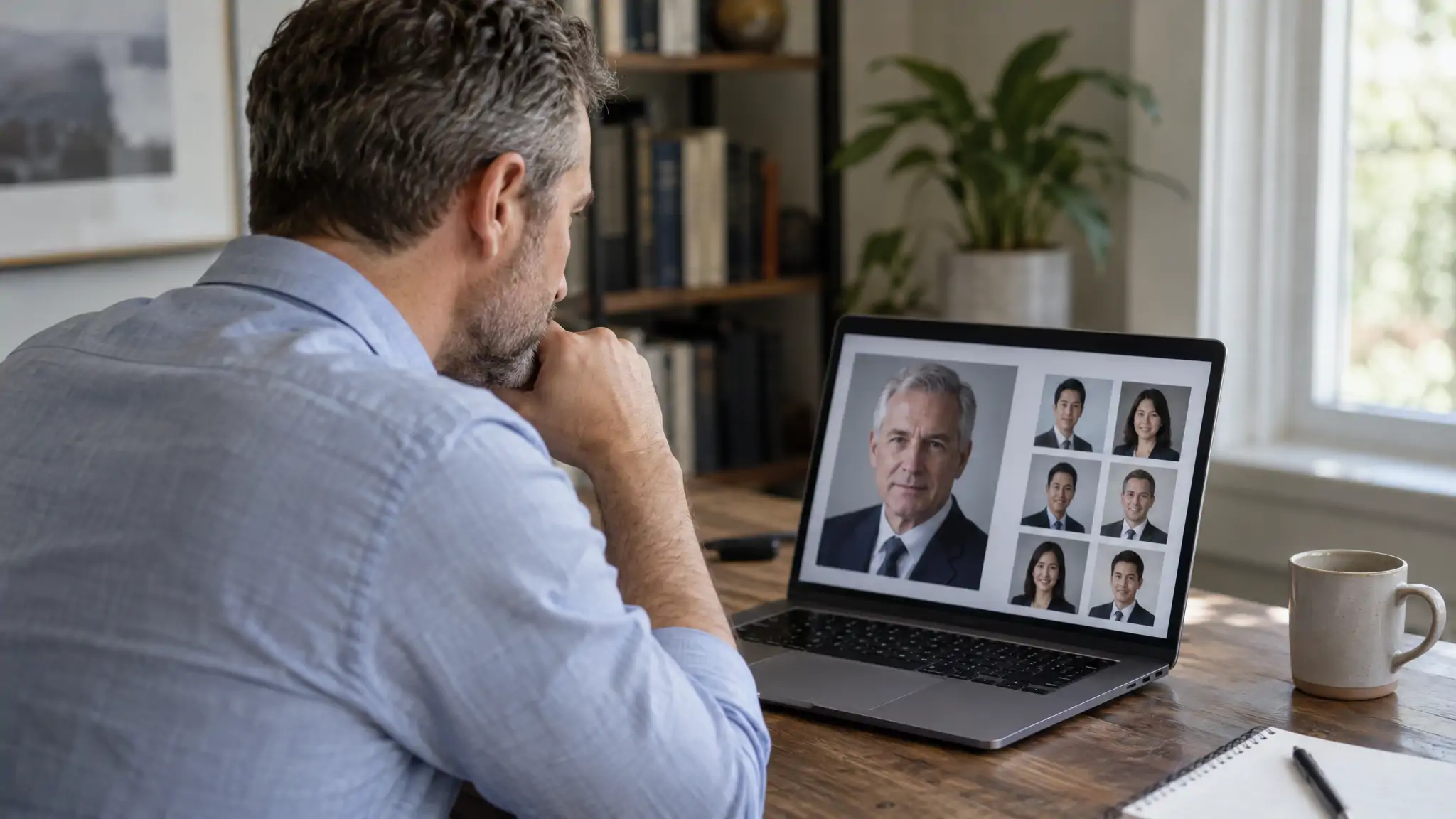
A bigger photo answers "what does this person look like". It does not answer "is this person real", which is usually the reason you were squinting at a 100-pixel circle in the first place. This guide covers both.
In this article, we're going to discuss
- How to use a LinkedIn profile picture viewer at full size
- Does LinkedIn tell someone you viewed their profile picture?
- Viewing is not verifying: check who is in the LinkedIn photo
- Red flags in a fake LinkedIn profile photo
- Find a LinkedIn profile from a photo
- What to do next
- LinkedIn profile picture viewer FAQ
How to use a LinkedIn profile picture viewer at full size
The photo in the circle is a shrunken copy of a larger file, and LinkedIn will hand you the larger one if you ask in the right place.
On a computer
- Open the person's profile while logged in.
- Click the round profile photo. LinkedIn opens it in a larger pop-up.
- Right-click the enlarged photo and choose Open image in new tab (the wording varies slightly by browser). The file opens on its own page, served from LinkedIn's image server, and Ctrl+S saves it.
In the LinkedIn app
Tap the profile photo to open the large view, then take a screenshot. Crop it to the face before you do anything else with it. The status bar, the battery icon and the Message button add nothing to a face search.
Logged out, through the public profile
Every member has a public profile at linkedin.com/in/username, which is what search engines and logged-out visitors see. Whether the photo appears there is the owner's choice. LinkedIn's help page on profile photo visibility lists four settings (1st-degree connections only, your network, all LinkedIn members, and anyone) and says the default is Anyone. So most photos are visible logged out, and the ones that aren't can't be pulled out by an outside tool either.
Online viewers and downloaders
Sites such as SocialFetch and MyFeedIn ask for a profile URL and return the public photo without any LinkedIn login. They are handy and they come with limits. SocialFetch allows 2 free lookups an hour and 6 a day. MyFeedIn allows 5 new profiles a day without an account and names 800 x 800 pixels as the largest size LinkedIn stores. Both see only what LinkedIn shows to logged-out visitors.
Ignore the "HD" in tool names. No viewer can return more detail than the file the member uploaded and LinkedIn kept. A tool that hands you a 2,000-pixel version has upscaled it, which means software invented the missing pixels. The face looks sharper and is less accurate, which is the wrong trade if you are about to compare it with other faces.
Does LinkedIn tell someone you viewed their profile picture?
No. LinkedIn does not notify anyone that their photo was opened, saved or screenshotted. What it records is the profile visit: if you are logged in and browsing normally, your name and headline land in that person's Who's Viewed Your Profile list whether you looked at the photo or not.
| What you do | What the owner can see |
|---|---|
| Visit the profile logged in, normal browsing mode | Your name and headline in Who's Viewed Your Profile |
| Visit the profile in private mode | "LinkedIn Member", marked as viewing in private mode, and nothing else |
| Click or enlarge the photo during that visit | Nothing beyond the profile visit itself |
| Screenshot the photo | Nothing, because LinkedIn has no screenshot alert |
| Open the public profile logged out, or use a URL-paste viewer | Nothing tied to your account |
| Send a connection request, follow, react or message | Your name, as with any interaction |
| Upload the screenshot to FaceCheck.ID | Nothing, because the search never touches LinkedIn |
Private mode lives under Me > Settings & Privacy > Visibility > Visibility when viewing other profiles. LinkedIn's private mode help page spells out the catch: on a free Basic account, browsing privately also hides your own list of viewers. Premium members keep their 90-day viewer list while browsing privately, and nobody, Premium or not, can see the names of private-mode viewers.
This is not anonymity in any strong sense. The owner can't see you, but LinkedIn still knows which account opened which profile, and so does anyone looking over your shoulder on the train.
Viewing is not verifying: check who is in the LinkedIn photo
A full-size headshot tells you what a face looks like. It says nothing about whether that face belongs to the name printed under it. Fake LinkedIn profiles borrow their photos from stock libraries, real professionals' company pages, strangers' Instagram accounts and AI face generators. A face search finds the first three and can flag the fourth.
- Save or screenshot the enlarged photo using the steps above.
- Crop it so the face fills most of the frame.
- Go to FaceCheck.ID, upload the photo and click Search Internet by Face.
- Read the score on each match and note what kind of page the face turns up on.
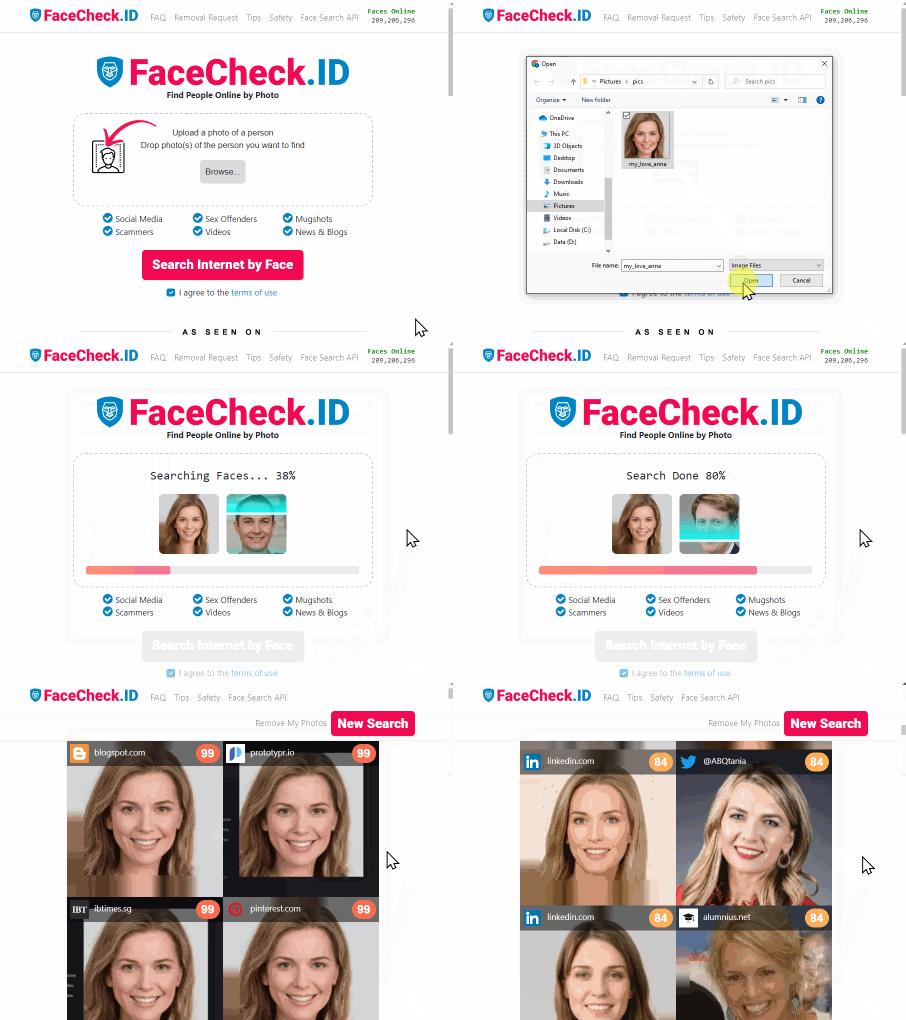
A face search on a saved LinkedIn photo takes a few seconds from upload to results.
FaceCheck.ID is for photos of adults only. Its model is trained on adult faces, and searching for a minor is prohibited and grounds for a ban.
The free search shows every matching face thumbnail with its score. Credits unlock the links to the source web pages, which is where you see the names, employers and dates attached to each match. Often the thumbnails settle the question on their own: a corporate headshot that sits in a row of identically lit studio shots of the same face is a stock photo, and you don't need the link to know it.
Your search stays private. FaceCheck.ID does not log IP addresses, deletes search history within 24 hours and does not add the photo you upload to its index.
What the scores mean
| Score | FaceCheck.ID label | What it means for a LinkedIn photo |
|---|---|---|
| 90-100 | Certain match | Strong match. Open the source page and compare its name and employer with the LinkedIn profile. |
| 83-89 | Confident match | Likely the same person in a different photo. Check that the pages agree with each other on who it is. |
| 70-82 | Uncertain match | Possibly the same person. Read the context and search a second photo before you conclude anything. |
| 50-69 | Weak match | Lookalikes. Treat them as noise unless several point to the same page. |
Every score measures how similar two faces are, not who anyone is. Unrelated people look alike, and a stolen photo scores just as high against its real owner as against the fake profile using it. A high score tells you the faces match, not which account is the honest one.
Red flags in a fake LinkedIn profile photo
LinkedIn catches most fake accounts on its own. Its Community Report for July to December 2025 says 99.7% of the fake accounts it stopped were caught proactively, before any member reported them. The ones that reach your inbox are the ones that got past that filter, usually with a believable photo, a real-sounding employer and a recruiter's boundless admiration for your "impressive background".
What a face search turns up on a fake profile:
- The headshot appears on a stock-photo site. Real people rarely license their own LinkedIn photo from a stock library.
- The same face sits on other LinkedIn or company pages under a different name or a different employer.
- The face shows up on dating sites or social accounts under another name. FaceCheck.ID marks this as a red flag when one face appears across many profiles with different names, and also when a match sits on a scam-report site.
- A "senior executive" with 500+ connections returns no match at all. Real executives leave a public trail of conference speaker pages, press releases and company team pages. An AI-generated face has no original owner, so there is often nothing to find. When the face does appear on a known AI-generated-face source, FaceCheck.ID flags it. An empty result is a reason to look harder, not proof of a fake.
Then check what LinkedIn shows. A verification badge next to the name means the member confirmed a government ID through a partner such as CLEAR or Persona, or confirmed a workplace through a work email or a similar route, according to LinkedIn's verifications help page. You have to be logged in to see the badges. A verified badge plus a face that also appears on that person's own company page is about as solid as LinkedIn evidence gets.
Worked example: a recruiter with a borrowed face
This example is illustrative, not a real case. A "Senior Talent Partner" at a fintech you have never heard of messages you about a remote role paying well above market. Her profile is two months old, her photo is a crisp studio headshot, and she would like to continue the conversation on Telegram.

You open the photo full size, save it and run a face search. The top match, at 94, is the same headshot on a stock-photo site. A second match, at 88, shows the same woman on a real estate agency's team page in another country, under a different name.
Verdict: the photo belongs to someone else, most likely the estate agent, who has no idea she now recruits for a fintech. Report the profile through the More button on the profile and choose Report / Block, then stop replying. Leave the agent alone, or at most send her a polite heads-up. She is the other person this profile is using.
Find a LinkedIn profile from a photo
The same search works in reverse when you have a face and want the LinkedIn profile behind it: a speaker from a conference photo, a webinar screenshot, a contact who sent a picture but never a surname.
- Upload the photo to FaceCheck.ID.
- Look through the matches for LinkedIn pages and for pages that usually print a name next to a face, such as company team pages, conference speaker lists and press releases.
- Use credits to open those source pages, take the name, and search for it on LinkedIn.
FaceCheck.ID searches public web pages. It does not log in to LinkedIn, so a photo set to connections-only or LinkedIn-members-only can't be searched, and a direct LinkedIn match exists only if that public photo was indexed. In practice the face often turns up on a company website first and the LinkedIn profile follows from the name. Our guide to finding LinkedIn profiles by photo goes further into that route, and the same method works for searching Instagram by photo.
Google Lens and TinEye are worth a second pass. They find exact copies of a picture, which helps when the profile photo is a stock image, but they don't recognize the same person in a different photo. Upload a stranger's headshot to Lens and you mostly learn where to buy a similar navy blazer.
One rule matters more on LinkedIn than on most platforms. FaceCheck.ID's terms prohibit using results for employment, credit, insurance or tenant-screening decisions. Checking whether a recruiter who contacted you is real is fine. Screening job applicants with a face search is not.
What to do next
If you only wanted a better look, save the photo and you're done. If the profile is asking you for something, such as a call off the platform, a move to WhatsApp or Telegram, an "onboarding fee" or a scan of your passport, run the face search before you reply.
A face that leads back to one consistent person, plus a verification badge, plus a matching company page, is a good sign. A stock-photo hit or a second name means report the profile and stop answering. For the dating-app version of the same check, the catfish pictures search guide walks through it in three steps. If it's your own headshot on a profile with someone else's name, report it to LinkedIn as impersonation from that profile's More menu.
LinkedIn profile picture viewer FAQ
How do I view a LinkedIn profile picture full size?
Open the profile and click the round photo; LinkedIn shows a larger copy in a pop-up. On a computer, right-click it and choose Open image in new tab to get the file on its own; in the app, tap the photo and screenshot it. Online viewers that take a profile URL return the same public file, and none of them can go beyond the size LinkedIn stores, which MyFeedIn puts at 800 x 800 pixels.
Can I view a LinkedIn profile without the person knowing?
Yes. Turn on private mode under Me > Settings & Privacy > Visibility > Visibility when viewing other profiles, and you appear in their list only as an anonymous LinkedIn Member. Viewing their public profile while logged out leaves no trace in their list at all. On a free account, private mode also hides your own list of viewers, and LinkedIn itself still knows which account looked.
Will someone know if I screenshot their LinkedIn profile picture?
No. LinkedIn has no screenshot notification. The only thing the owner can see is the profile visit, and only if you were logged in and browsing in normal mode when you opened it.
Can you see if someone stalks your LinkedIn?
Partly. Who's Viewed Your Profile shows logged-in members who visited in normal mode, and Premium members see the list for the last 90 days. Visitors in private mode appear as anonymous LinkedIn Members, while logged-out visitors, screenshots and third-party viewers don't appear at all.
Why can't I see someone's profile picture on LinkedIn?
Usually because of their visibility setting. A member can limit the photo to 1st-degree connections, their network, or logged-in LinkedIn members, so you see a grey silhouette unless you fit that group. Being logged out, being blocked by the member, or the account being deactivated has the same effect, and some people simply never uploaded a photo.
Can I do a LinkedIn profile picture lookup to find who the photo belongs to?
Yes, with a face search rather than LinkedIn's own search, which has no image lookup. Upload the photo to FaceCheck.ID: the free search shows matching faces with their scores, and credits unlock the source pages where you can find a name to search on LinkedIn. The match is a similar face, not a confirmed identity, so check the name against a second source before you rely on it.

Read More on Facial Recognition Search
Going on a Date? Lookup Child Sex Offenders by Photo
Single moms face a hidden danger on dating apps: predators who target them specifically to gain access to children. Learn how to spot manipulative tactics, recognize warning signs that someone isn't who they claim to be, and discover the one verification step that could protect your family before it's too late.
On the subject in other languages
 Visualizador de fotos de perfil do LinkedIn: veja a foto em tamanho real e confira quem é a pessoa
 LinkedIn 头像查看器:查看全尺寸照片并核实对方身份
 Prohlížeč profilových fotek na LinkedInu: zobrazte fotku v plné velikosti a zjistěte, kdo na ní je
 LinkedIn-Profilbildbetrachter: Foto in voller Größe anzeigen und prüfen, wer darauf zu sehen ist
 Visor de fotos de perfil de LinkedIn: mira la foto a tamaño completo y comprueba quién es
 Visionneuse de photo de profil LinkedIn : affichez la photo en taille réelle et vérifiez de qui il s’agit
 Visualizzatore di foto profilo LinkedIn: guarda la foto a grandezza naturale e scopri chi è
 LinkedInプロフィール写真ビューア:写真をフルサイズで表示し、誰なのか確認する
 LinkedIn 프로필 사진 뷰어: 사진을 전체 크기로 보고 누구인지 확인하는 방법
 Przeglądarka zdjęć profilowych LinkedIn: zobacz zdjęcie w pełnym rozmiarze i sprawdź, kto na nim jest
 Просмотр фото профиля LinkedIn: откройте фото в полном размере и узнайте, кто на нём
 عارض صورة الملف الشخصي على LinkedIn: شاهد الصورة بالحجم الكامل وتحقق من هوية صاحبها
 LinkedIn Profil Fotoğrafı Görüntüleyici: Fotoğrafı Tam Boyutta Görün ve Kim Olduğunu Kontrol Edin
Popular Topics
Identity Confirm Identity Search Instagram How To Instagram TinEye LinkedIn Catfishing Fake Profiles Fake Accounts Face Lookup Screenshot Google Lens Image Lookup Picture Lookup Face Search Face Match ImpersonationThe Ultimate Face Search Battle: PimEyes vs FaceCheck - Who Comes Out on Top in 2026?