Public Records
When a face-search result points to a likely identity, public records are often the next stop for confirming whether the match is real. They turn a name guess into something verifiable, and they help separate two people who happen to look alike.
How public records fit into a face-search workflow
A reverse image search on FaceCheck.ID can surface a name, employer, city, or social profile tied to a face. None of that proves identity on its own. Photos get reused. Lookalikes exist. Profiles get scraped, mirrored, and reposted with the wrong captions. Public records give an independent layer of evidence that a person with that name actually lives where the search results suggest, works where the bio claims, or has the legal history a tipster mentioned.
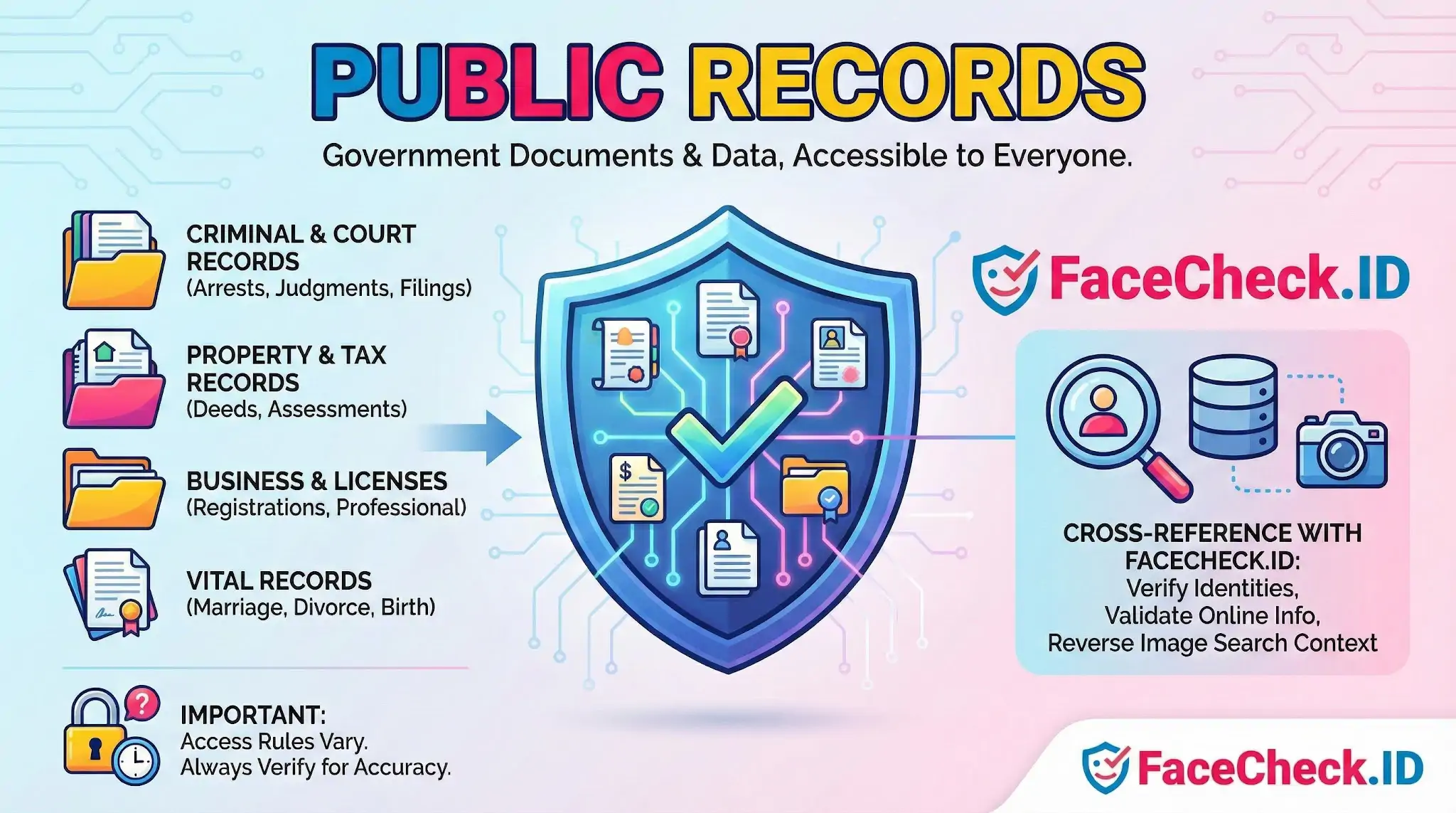
Records typically pulled in this kind of follow-up include:
- County criminal dockets and arrest logs that confirm a name, date of birth, and jurisdiction
- Civil court filings showing lawsuits, restraining orders, divorces, or evictions
- Property tax rolls and deed records linking a name to an address
- Business filings, LLC registrations, and registered agent listings
- Professional licenses for nurses, attorneys, contractors, real estate agents, and similar regulated roles
- Marriage and divorce records, where state law allows access
- Sex offender registries, which often include a current photo that can be visually compared to a face-search hit
The useful pattern is convergence. A face match leading to a LinkedIn profile, a state bar listing, and a property record in the same city is much stronger evidence than any single hit.
Common investigation scenarios
People bring public records into face-search work for a handful of recurring reasons.
A dating-app user runs a suspicious profile through FaceCheck.ID, gets a name and city from the matches, and wants to confirm the person is real and not married. Marriage records and property records in that county can answer that quickly.
A small business owner sees a face match tied to a fraud complaint or court filing. Pulling the actual case file shows whether the dispute was civil, criminal, dismissed, or ongoing, which matters before any decision is made.
A journalist or open-source researcher identifies someone in a photo and wants to map their affiliations. Business registrations and nonprofit filings often expose ownership and board ties that social media hides.
A scam victim uses face search to identify the person whose photos were stolen and impersonated. Public records help distinguish the actual person, who is also a victim, from the scammer using their image.
Where public-records access varies
Rules change by country, state, and even county. United States access tends to be broad but fragmented across thousands of clerk offices. The EU and UK restrict much more under data protection laws. Some records require an in-person request, a written FOIA-style petition, a fee, or proof that you have a legitimate interest. Sealed juvenile records, expunged convictions, and protected addresses for domestic violence survivors will not appear, and that absence does not mean the underlying event did not happen.
Aggregator sites repackage public records but frequently lag behind the source by months or years. Treat them as leads, not evidence.
What public records cannot prove on their own
A public record confirms that a document exists with certain names, dates, and facts on it. It does not prove that the person in the face-search photo is the same person named in the record. Common-name collisions are constant. Two James Wilsons in the same metro area can produce mixed property and court hits that look like one person's history.
Public records also do not capture intent, current behavior, or whether old information is still relevant. A ten-year-old civil case says little about who someone is today. An arrest is not a conviction. A clean record does not mean a person is safe, only that nothing reached the public file.
The honest workflow is to use face search to generate candidates, use public records to test those candidates, and treat any single match as a hypothesis until multiple independent sources line up.
FAQ
What are “Public Records” in the context of face recognition search engines?
“Public Records” generally refers to information that is legally available to the public from government or official sources (for example: court filings, property records, business registrations, professional licenses, voter or campaign records where applicable, and some law-enforcement/public-safety publications depending on jurisdiction). In face recognition search engines, the term usually describes result pages that contain publicly accessible identity-related details alongside photos (such as a mugshot page, a court docket image, or an agency PDF).
Why do face recognition search results sometimes include Public Records pages?
Because many Public Records are published online and can include headshots, scanned documents, or images that contain faces. If a search engine has indexed those pages (directly or via third-party sites that republish public information), its face-matching system may surface them when the face in your query appears similar to a face shown on a Public Records-related page.
Does a Public Records match mean the person in my photo is definitely the same person named in the record?
No. A Public Records result is not proof of identity. Face matches can be wrong due to look-alikes, low-quality images, aging, lighting, or miscaptioned/republished pages. Treat Public Records hits as leads to verify by checking multiple independent identifiers on the source page (e.g., full name, date, location, case number, employer, or other corroborating details) and confirming the original source rather than only a repost.
How should I verify and interpret Public Records results returned by a face search tool (e.g., FaceCheck.ID)?
Open the source link and assess whether it is an official government domain or a third-party aggregator; prioritize official sources when possible. Compare multiple photos (not just one), look for consistent biographical details, and confirm whether the record clearly connects to the same person across time and context. If using a tool like FaceCheck.ID (or similar), use any similarity indicators as a starting point, not a conclusion, and avoid making accusations or decisions based solely on a single Public Records match.
Can I remove or opt out of Public Records-related results in face recognition search engines?
It depends on the site and the jurisdiction. If the image is hosted by an official agency site, removal may be limited and governed by that agency’s policies and local law. If the image appears on a third-party republisher, that site may offer takedown/opt-out procedures. Separately, some face recognition search engines provide opt-out or removal request processes for indexing/display; you typically need to follow their specific instructions and may need to confirm the URLs to be removed.

Recommended Posts Related to public-records
-
How to Find Anyone Online: A Guide to Internet Sleuthing
Below: the search engines, the social platforms, the public records, the slightly obscure OSINT tools that investigators actually use. Pipl: Built specifically to surface online identities — social profiles, forum posts, public records. Spokeo: Aggregates social profiles, public records, and online directories into one view.
-
Reverse Image Search - Social Catfish vs FaceCheck.ID
You give it whatever scrap of information you have on someone — a name, an email, a phone number, a username, an address, or a photo — and it tries to build a picture from public records and online sources. Social Catfish aggregates from public records and online sources, so removal there usually means contacting the original source (the data broker, the social profile, the public registry) rather than the search tool itself. The tool performs much better on emails linked to social media, forum posts, data breaches, and public records.
-
How to Find Someone Online
Find Someone Using Public records. When you want to find public records, you have several options. Another option is to use a public records database such as MyHeritage, which offers a broad range of public records.
-
How to Search Arrest Records and Mugshots by a Photo of a Person
If that doesn't work, try looking for the person's name on a public records website. Mugshots are stored in the police department's records, but many are also published online because they are public records. If this happens, it would be harder for people to find mugshots, but they would still be accessible through public records requests.
-
Uncover the Truth Before Your First Date
Access to Public Records. Face search engines can access a wealth of public records, including criminal records, court records, and social media profiles.