Face Recognition AI
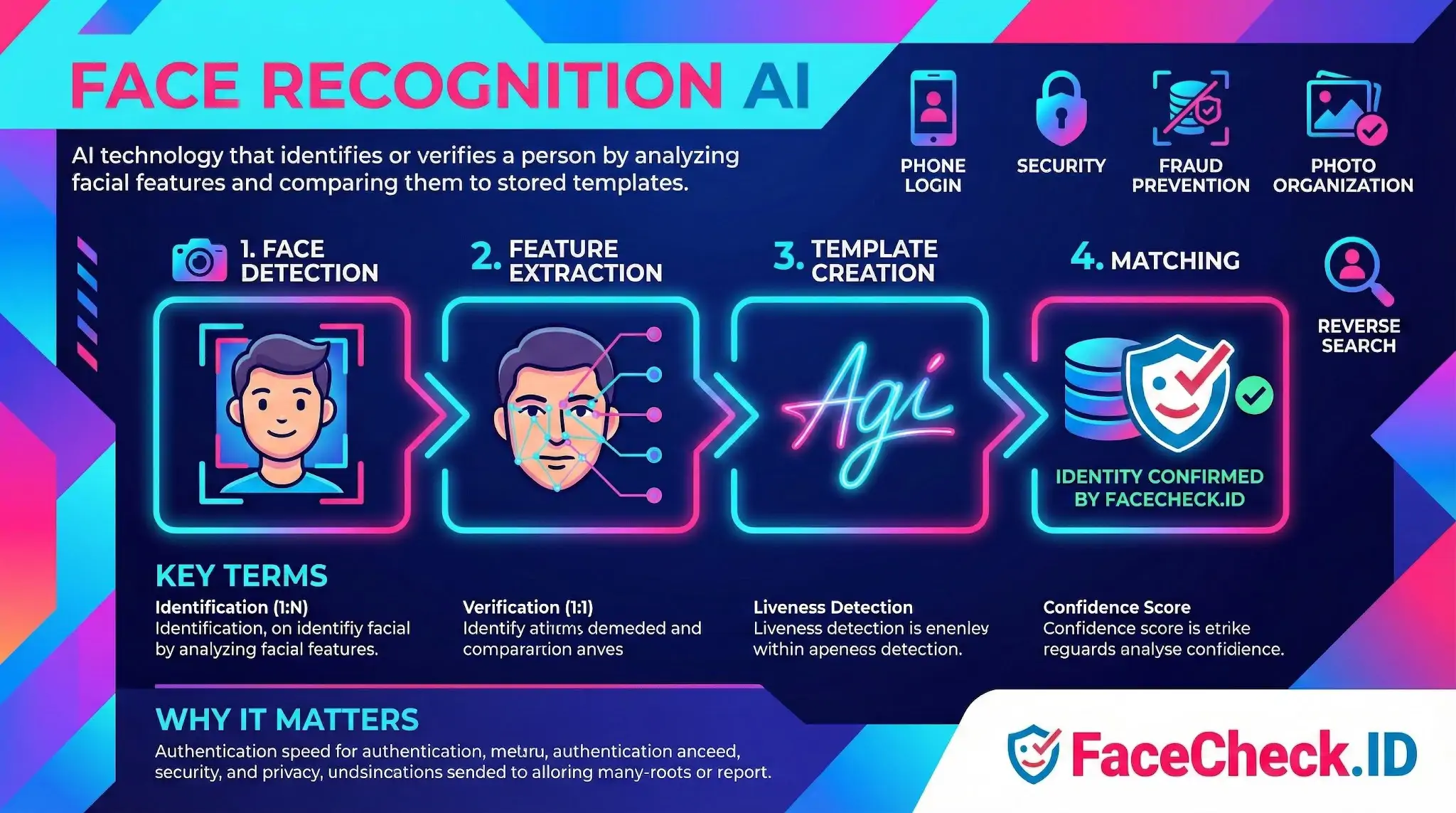
Face Recognition AI is the technology behind tools like FaceCheck.ID that turn a single photo of a face into a search query against the public web. Instead of matching keywords, the system matches geometry, finding pages, profiles, and image archives where the same face appears.
How face recognition powers reverse image search
When you upload a photo to a face-search engine, the system runs through several stages before any results appear. Each stage affects how reliable the matches will be.
- Face detection: The model locates the face in the uploaded image, ignoring background, clothing, and other people in frame.
- Alignment and normalization: The face is rotated, cropped, and rescaled so that eyes, nose, and mouth land in predictable positions. This is why front-facing photos work better than profile shots.
- Embedding generation: The aligned face is converted into a numeric vector, often called a face embedding or faceprint, that captures the geometry of features rather than their pixel values.
- Vector search: That embedding is compared against millions of embeddings extracted from publicly indexed images. The system returns the closest matches ranked by similarity.
The output is not a name. It is a list of indexed pages, social profiles, news articles, blog posts, mugshot databases, or forum avatars where a similar-looking face appears. Identification still requires a human to read the surrounding context.
Why image quality changes what the AI can find
Two photos of the same person can produce very different search results depending on conditions. The embedding model is sensitive to factors that distort facial geometry or remove information.
- Resolution and compression: Heavily compressed thumbnails or screenshots from videos lose the fine detail needed for a strong match.
- Face angle: Anything beyond about 30 degrees off-center weakens the match. A perfect side profile rarely produces useful results.
- Lighting: Harsh shadows, strong backlight, or overexposure flatten features and confuse the model.
- Occlusions: Sunglasses, masks, hats pulled low, hair across the face, or heavy filters reduce the usable feature area.
- Age gap: A current face embedding does not always match a high school yearbook photo from twenty years ago, especially across puberty or significant weight change.
LinkedIn headshots and dating-profile selfies tend to produce cleaner matches because they are front-facing, well-lit, and often reused across multiple sites, which gives the search index more chances to surface the same person from different angles.
What confidence scores actually mean
Every match is returned with a similarity score. Higher scores indicate the embeddings are closer in vector space, but the score is a probability of geometric similarity, not proof of identity. A score in the 90s on FaceCheck.ID usually points to the same person across different photos. Scores in the 70s often need manual review because lookalikes, siblings, and people of similar ethnicity and age can land in that range. Anything lower is mostly noise.
This matters most in real investigations. If someone is checking whether a dating-app match is using stolen photos, a single mid-range hit on a stock photo site is often enough evidence. If someone is trying to identify a suspect from a single grainy frame, the same score might be misleading.
Where face recognition stops being useful
Face Recognition AI is good at narrowing the field. It is not good at the last mile of identification.
- It cannot prove identity on its own. Two unrelated people can have very similar facial geometry, especially under poor image conditions.
- It only finds faces that have been publicly indexed. Private accounts, deleted posts, and platforms that block crawlers are invisible.
- A missing match does not mean a person has no online presence. It means the indexed copy of the web does not contain a usable photo.
- Reused or stolen photos can produce strong matches to the wrong identity. A scammer using a model's headshot will return that model's profiles, not the scammer's.
The technology shifts the burden from finding a face to interpreting what the matches mean. That interpretation still belongs to the person reading the results.
FAQ
What is a face embedding (face vector) and why is it central to Face Recognition AI search engines?
A face embedding (also called a face vector) is a numeric representation of a face produced by a neural network. Face Recognition AI search engines compare embeddings to find visually similar faces, allowing matches even when the photos differ in lighting, angle, crop, or image quality.
Why can different face recognition search engines return different results for the same face?
Results can differ because engines use different AI models, training data, similarity thresholds, ranking methods, and indexing coverage of the public web. One tool may be better at certain angles or demographics, while another may simply have indexed different websites or versions of the image.
Can Face Recognition AI search engines work if the face is partially hidden or low quality?
Sometimes, but performance drops when key facial features are obscured (masks, heavy sunglasses, extreme side profiles), or when the image is blurry, very small, heavily compressed, or filtered. Using a clearer, front-facing image with good lighting and minimal edits usually improves match quality.
How should I interpret match strength or similarity scores in face recognition search results (including tools like FaceCheck.ID)?
Similarity scores are best treated as a confidence hint, not proof of identity. A higher score typically means the face embedding is closer, but look-alikes, edited images, and poor-quality inputs can still produce misleading scores. Validate using multiple photos, consistent context (accounts, usernames, timestamps), and corroborating non-face evidence.
What are the biggest privacy and safety considerations when using Face Recognition AI search engines like FaceCheck.ID?
Key considerations include consent, potential harassment or doxxing risk, and the possibility of false association (especially with sensitive sources like mugshots or adult content). Minimize harm by searching only for legitimate purposes, avoiding sharing results widely, using results as leads rather than conclusions, and using opt-out/removal processes where available.


Recommended Posts Related to face-recognition-ai
-
How to Find Someone Using a Screenshot
That's because they are not made to search for people and do not use facial recognition AI.
-
How to Find Someone with a Photo?
FaceCheck.ID is a robust "investigative search engine" that uses a state-of-the-art facial recognition AI to search for people by image. Specialized tools such as FaceCheck.ID, PimEyes, Social Catfish, and Search4faces use facial recognition AI to match faces and provide valuable insights about individuals.
-
All About Face Recognition Technology
How Does Face Recognition AI Work? Face recognition AI works by determining certain characteristics of a person's face and comparing them to a database of known faces. Face recognition AI can also take into account other factors such as hair color and style, and skin tone.
-
Yandex Image Search: Complete Guide to Finding Faces (2026)
Instead of general visual similarity, it uses dedicated facial recognition AI trained specifically on matching human faces across different photos, angles, lighting conditions, and even years apart. Purpose-built tools like FaceCheck.id go even further with dedicated facial recognition AI.
-
Instagram Image Search to Find Instagram Profile by Photo using Face Search Engine
It's because FaceCheck.ID is using facial recognition AI.