Fake Accounts: Spotting Stolen Photos
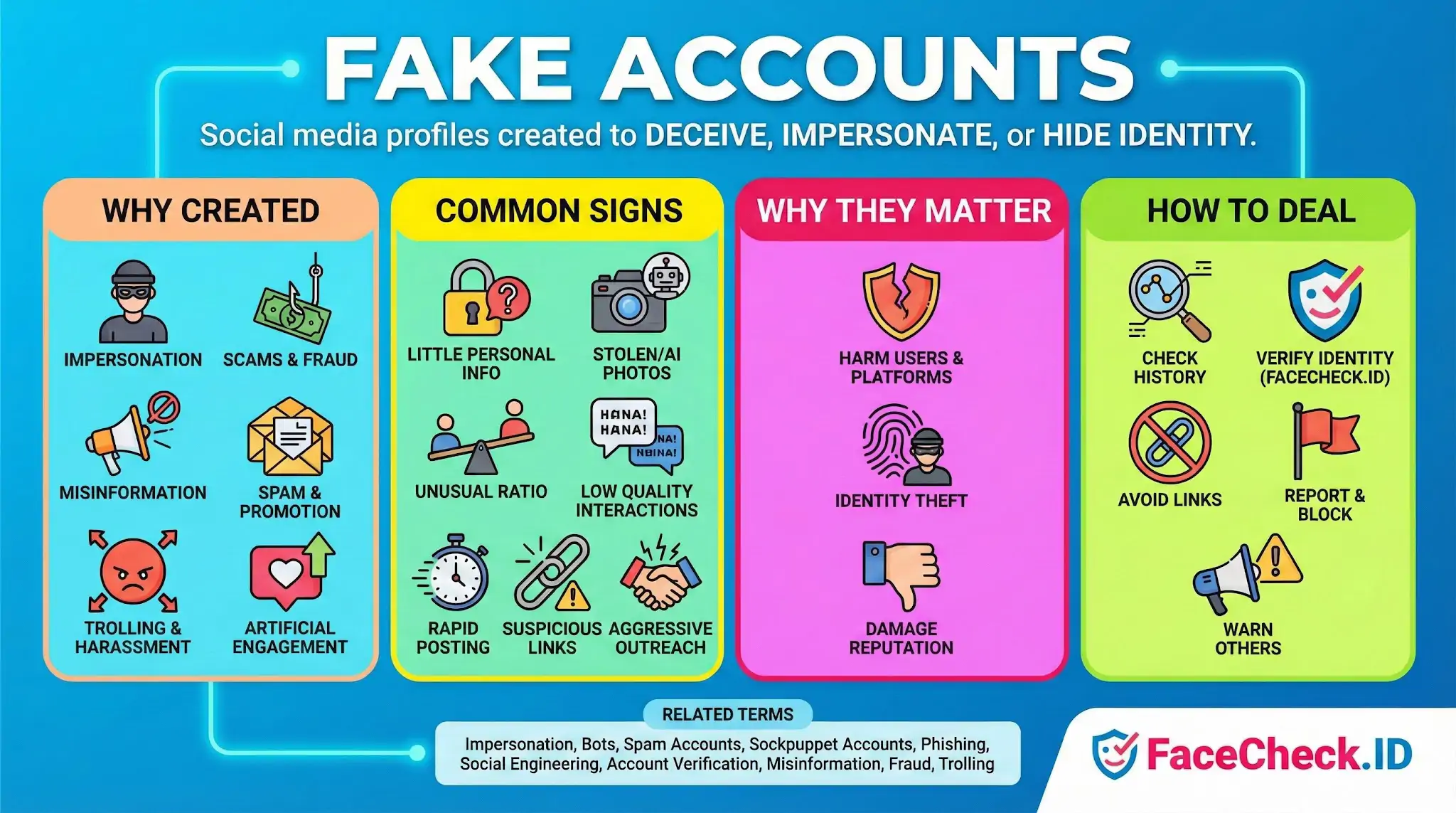
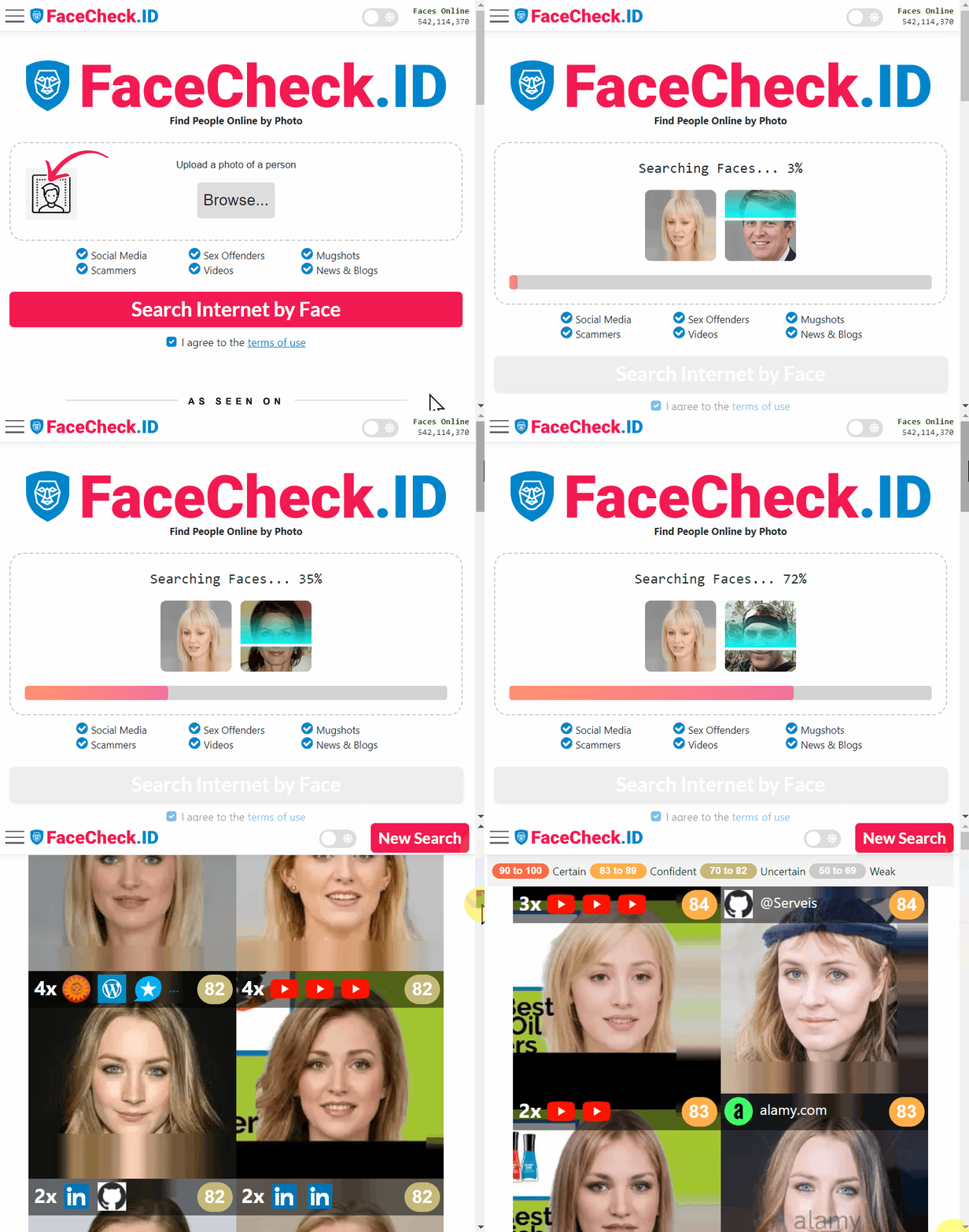
Fake accounts are one of the main reasons people run reverse face searches in the first place. When a profile photo looks too polished, the bio feels thin, or a stranger slides into a DM with a romantic pitch, running the face image through FaceCheck.ID often reveals whether that photo belongs to someone else entirely or appears across dozens of unrelated profiles.
How face search exposes fake accounts
A fake account usually fails in one specific way: the photo it uses already lives somewhere else on the public web. Scammers rarely generate fresh imagery for every profile. They reuse pictures scraped from Instagram, military personnel pages, modeling portfolios, fitness influencer feeds, or public LinkedIn profiles. A reverse face search can return matches showing the same face attached to a different name, country, or profession, which is the clearest evidence that the account is not who it claims to be.
Common fake account patterns that face search exposes:
- A "US Army general" profile whose photo traces back to a Spanish actor or a real soldier whose images were stolen
- A "single doctor working in Yemen" using headshots lifted from a clinic website in another country
- A young model on a dating app whose face appears on Russian or Brazilian Instagram pages under a different name
- A crypto recruiter on LinkedIn using AI generated faces that produce no matches at all, or only matches on This Person Does Not Exist style sources
- Multiple Tinder, Hinge, and Facebook profiles sharing the same face but different ages, jobs, and cities
Signals that pair well with face-match results
A face match alone is sometimes ambiguous. Identical twins exist, models license their photos, and some people genuinely run accounts on multiple platforms. Combine match data with profile-level signals before drawing conclusions:
- The face appears on accounts in languages the person claims not to speak
- The original source predates the suspicious account by years
- The matched profiles use entirely different names with no overlap
- The photo is a known stock image or a reused influencer shot
- The bio details contradict what the matched accounts show, such as marital status, military rank, or location
- Refusal to do a live video call or send a real-time photo with a specific gesture
Face confidence scores help here. A high-confidence match against a verified original source carries more weight than a borderline match against another low-quality profile.
Why fake accounts are hard to confirm with certainty
Face search narrows the question, but it does not always settle it. Several situations can produce misleading results.
A real person whose photos were stolen will have their face appear on both the legitimate account and the impersonator account. Telling which is which requires looking at account age, follower history, posting patterns, and verified links rather than the face match alone.
AI generated faces, particularly those produced by recent diffusion models, often return zero matches. Zero matches do not prove an account is fake. New users, private people, and anyone who avoids posting publicly will also produce empty results.
Cropped, heavily filtered, or low-resolution profile pictures can suppress matches even when the same face is widely indexed elsewhere. A profile that looks suspicious but returns nothing may simply be using a photo the search index has not crawled, not a synthetic identity.
What a face search result does and does not prove
A reverse face search can demonstrate that a photo is reused, mismatched, or stolen. That is strong evidence the account is not what it claims, but it is not proof of intent. The photo could belong to a friend, a public figure being parodied, or a private person whose image was scraped without their knowledge. Reporting an account as fake should rest on the full picture, including the conversation history, the platform context, and any financial requests, rather than a single match. Face search is best used as the first filter, not the verdict.
FAQ
What are “Fake Accounts” in the context of face recognition search engines?
Fake accounts are profiles created to mislead others about who is behind them. They may use stolen photos of a real person, AI-generated faces, or heavily edited images to appear authentic. In face recognition search results, a fake account often shows up as a page using someone else’s face rather than evidence of a genuine identity.
How can a face recognition search engine help detect fake accounts that reuse someone else’s photos?
Face recognition search can reveal the same face appearing across multiple unrelated accounts, usernames, or websites. Common signals include: the same portrait linked to many profiles; the “same person” appearing with different names/locations; older sources (news, professional sites) appearing before the suspicious profile; and widespread reposting that suggests the image was taken from elsewhere.
What patterns in face search results suggest a fake account might be using AI-generated (synthetic) faces?
AI-generated faces often produce few or no reliable matches across the web, or only visually similar (not identical) faces. You may see inconsistent or low-confidence matches, results that don’t converge on a consistent set of sources, and a lack of older references to the same face. However, absence of matches is not proof of an AI-generated face—some real people simply have limited online presence.
If a face search returns multiple matches for one photo, does that prove the account is fake?
No. Multiple matches can happen for legitimate reasons such as reposts, fan pages, public figure coverage, or the same person using several platforms. Treat results as leads: compare timestamps, check whether pages belong to the same individual (consistent bio, links, history), and look for independent confirmation (official websites, verified accounts, or consistent cross-links).
How should I act on fake-account suspicions based on results from tools like FaceCheck.ID?
Use results as indicators, not proof. Save URLs and screenshots of relevant matches, verify by checking original upload dates and context on each page, and look for corroborating evidence (consistent usernames, contact methods, prior mentions). If impersonation is likely, report the profile to the platform, and if your images are involved, consider takedown/reporting options offered by the site or service (including FaceCheck.ID where applicable). Avoid public accusations without strong confirmation to reduce the risk of misidentifying someone.

Recommended Posts Related to fake-accounts
-
Image Search for Catfish, 3 Steps to Uncover the Fakes!
An Instagram catfish is someone who creates a fake account on the social media platform to deceive others.
-
How Do You Reverse Image Search on Dating Sites?
Services like FaceCheck.ID help online daters expose fake accounts, protect themselves from scammers, and verify who they’re really talking to.
-
Fake Profile Scam? Why 99% of the Time the Person in the Photo Is Innocent
How to report a fake account. Use categories like impersonation, fake account, scam or fraud, or harassment if they're threatening you.
-
Social Media Lookup: Find Anyone's Profiles by Photo
Does this work for finding fake accounts? If you search a suspicious profile's photo and it matches a completely different person's social media, you've found a fake account.
-
How to Spot a Catfish in 2025: Red Flags in Fake Dating Profiles
This shows higher friction, but also that community reporting can deter fake accounts.