Reverse Image Search Google

Google's reverse image search is often the first tool people try when they want to know where a photo came from, but it has real limits when the goal is identifying a person rather than an object. Understanding what Google does well, and where face-recognition tools like FaceCheck.ID pick up the slack, matters whenever you are trying to verify someone's identity from a single picture.
How Google reverse image search actually works
Google matches images by visual signals: color layout, edges, textures, and increasingly, recognizable objects through Google Lens. It looks for copies and near-copies of the exact file or scene you submit. If the same photo has been republished on other sites, Google is good at finding those reposts. If the image has been cropped, recolored, or mirrored, results get weaker. If you submit a photo of a person whose face has never been published in that exact composition, Google usually returns lookalike scenes, stock photos, or unrelated thumbnails.
You can run a search three main ways:
- Google Images on desktop: click the camera icon and upload a file or paste a URL.
- Google Lens in Chrome: right-click any image and choose "Search image with Google."
- Google Lens on mobile: point your camera or upload from your gallery.
Why it falls short for identifying people
Google does not run face recognition on its public reverse image search. It will not tell you "this is the same person photographed at a different event." It will only find that exact image, or scenes that look visually similar in composition. That distinction matters enormously when you are dealing with:
- A profile photo from a dating app where the person used a unique image taken just for that profile.
- A scammer who pulled a stolen photo from an obscure source Google has not indexed prominently.
- A catfish who lightly edited a picture, changed the crop, or added a filter to defeat exact-match systems.
- Someone you met in person and photographed yourself, meaning the image has never been online before.
In these cases, Google often returns nothing useful, while a face-recognition engine can still match the person by their facial geometry across entirely different photos.
When Google is the right first step
Google reverse image search remains genuinely useful for a few investigation tasks before or alongside a face search:
- Checking whether a profile picture is a stolen stock photo or pulled from a celebrity's Instagram.
- Finding the original publication date of an image to spot recycled scam content.
- Locating a higher-resolution copy of a blurry or cropped face before running it through face search, since cleaner inputs produce stronger matches.
- Identifying background landmarks, logos, or objects that hint at where a photo was actually taken.
Treat Google as the tool for "where has this exact picture been posted," and a face-search engine as the tool for "where else does this person appear, in any photo."
Limits and where interpretation goes wrong
A clean Google reverse image search with no hits does not mean the person is real, and a flood of matches does not mean the person is who they claim to be. Stolen photos that came from private accounts, screenshots, or messaging apps may never appear in Google's index. Conversely, a photo that returns thousands of matches might just be a popular meme template or a stock image, not evidence of a single identity.
Even when Google does locate a source page, that page can itself be fake or reused. A LinkedIn profile, a news article, or a personal blog can all be fabricated around a stolen image. Confirming identity requires cross-referencing multiple matches, comparing facial features across angles, and weighing the consistency of names, locations, and timelines. Reverse image search is a starting point for that work, not an answer in itself.
FAQ
How do I do a reverse image search on Google with a face photo?
You can run a reverse image search with Google by using Google Images or Google Lens. Upload the photo (or paste an image URL), then review the results under visually similar images and pages that include the image. For face-related queries, cropping to the face and trying multiple crops (full head vs. just face) can change what Google returns.
Does Google Reverse Image Search actually identify a person by their face?
Usually no. Google’s reverse image search is primarily optimized to find the same image, close variants (cropped/resized), and visually similar content—not to reliably match the same person across different photos. Dedicated face search engines are designed for cross-photo face matching, which is a different task than finding duplicates.
Why do Google reverse image search results change when I use the same face photo again?
Results can change because Google’s index and ranking signals update over time, and because small differences in the query (crop, resolution, compression, lighting, or background) can shift “visual similarity” matches. If you need consistency, repeat searches using the exact same file and also test a tightly-cropped face-only version.
What should I do if Google Reverse Image Search shows irrelevant or wrong-person results for a face photo?
Treat the results as leads, not proof. Try a cleaner face crop, remove borders/watermarks, and test multiple images of the same person (different angles). Validate any candidate page by checking context (captions, usernames, upload dates, and whether multiple photos on the same source match the same person). If you need face-specific matching, consider a dedicated face search engine such as FaceCheck.ID, then verify any hits the same way.
When is FaceCheck.ID more useful than Google Reverse Image Search for face lookups?
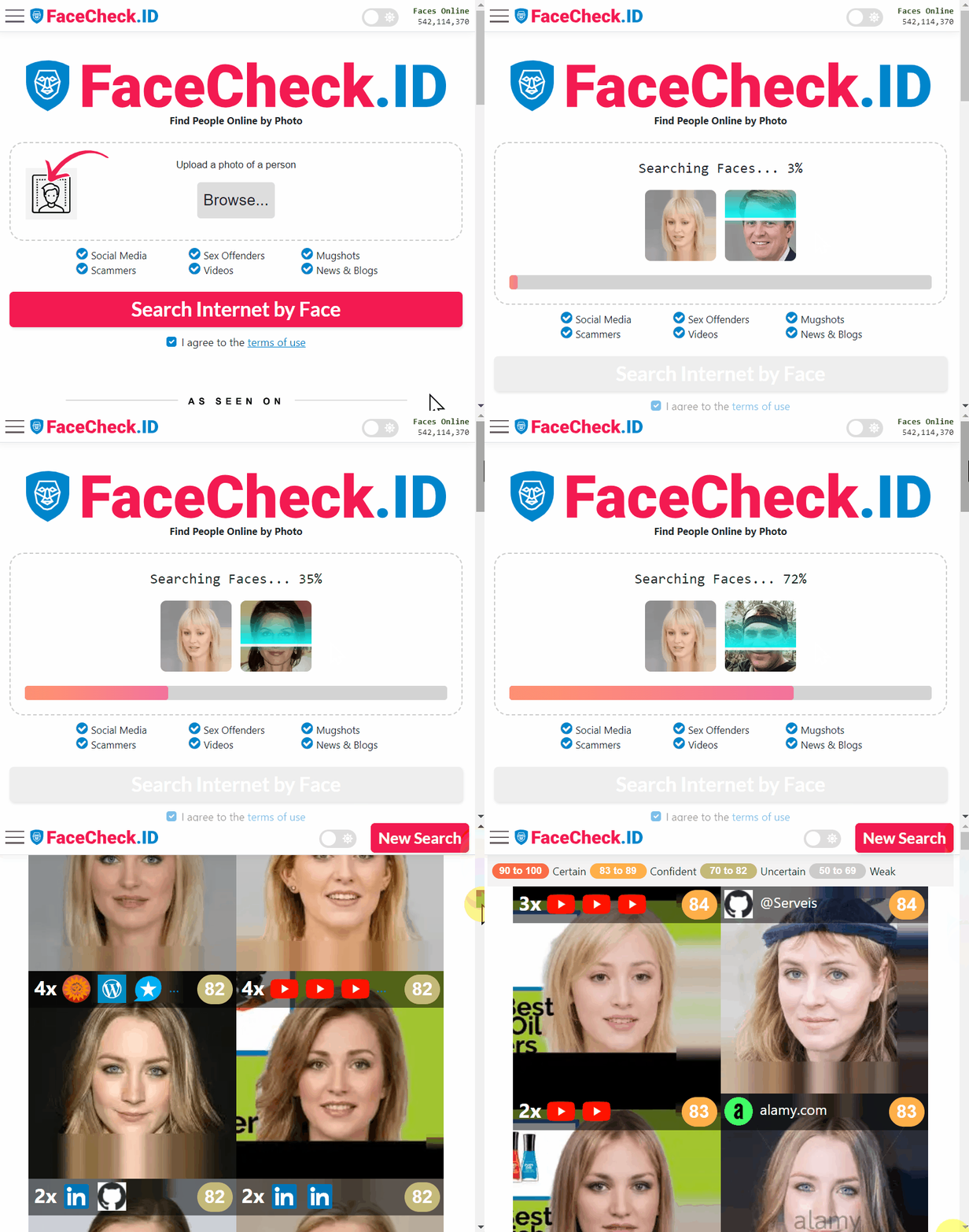
FaceCheck.ID can add value when you’re trying to find the same person across different photos (not just the same image reposted) or when Google returns mostly “similar-looking” images. Use it to broaden leads, then confirm by checking that multiple independent sources point to the same identity and that the surrounding details (location, timeframe, associated accounts) are consistent before you act on the result.

Recommended Posts Related to reverse-image-search-google
-
AI Face Search: How It Works and Best Tools (2026)
This is fundamentally different from traditional reverse image search. Google Images uses perceptual hashing and object recognition to find visually similar images. Reverse image search (Google, TinEye) finds copies or visually similar images by matching pixel patterns.
-
Tutorial: Reverse Image Search for Instagram
Instagram has no built-in reverse image search. Google's face search is, charitably, not a thing.
-
How to Reverse Image Search from Android in 4 Steps
How To Reverse Image Search (Google). How To Reverse Image Search (Google).
-
OnlyFans Finder: How to Search by Face to Find Profiles
The key difference from regular reverse image search: Google or TinEye match the exact image (or near-duplicates).
-
PimEyes Review: Is It Worth the Price in 2026?
How is PimEyes different from Google reverse image search? Google reverse image search matches images by visual similarity (colors, shapes, composition).