PimEyes Review: Is It Worth the Price in 2026?
You've probably heard of PimEyes. It's one of the most talked-about face search engines on the internet, and for good reason: it genuinely works. Upload a photo of a face, and PimEyes will find other photos of that same person across the web. The technology is real. The question is whether it's worth the price, because PimEyes has gotten expensive, and the free version is designed to frustrate you into paying.
If you're here because you need to search for someone by their face and you're trying to figure out if PimEyes is the right tool, this review covers everything: what it actually does, how accurate it is, what it costs, the privacy controversies, and whether there are better options for your money.
In this article, we're going to discuss
What PimEyes Actually Does
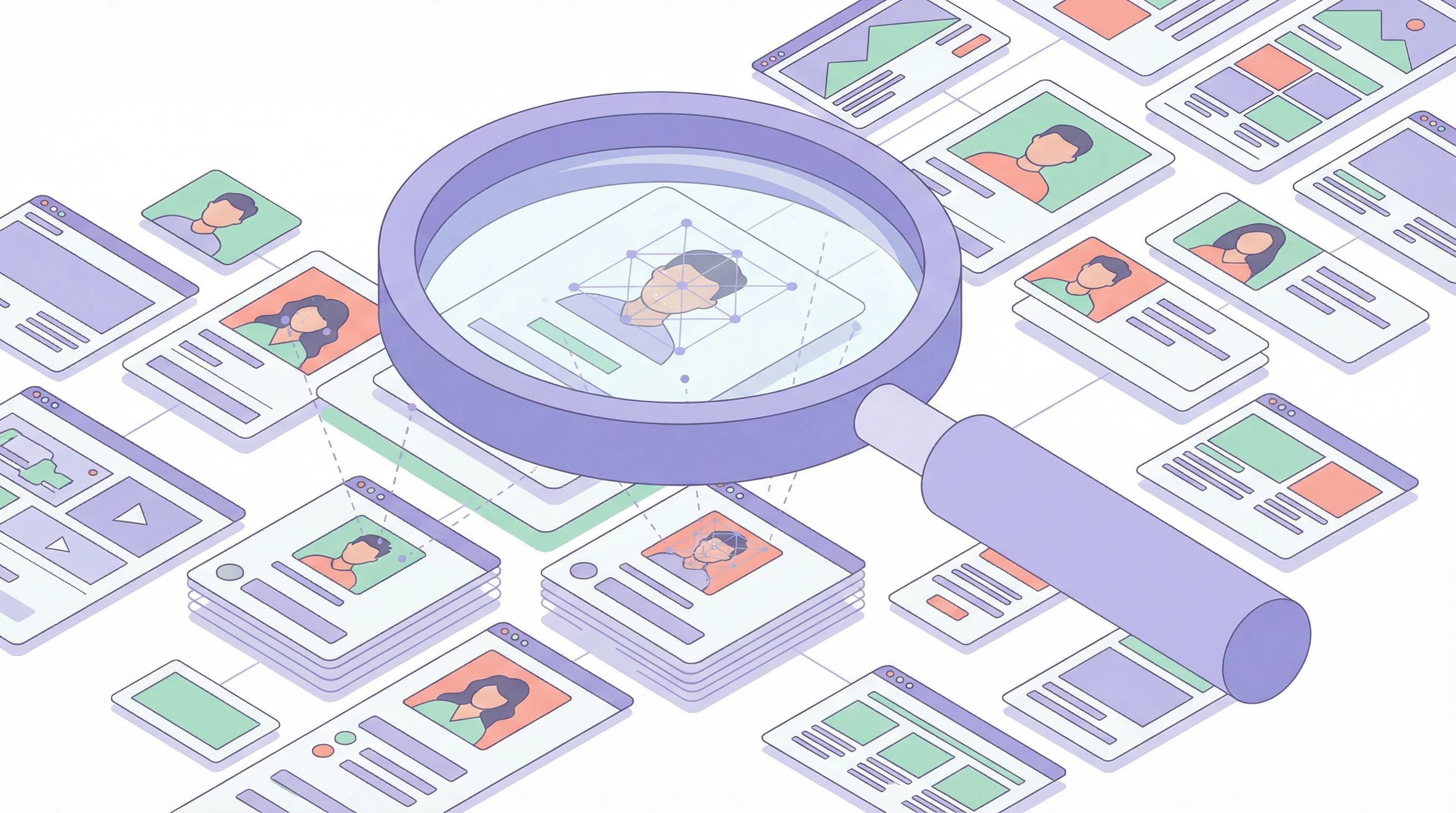
PimEyes is a face search engine built on facial recognition technology. You upload a photo containing a face, and it scans its database of publicly available images to find other photos of that same person. It maps the facial geometry (distance between eyes, nose shape, jawline structure) and matches it against indexed photos from across the web.
The results show you thumbnails of matching faces along with links to the source websites where those photos appear. This can include social media profiles, news articles, blog posts, forums, and any other publicly accessible web page.
PimEyes was founded in Poland in 2017 and has changed ownership multiple times. It's currently marketed primarily as a tool for protecting your own online presence, though it's widely used for identifying other people as well.
PimEyes Pricing: What You're Actually Paying
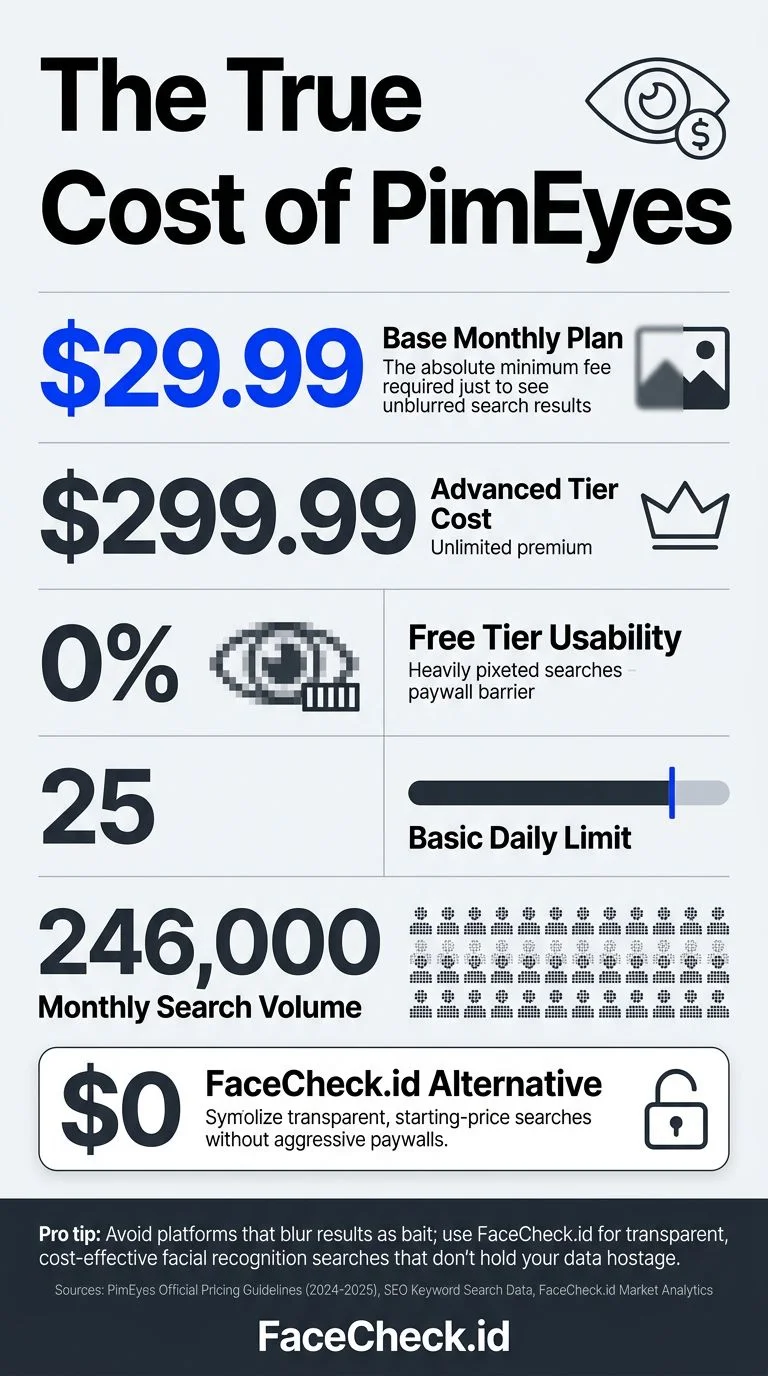
This is where PimEyes loses a lot of people. Here's the current pricing breakdown:
Free tier: You can upload a photo and PimEyes will show you blurred results. You can see that matches exist, but you can't see the actual images or click through to source pages. It's a teaser designed to make you pay. Functionally useless for anything practical.
Open Plus ($15.99/month): 25 searches per day. You get unblurred results with source links. No alerts or monitoring.
PROtect ($29.99/month): 25 searches per day plus ongoing monitoring. PimEyes will alert you when new photos of your face appear online. Includes a takedown request feature (DMCA-style).
Business plans: Custom pricing for companies. Significantly more expensive.
The catch: even on paid plans, you only get 25 searches per day. If you're just checking one or two photos, paying $16-30/month for a subscription feels steep. And PimEyes charges monthly, there's no per-search option.
Compare that to FaceCheck.id, which offers per-search pricing. If you only need to check a few photos, you pay for what you use instead of committing to a monthly subscription you might not need again.
How Accurate Is PimEyes?
In my testing, PimEyes is genuinely good at finding faces. I ran several searches with clear, front-facing photos and got relevant results within seconds. The accuracy on well-lit photos with direct face angles is impressive, probably in the 90%+ range for people with a reasonable online presence.
Where it struggles:
Low-resolution photos. Blurry screenshots from video calls or zoomed-in surveillance footage produce poor results. This isn't unique to PimEyes; all face recognition systems have this limitation.
Side angles. Photos taken from extreme side angles reduce accuracy significantly. Face mapping needs to see enough of the facial structure to create a reliable match.
Photos with obstructions. Sunglasses, masks, heavy makeup, and hats that cover the forehead all reduce accuracy. The more of the natural face that's visible, the better the results.
People with minimal online presence. If someone has very few public photos online, no face search engine will find them. PimEyes can only match against what's been indexed.
One thing I noticed: PimEyes occasionally returns false positives, people who look similar but aren't the same person. Always verify results by clicking through to the source page and checking the context. Don't treat a PimEyes match as proof of anything without additional verification.
The Privacy Problem
PimEyes has been at the center of multiple privacy controversies, and they're worth understanding before you use the service.
The core concern: PimEyes scrapes and indexes publicly available photos without people's consent. You didn't agree to have your face indexed in their database. Neither did anyone else. The technology works because it processes billions of photos from across the public web, and the people in those photos never opted in.
Regulatory pushback: PimEyes has faced scrutiny from European data protection authorities. In 2022, Italy's data protection authority fined PimEyes for GDPR violations. The UK's ICO has also raised concerns. PimEyes responded by restricting some features in the EU, but the core service continues to operate.
The Clearview AI comparison: PimEyes is often compared to Clearview AI, which made headlines for selling facial recognition to law enforcement. PimEyes claims it's different because it's marketed to individuals, not governments. The underlying technology and privacy implications are similar, though.
Opt-out exists but it's limited. PimEyes offers an opt-out feature on paid plans where you can request that your face be excluded from search results. The irony: you need to pay PimEyes to stop PimEyes from indexing your face.
This doesn't mean you shouldn't use face search tools. It means you should understand what you're participating in when you do.
PimEyes vs. FaceCheck.id: Honest Comparison
Both tools do face search, but they approach it differently:
Pricing model. PimEyes requires a monthly subscription ($16-30/month). FaceCheck.id offers per-search pricing. If you're checking one photo to verify a dating match, FaceCheck.id is significantly cheaper. If you need daily monitoring of your own face online, PimEyes' PROtect plan is built for that.
Database coverage. Both search publicly available images, but their indexes differ. In my testing, FaceCheck.id returned results from social media platforms (Instagram, Facebook, LinkedIn) more consistently. PimEyes had broader coverage of news sites and blogs. For most people trying to identify someone from a dating app, social media coverage matters more.
Speed. Both return results in seconds. FaceCheck.id felt slightly faster in my tests, but the difference is marginal.
Free tier. PimEyes' free results are blurred and useless. FaceCheck.id's free tier lets you actually see what you're getting before you pay.
Privacy approach. Both index public photos. FaceCheck.id offers a straightforward opt-out process. PimEyes gates its opt-out behind a paid subscription.
Who should use which? If you need ongoing monitoring of where your face appears online, PimEyes PROtect makes sense. For everything else (verifying dating profiles, checking if someone is who they claim to be, one-time identity checks), FaceCheck.id gives you better value.
How to Use PimEyes (If You Decide To)
- Go to pimeyes.com and create an account.
- Upload a clear face photo. Same rules as any face search: front-facing, good lighting, face fills most of the frame.
- Review the blurred results (free) or purchase a plan to see full results.
- Click through to source pages to verify matches. Don't rely on thumbnails alone.
- Use the "Set Alert" feature (PROtect plan) if you want ongoing monitoring.
Or, try FaceCheck.id first. Go to FaceCheck.id, upload the same photo, and compare results. Many people find that FaceCheck.id gives them what they need without the monthly commitment.
Better Alternatives to PimEyes
If PimEyes' pricing or privacy approach doesn't work for you, here are other options:
FaceCheck.id
Best all-around alternative. Per-search pricing, strong social media coverage, fast results. My top recommendation for most use cases. Works great for dating verification, identity checks, and finding someone's social profiles from a photo.
Yandex Images
Free. Surprisingly decent at matching faces compared to Google. The trade-off is that you're uploading photos to Russian servers. Fine for non-sensitive searches, not ideal for personal safety situations.
Google Lens
Free but bad at faces specifically. Google Lens matches images by visual similarity (colors, composition, objects), not facial geometry. You'll get "person wearing blue shirt" results, not identity matches. Useful for finding where a specific image was posted, not for identifying people.
Social Catfish
Combines face search with name, phone, and email lookups. More expensive than FaceCheck.id, slower results, but useful if you have additional identifying details beyond just a photo.
FAQ
Is PimEyes legal to use?
Yes, in most countries. PimEyes searches publicly available photos, which is legal. However, using the results to stalk, harass, or discriminate against someone is illegal regardless of the tool. Some jurisdictions (notably in the EU) have placed restrictions on PimEyes due to GDPR concerns, but using the service as a consumer for personal verification purposes is generally legal.
Can PimEyes find anyone?
No. PimEyes can only find people whose photos are publicly indexed on the web. If someone has very few public photos, strict privacy settings on their social media, or simply doesn't have much of an online presence, they won't appear in PimEyes results. No face search engine finds everyone.
Is PimEyes free?
Technically, PimEyes has a free tier, but it only shows blurred results without source links. You can see that matches exist but can't actually use the information. For practical purposes, PimEyes requires a paid subscription ($15.99+/month). FaceCheck.id offers per-search pricing as a more affordable alternative for occasional use.
Does PimEyes notify the person I search for?
No. PimEyes does not notify anyone when their face is searched. Your searches are private. The person you're searching for has no way of knowing you looked them up.
How is PimEyes different from Google reverse image search?
Google reverse image search matches images by visual similarity (colors, shapes, composition). PimEyes uses facial recognition technology that maps the unique geometry of a face and finds other photos of the same person regardless of background, angle, or clothing. Google finds similar-looking images. PimEyes (and FaceCheck.id) find the same person.
Want to try a face search without the monthly subscription? Upload a photo at FaceCheck.id and see your results in seconds.

Learn More...
Unlocking the Power of Facial Recognition Technology: 10 Eye-Opening Facts
Facial recognition now tops 99% accuracy, but how does it actually work, and what are the hidden limitations no one talks about? From detecting emotions to identifying disguised individuals, these 10 facts reveal what the technology can really do and the biases that could affect you.
On the subject in other languages
 Análise do PimEyes: vale o preço em 2026?
 PimEyes 评测:2026 年它值这个价吗?
 Recenze PimEyes: Vyplatí se v roce 2026 za tuto cenu?
 PimEyes-Test: Ist es 2026 den Preis wert?
 Análisis de PimEyes: ¿merece la pena por su precio en 2026?
 Avis sur PimEyes : vaut-il son prix en 2026 ?
 Recensione di PimEyes: vale il prezzo nel 2026?
 PimEyesレビュー:2026年、その価格に見合う価値はある?
 PimEyes 리뷰: 2026년에도 가격만큼의 가치가 있을까?
 Recenzja PimEyes: czy warto zapłacić tę cenę w 2026 roku?
 Обзор PimEyes: стоит ли сервис своих денег в 2026 году?
 مراجعة PimEyes: هل يستحق سعره في 2026؟
 PimEyes İncelemesi: 2026'da Fiyatına Değer mi?
Popular Topics
Face Search Engine Identity Social Media Image Search Facial Recognition How To Facebook Instagram Facial Recognition Technology Social Media Profiles Find Someone LinkedIn Catfishing Law Enforcement PimEyes Yandex Images Find Anyone Image Search Google Reverse Image Search Google Screenshot Google Lens Face SearchFaceCheck vs PimEyes: Which Search Engine Reigns Supreme in 2026?