Doppelgänger Matches in Face Search
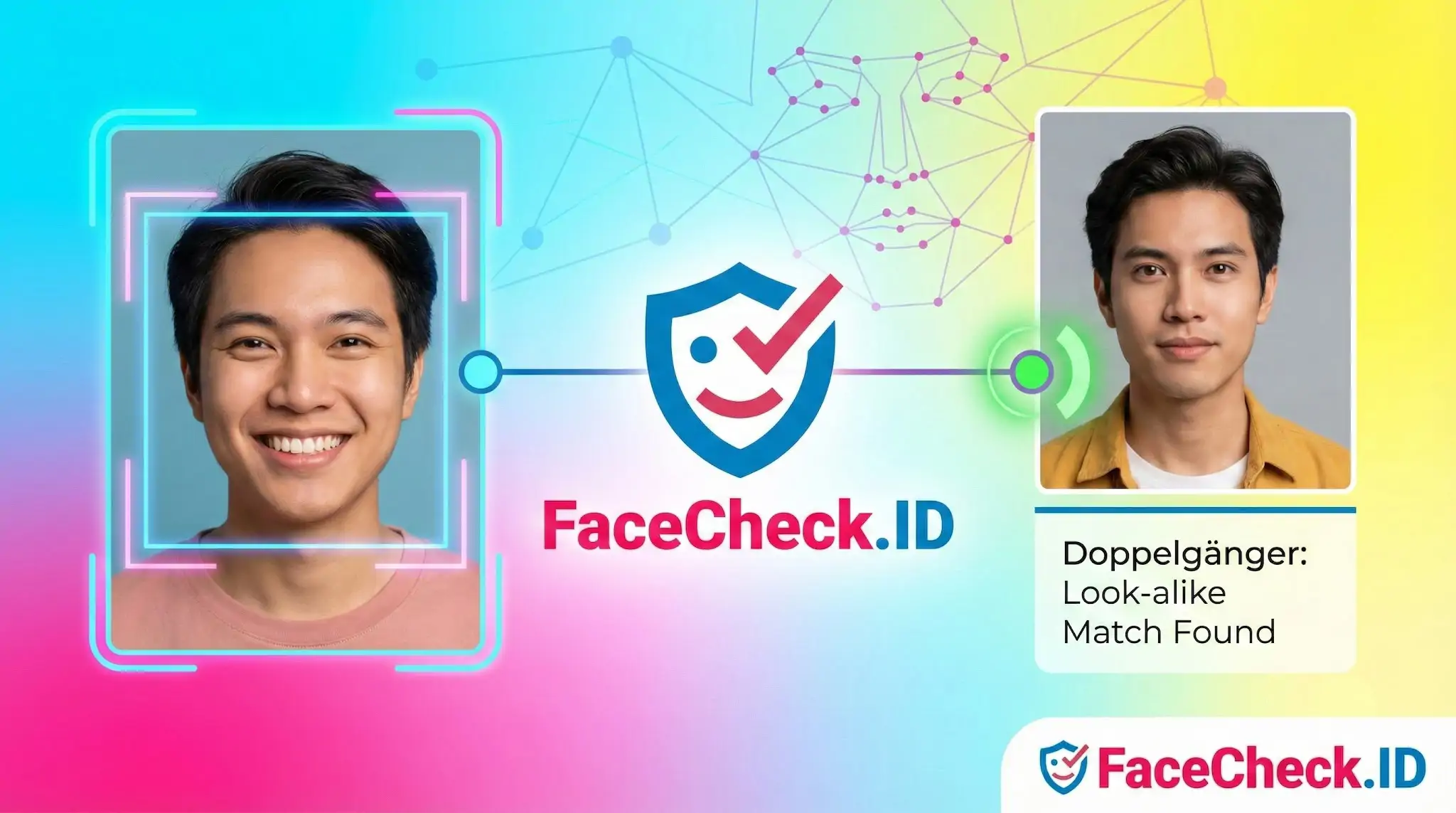
When you run a face through a reverse image search engine like FaceCheck.ID, the results almost always include a few faces that look like your subject but aren't your subject. These are doppelgängers — unrelated people whose facial geometry happens to overlap enough to trigger a match. Understanding them is essential to reading face-search results correctly.
How doppelgängers show up in face-search results
A face-recognition engine doesn't "recognize" a person the way a human does. It converts a face into a numerical embedding — a vector representing the relative positions and proportions of features like eye spacing, jaw width, brow ridge, nose bridge, and cheekbone structure. When two unrelated people share enough of those measurements, their embeddings land close together in the same mathematical space, and the system reports a similarity score.
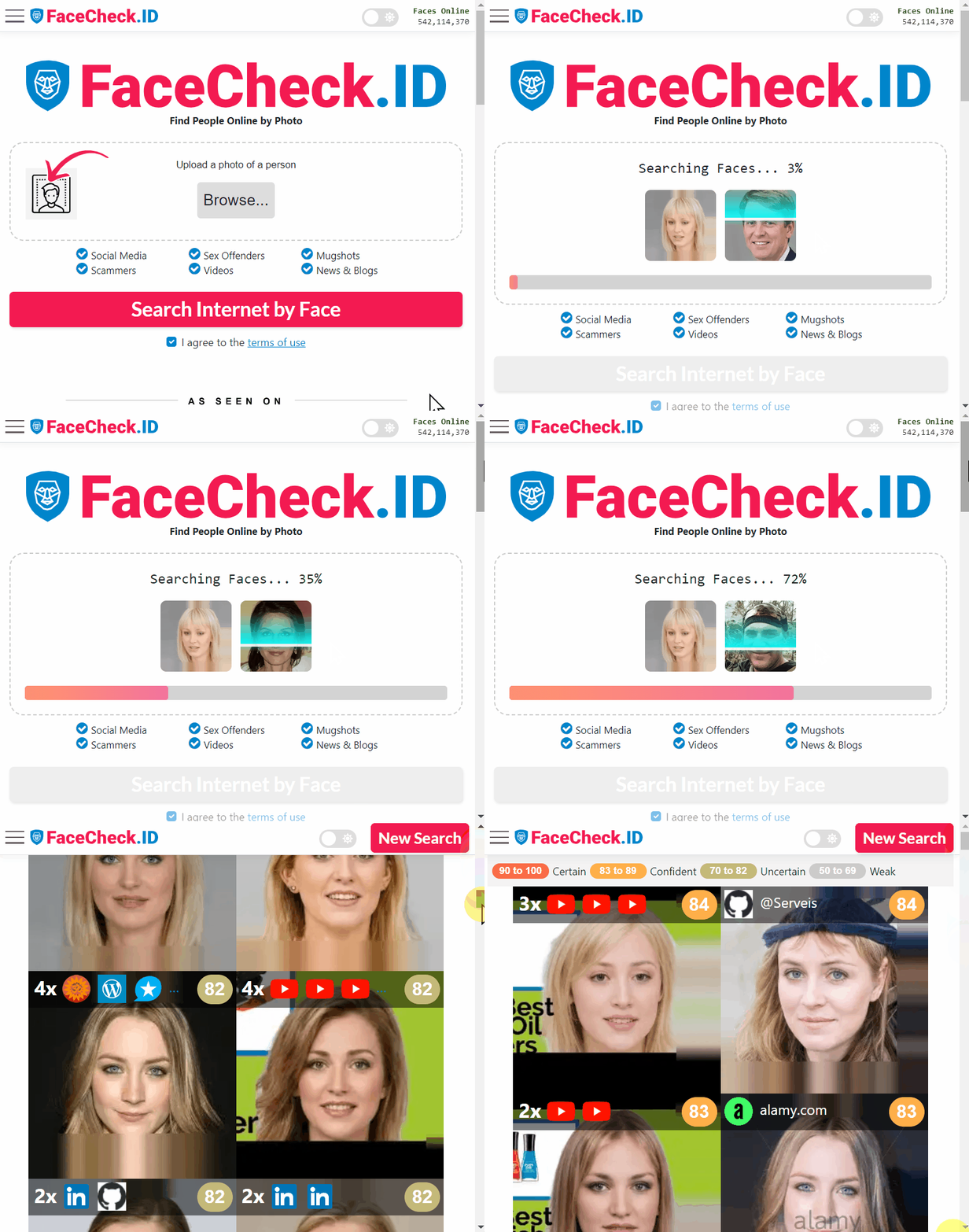
In practice, this means a search for one person can return hits on completely unrelated individuals: a stranger on LinkedIn, a model in an old stock photo, a tagged guest at someone else's wedding. These are true doppelgänger matches — not errors in the strict sense, just confidence scores that fall short of identity. On FaceCheck.ID, lower-confidence results (typically below the 83% threshold) are where most doppelgängers cluster. Above that range, matches are far more likely to be the same person, but doppelgängers occasionally still appear, especially among people of similar age, ethnicity, and grooming style.
Certain photo conditions inflate the doppelgänger rate. Low-resolution images, off-angle shots, heavy makeup, beards that obscure jawline geometry, sunglasses, and harsh lighting all reduce the number of distinguishing features the system can extract. With less unique data to compare, the embedding becomes broader, and more unrelated faces fall inside its similarity radius.
Doppelgängers, identical twins, and family resemblance
Identical twins are the hardest case for any face-recognition system. Their underlying facial geometry is almost the same, so embeddings sit extremely close together. Most engines, including production systems used by border control, struggle to separate them reliably without auxiliary signals like context, clothing, or surrounding metadata. Siblings and parent-child pairs sit one tier below — close enough to produce false positives, especially in childhood photos.
True genetic doppelgängers — unrelated people who look strikingly alike — are rarer than they seem but real. Studies of unrelated look-alikes have found measurable overlap in DNA regions tied to facial morphology, which is why face-search systems can be genuinely fooled rather than merely confused. If you're using FaceCheck.ID to investigate a possible catfish, scammer, or impersonator, this is the failure mode to watch for: a confident match that turns out to be a different person who happens to share a face.
Reading a doppelgänger match correctly
A face-recognition hit is evidence, not proof. Before treating any result as a confirmed identity, it helps to look beyond the face itself:
- Context cues in the surrounding image — tattoos, scars, jewelry, hairlines, ear shape, and dental features are far more individuating than overall facial structure.
- Cross-platform consistency — if the same face appears across multiple unrelated profiles with consistent names, locations, and timelines, that's stronger signal than any single match.
- Image age and provenance — a 90% match against a photo from 2008 may be the same person at a different age, or a doppelgänger from the same demographic cohort.
What a doppelgänger match doesn't prove
A high similarity score on its own does not establish identity, and a doppelgänger match is not evidence that someone is impersonating, related to, or connected with the person being searched. It only means two faces are mathematically close. Confusing the two is how face search gets misused — accusing strangers of being catfishers, misidentifying suspects, or assuming a stock photo subject is the person who posted it.
The honest interpretation is narrower: face search narrows a field of billions to a handful of candidates. Verifying which candidate is actually your subject — versus a doppelgänger sharing their bone structure — is a separate step that requires corroborating information the algorithm can't see.
FAQ
What does “Doppelgänger” mean in the context of face recognition search engines?
In face recognition search, a “Doppelgänger” usually refers to a different person who looks very similar to someone else, causing visually close matches in search results even though the identities are not the same.
Why do face recognition search engines sometimes return a Doppelgänger instead of the same person?
Because the system compares facial features and overall similarity rather than verifying identity. Similar facial structure, age, hairstyle, lighting, camera angle, or image quality can make two different people appear highly similar and be ranked as a close match.
How can I tell whether a match is a true match or a Doppelgänger?
Check multiple photos, not just one. Look for consistent details across images such as scars, moles, ear shape, tooth gaps, tattoos, and facial asymmetry. Also compare contextual clues (locations, friends, usernames, timelines) and treat single-image matches as uncertain.
Can a Doppelgänger result cause false identification, and how can I reduce that risk?
Yes. A look-alike can be mistaken for the same person, especially with low-quality or heavily edited images. To reduce risk, use clear front-facing photos, test with multiple reference images, avoid over-relying on one high-score result, and confirm with independent evidence beyond facial similarity.
How does FaceCheck.ID handle Doppelgänger-like matches in its results?
FaceCheck.ID (like other face search engines) returns visually similar faces and typically ranks results by similarity. Users should treat top matches as candidates rather than confirmed identity, review multiple results and sources, and verify using additional photos and contextual information to rule out Doppelgängers.

Recommended Posts Related to doppelgänger
-
Doppelgänger Effect in Facial Recognition Technology
This uncanny experience is known as the "Doppelgänger Effect.". The word "Doppelgänger" comes from German and literally means "double-goer." It's a phenomenon where a person sees their exact copy or a close likeness of themselves. In fact, many people have reported seeing their doppelgänger, either in a dream or in real life.
-
Yilong Ma: Elon Musk's Doppelgänger or a Deepfake Masterpiece?
The Rise of a Doppelgänger. Yilong Ma, often referred to as Elon Musk's Chinese doppelgänger, has been at the center of a controversy regarding his authenticity. Find Your Doppelgänger.
-
Find Twitter Profiles by Photo using Search by Face Engine
Find your doppelganger on Twitter! A new trend in online search is using facial recognition to find someone's doppelganger.
-
Facial Recognition Resources
https://www.theguardian.com/commentisfree/2018/jan/16/find-your-art-doppelganger-facial-recognition-technology-frightening. Finding your museum doppelganger is fun but the science behind it is scary.
-
How to Find Someone's Instagram Without Knowing Their Username
A face that matches but lives on the wrong continent is probably a doppelgänger. Face recognition returns visual similarity, not identity confirmation, so the highest-scoring result can be a doppelgänger rather than your person.