How to Stay Scam-Proof in 2026: Defending Yourself From GhostGPT and the New Wave of AI Cybercrime
"Amateurs hack systems, professionals hack people." Bruce Schneier
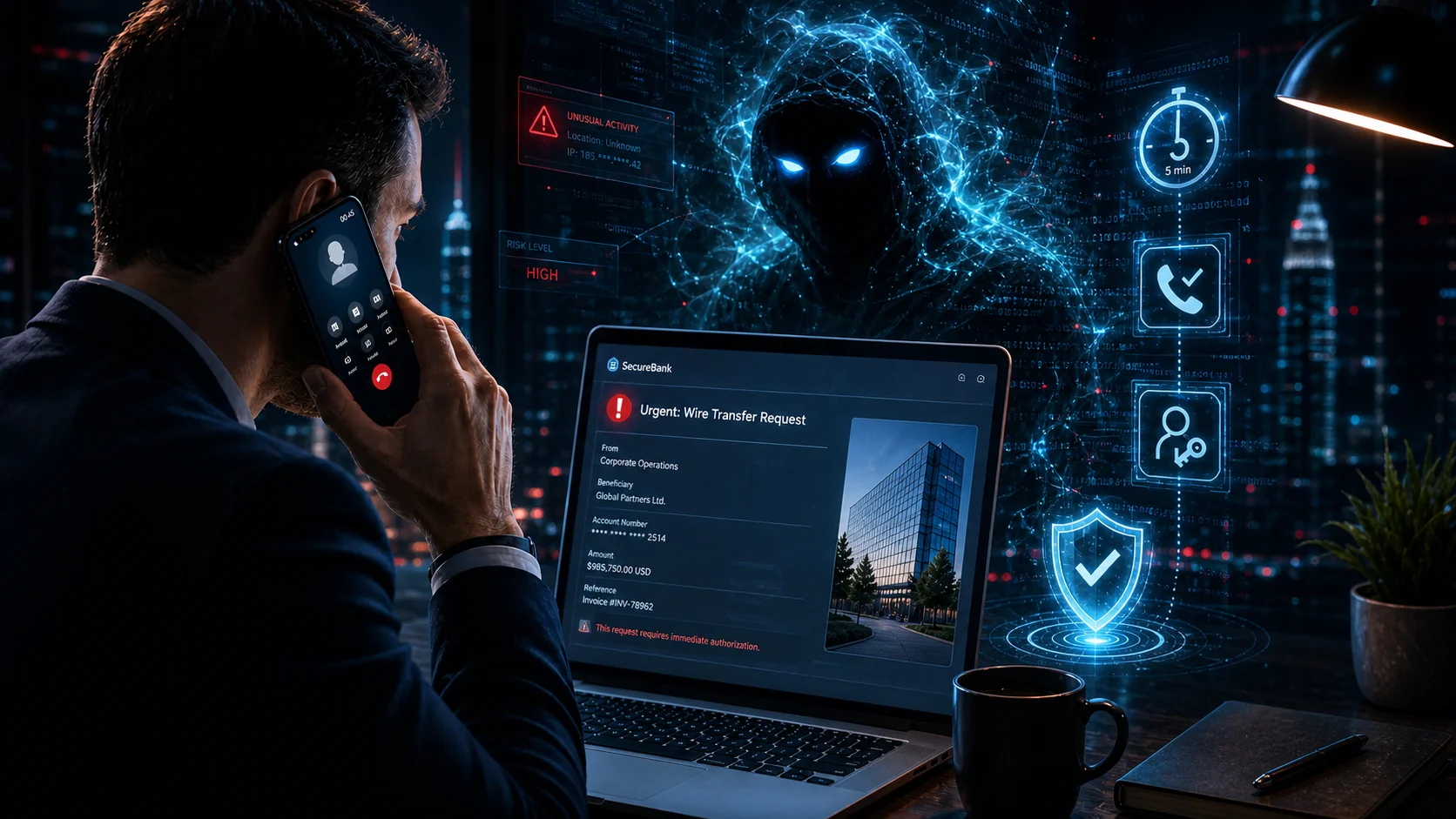
The email looks fine. The grammar is clean, the logo is right, your boss's name is spelled correctly, and the request makes sense given what you discussed at last week's offsite — which the sender somehow knows about. You're forty seconds away from wiring $24,000 to a vendor that doesn't exist.
Welcome to scams in 2026.
The tool sitting on the other end of that email is probably GhostGPT — the cheap, fast, no-logs AI cybercrime chatbot that's been quietly taking over Telegram since late 2024. Last year we wrote about FraudGPT and the romance scams it powers. GhostGPT is its smaller, sharper, harder-to-trace cousin: less drama, more efficiency, and a price tag low enough that the person targeting you may have been a software developer on Tuesday and a scammer by Thursday.
You don't need to understand how it works to defend against it. You need to know what to do in the thirty seconds before you click.
In this article, we're going to discuss
It's Not Just Your Inbox
The wire-transfer scenario at the top is one face of the threat. The other is the long game. Romance scams used to be limited by something basic: a single human can only hold so many fake relationships in their head at once. AI removes that ceiling. One operator can now run dozens of "boyfriends" or "girlfriends" in parallel — each conversation remembered, each reply in the right tone, each message arriving when it should regardless of timezone. Pig butchering — the industry's grim term for the long-romance-into-crypto-investment combo — has exploded for exactly this reason. The relationship phase used to be the bottleneck. It isn't anymore.
The defenses below cover both. With business email compromise, you have thirty seconds before you click. With a romance scam, you have weeks — and those weeks contain a lot of signals if you know what to read.
Why the Old Scam-Spotting Tricks Don't Work Anymore
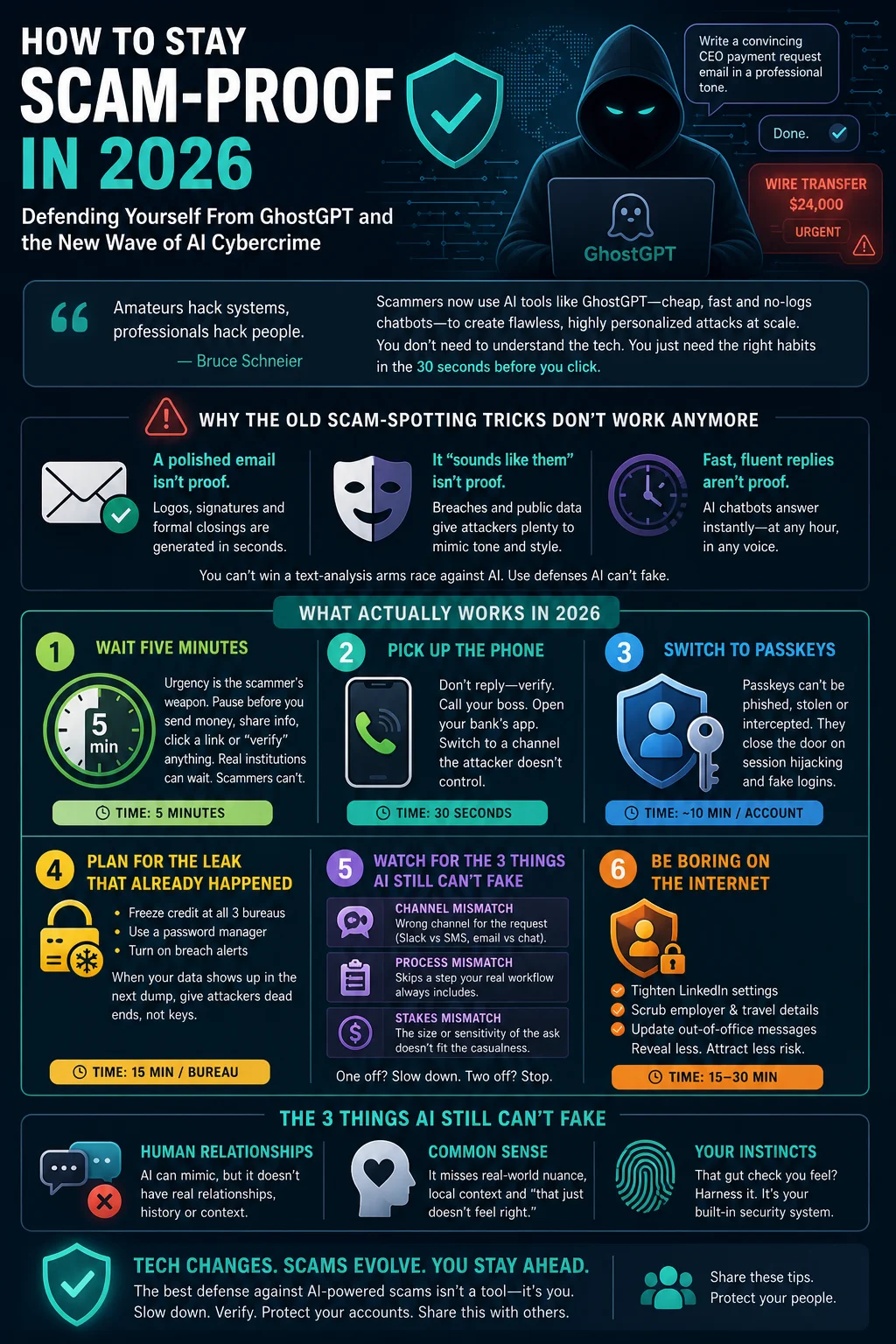
For two decades, the standard advice was look for the typos. Bad grammar, weird capitalization, awkward phrasing — these were the tells. They aren't anymore. GhostGPT writes clean prose in any language, in any tone, on demand, and it costs as little as $50 a week to use. Spotting a scam by spelling is now like checking a counterfeit $20 bill by making sure it's the right color.
A few specific instincts you can stop trusting:
- A polished email isn't proof of a real sender. Logos, signatures, formal closings — all generated in seconds.
- A message that "sounds like them" isn't proof it's them. Past data breaches and your public LinkedIn profile have already given attackers enough material to mimic your colleagues' tone.
- A fast, fluent reply doesn't prove there's a person on the other end. A scammer with a chatbot can answer your follow-up questions instantly, in your manager's voice, at 3 a.m.
You're not going to win a text-analysis arms race against an AI. So don't try. The defenses below all rely on things AI can't fake — and most of them take less than five minutes to set up.
What Actually Works in 2026
1. Wait five minutes.
Almost every successful scam depends on rushing you past your own judgment. So slow down. For any message asking you to send money, share credentials, click a link, or "verify" something, wait five minutes before acting on it. Real institutions can wait. Scammers can't, because the urgency is the weapon — without it, the message has to stand on its own merits, which it usually can't. Five minutes is the cheapest security tool you'll ever own.
2. Pick up the phone.
If your boss emails asking for a wire transfer, don't reply to the email — call them. If your bank texts something alarming, don't tap the link; open the bank's app yourself. The single most effective defense against AI-generated impersonation is shifting the conversation to a channel the attacker doesn't control. One thirty-second phone call neutralizes most business email compromise scams, which currently cost U.S. companies billions a year.
3. Switch to passkeys.
Modern phishing increasingly steals session cookies — the digital ID your browser uses to prove you're already logged in — which lets attackers slip past two-factor authentication entirely. Passkeys close that door. They can't be phished, can't be stolen by a fake login page, and can't be intercepted by a session-hijacking script. Setup takes about ten minutes per account. Start with the three that would ruin your week if they got hijacked: your primary email, your bank, and your work account.
4. Plan for the leak that already happened.
The reason these scams feel personal is that the attackers genuinely know things about you, scraped from breaches you may not even remember being part of. You can't undo a leak, but you can blunt it: freeze your credit at all three bureaus (free, fifteen minutes per bureau, blocks new accounts in your name), use a password manager so one stolen password doesn't unlock everything else, and turn on breach alerts in your email or password manager. When your data shows up in the next dump — and it will — the attacker gets a list of dead ends instead of a working key.
5. Watch for the three things AI still can't fake.
Even when the writing is flawless, real-world scams still leak in three places:
- Channel mismatch — a request that should have come over Slack arrives by SMS, or vice versa.
- Process mismatch — the request skips a step your real workflow always includes (no PO number, no second approver, no usual cc).
- Stakes mismatch — the size or sensitivity of the ask doesn't fit the casualness of the medium.
When one of these is off, slow down. When two are, stop entirely.
6. Be boring on the internet.
Scammers, like water, follow the path of least resistance. The single biggest thing you can do to stay off the target list is reveal less from the outside: tighten LinkedIn privacy settings, scrub the employer-and-travel detail from your social profiles, and rewrite your out-of-office to stop announcing your exact whereabouts. ("I'm at a conference in Vegas until Friday" reads as friendly to colleagues and as a free targeting brief to scammers.) The less the AI generating personalized scams against you has to work with, the more attractive the next person on the list looks.
One Last Thing
GhostGPT and whatever replaces it next year don't beat you with technology — they beat you with timing. The AI is what makes the message look real. The timing — the manufactured urgency, the moment of distraction, the late-night ping — is what makes you act on it before you think.
You don't need to outpace the AI. You just need to be the kind of person who waits five minutes, makes the phone call, and treats urgent as the suspicious word it usually is. That person almost never gets scammed, no matter how clean the email looks.
The criminals are paying $50 a week. Your defense costs nothing.
Frequently Asked Questions
I think I just got an AI-generated scam email — what do I do right now?
Don't reply, don't click anything, and don't forward it to a coworker for a "second opinion" (that's how the link gets clicked). If you already handed over a password, change it on the affected account immediately and on anywhere else you reused it. If you wired money, call your bank within the hour — speed is everything once funds start moving. Then file a report at reportfraud.ftc.gov so it joins the pile that helps catch the operator.
Are passkeys actually safer than the two-factor authentication I already have?
Yes, meaningfully. SMS codes can be hijacked through SIM swaps, authenticator apps can be defeated by session-cookie theft, and any code-based 2FA can be tricked out of you on a convincing fake login page. Passkeys are tied cryptographically to the real domain, so a fake site simply can't accept them. They aren't magic, but they close the doors most attackers are walking through right now.
How do I help my parents (or anyone less tech-savvy) avoid these scams?
Forwarding them an article won't do it. Set up two things instead: a family code word that has to appear in any urgent money request (no code word, no transfer), and a "before you do anything, call me" rule. Most scams die the moment a second person looks at the message — the AI is good at fooling one panicked individual, not a calm phone call between two.
If I get scammed, will my bank give me my money back?
Sometimes, but don't bet on it. Unauthorized debit-card or ACH transactions are usually covered under federal law (Regulation E) if you report quickly. But if you authorized the transfer yourself — which is what happens in business email compromise, romance scams, and most AI-driven fraud — recovery is much harder, and wire transfers are often unrecoverable within hours. The cheap insurance is the five-minute pause, not the chargeback.
Won't my spam filter or antivirus catch this stuff?
Less and less. Modern scam emails are written by the same kind of model your spam filter uses to evaluate them, which makes the signal genuinely harder to find. Newer email security tools that pit AI against AI do better, but the realistic assumption is that nothing important will be filtered out for you. The last line of defense is, and will keep being, you.
Are tools like GhostGPT also being used for romance scams?
Yes, and increasingly so. The same chatbot that writes a perfect business email can write a perfect "thinking of you" message and keep up an emotionally responsive conversation 24/7. That's what makes the modern romance scam different from the version your aunt got warned about a decade ago: the scammer no longer has to be online when you are, no longer has to remember what they said yesterday, and no longer has to share a language with you. The AI handles all three.
What is "pig butchering" and why is it suddenly everywhere?
It's the industry term — yes, really — for a scam that pairs a long romantic build-up with a crypto investment pitch at the end. The scammer spends weeks or months getting close, then mentions an investment platform that's been good to them. The platform looks real, the early "returns" look real, and the moment you try to withdraw a meaningful amount is when everything stops working. AI supercharged this category specifically because the relationship-building phase used to be the bottleneck. One operator can now run dozens of these in parallel.
I've been talking to someone online for months but never met. How do I check if they're real?
Run their photos through FaceCheck.ID — unlike Google Images, it does actual facial recognition and finds different photos of the same face across the web, which is what you need when a scammer is using stolen pictures of a real person. Then test the relationship against four signs: have you ever video-chatted live (not exchanged pre-recorded clips)? has every in-person meeting been "postponed" by a convenient excuse? did "I love you" arrive unusually fast? has money or a "great investment opportunity" come up? Three out of four means it's a scam. Stop sending money first, save your messages, and report it through reportfraud.ftc.gov.
Sources
- GhostGPT: An Uncensored AI Chatbot Helping Cybercriminals — Abnormal AI (original research report)
- For $50, Attackers Can Use GhostGPT to Write Malicious Code — Dark Reading
- What Is GhostGPT? — TechRepublic
- GhostGPT offers AI coding, phishing assistance for cybercriminals — SC Media
- New GhostGPT AI Chatbot Facilitates Malware Creation and Phishing — Infosecurity Magazine
- Hackers are using a new AI chatbot to wage attacks: GhostGPT — IT Pro
- GhostGPT: A Malicious AI Chatbot for Hackers — Security Boulevard
- How GhostGPT Is Empowering Cybercrime in the Age of AI — Cyber Defense Magazine
- GhostGPT: The Uncensored AI Empowering Cybercriminals — Global Anti-Scam Alliance
- GhostGPT: AI Tool for Cybercrime — OECD AI Incidents Registry

Read More on Facial Recognition Search
Tackling Image Theft for Influencers, Actors, and Models: Protecting Your Online Image
Your photos could be fueling romance scams, fake escort ads, or AI-generated deepfakes right now - and you'd never know. For models, actors, and influencers, stolen images don't just violate your rights. They can destroy your reputation overnight. Learn how to spot unauthorized use and take quick action before the damage spreads.
Popular Topics
Facial Recognition Google Images LinkedIn Scammers Romance Scam Impersonation Phishing Pig ButcheringTop Reverse Image Search Tools: PimEyes vs FaceCheck Detailed Analysis