Find Your Twin: How to Spot Your Look-Alike Online
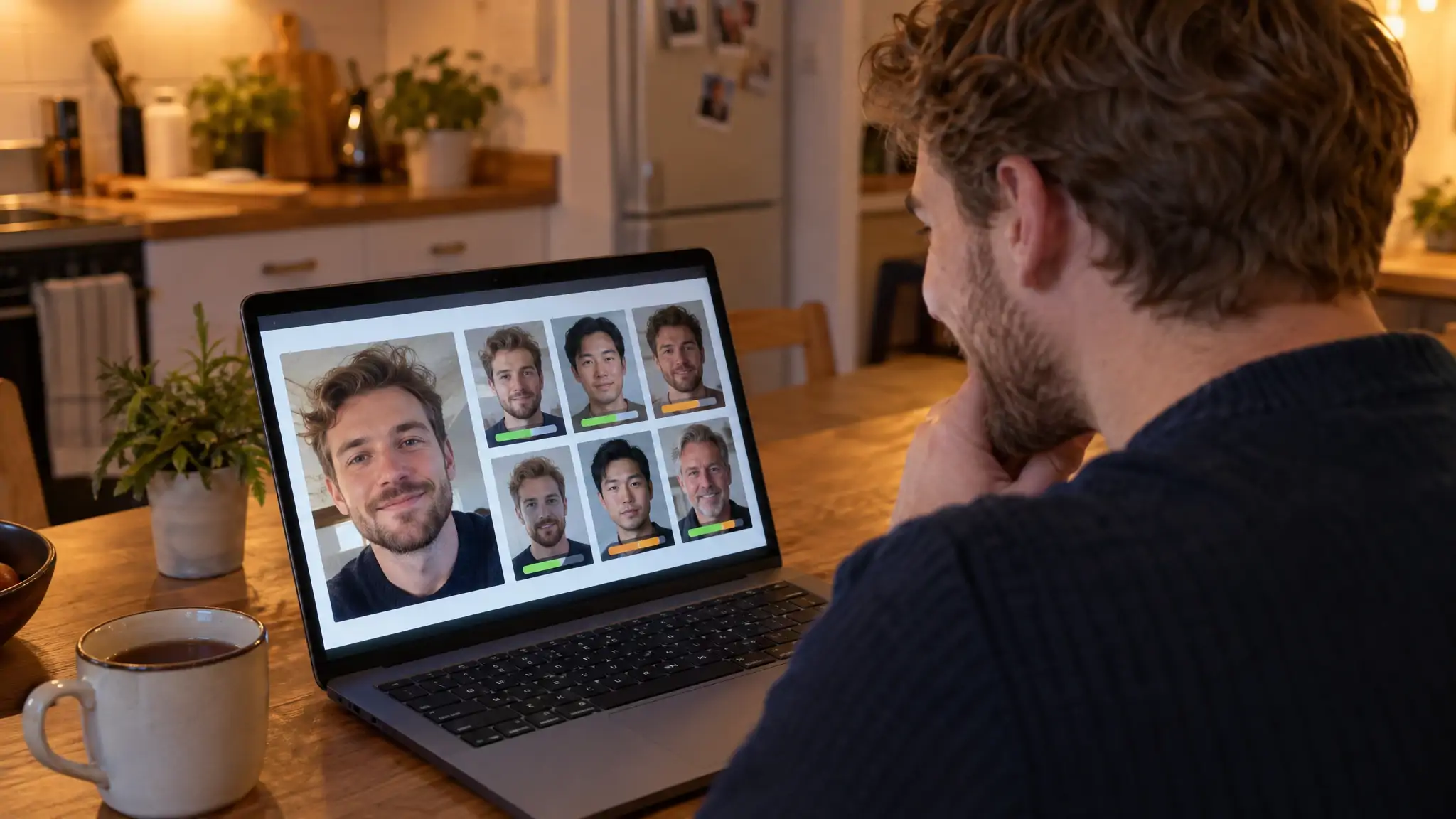
To find your twin, upload a clear, front-facing selfie to a doppelganger site such as Twin Strangers or to a face search engine such as FaceCheck.ID. Doppelganger sites match you only against members who signed up to be matched. A face search engine compares your face with faces on public web pages and scores each one, so your look-alike doesn't have to have joined anything.
- Take a straight-on selfie in even light, with no sunglasses and no hair across your eyes.
- Run it on an opt-in doppelganger site, a face search engine, or both.
- Skip the matches that are actually you, then compare the best remaining faces side by side.
This page is about faces. If you were hoping to find your twin flame, a face search engine can't help, and neither can we.
In this article, we're going to discuss
Two ways to find your twin online
Most "find my twin" websites blur two very different tools together. Which one you pick decides who you can possibly be matched with.
Opt-in doppelganger databases. Twin Strangers is the best known. You create a free account, add a few basic details and your photos, and facial recognition ranks the members who look most like you, according to a 2018 hands-on report published by Click2Houston. You can "star" a match, which sends them an email, and the two of you take it from there. The Twin Strangers homepage showed a running total of about 12.9 million when we checked in October 2026. Everyone in that pool wants to be found, which is the charm. The catch is just as plain: your twin has to have signed up too.
Public-web face search. FaceCheck.ID indexes faces that appear on public web pages: social media profiles, news articles, blogs, event galleries. Your look-alike never had to register, so the pool is far wider than any membership site. The photo you upload is not added to the index, so searching doesn't turn you into someone else's result. What it can't see is anything behind a login: private Instagram or Facebook accounts and closed apps such as Snapchat or WhatsApp.
Two other tools turn up in the same searches and answer different questions:
| Tool type | Example | Who you're compared with | Good for | Blind spot |
|---|---|---|---|---|
| Opt-in doppelganger site | Twin Strangers | Members who uploaded selfies | Meeting a twin who also wants to meet you | Your twin has to have joined |
| Public-web face search | FaceCheck.ID | Faces on public web pages | Finding look-alikes who never signed up for anything | Private accounts and closed apps |
| Celebrity look-alike app | Many free web apps | A fixed set of famous faces | A party game | Names a star even when the match is poor |
| Family photo comparison | FamilySearch Compare-a-Face | Relatives in your FamilySearch tree | Seeing which ancestor you take after | Strangers aren't in it |
If you want a twin you can actually chat with, start with an opt-in site. If you want to know whether your face exists out there on someone else, use face search.
Take a selfie that gets fair matches
Every twin finder does better with a better photo, and most bad results are the photo's fault. Twin Strangers' own upload tips say to look straight at the camera, keep hair off your face and eyes, center your head, and not tilt it up, down or sideways. The same rules hold for FaceCheck.ID.
- Face a window instead of standing under a ceiling light, which throws shadows into your eye sockets.
- Hold the phone at eye level. A selfie taken from below the chin mostly shows the model your nostrils.
- Take off sunglasses and skip the beauty filter. Smoothing and reshaping filters change the very geometry the search compares.
- Crop the photo to your face alone. A group shot gives the search a choice you didn't mean to offer.
- Use a recent photo. A picture from ten years and two haircuts ago finds the twin of who you used to be.
Angle matters more than people expect. A head turned to one side changes the scores, which is one reason the same person can get different twins from the same site with two different selfies.
How to find your doppelganger with FaceCheck.ID
Search with a photo of yourself. Running a friend's face to find their twin is something to ask them about first. The model is trained on adult faces only, and searching for anyone under 18 is prohibited and grounds for a ban.
- Go to facecheck.id, upload your selfie and accept the terms of use.
- Wait for the results grid. A free search shows every matching face thumbnail with its score. Credits unlock the links to the web pages where each face was found.
- Set aside the hits that are you. Your own headshots and tagged photos usually sit at the top with scores of 90 or more.
- Look at the matches between roughly 75 and 88 that are clearly someone else. That is where stranger twins tend to land.
- Put your selfie next to each candidate and compare the parts that lighting and styling can't fake: eye spacing, the bridge of the nose, the jawline, the hairline. Hair color and glasses are costumes and don't count.
A worked example
Here is a hypothetical search to show how the reading goes. Mei, 29, uploads a window-lit selfie. The grid opens with a 95 and a 92: her company bio photo and a race photo from a 10K she ran last spring. Below them are an 87 on a stranger's alumni-event photo, an 84 on a travel blogger's author picture, a 78 on a wedding gallery, and a long tail of scores in the 60s.
The 87 and the 84 are her twin candidates. Side by side, the 87 shares her eye shape and jaw but has a narrower nose. The 84 is uncanny from the eyebrows down, the kind of match that makes you text a screenshot to your sister. Neither woman is Mei, and neither has any idea this is happening, which is exactly how it should stay.
The free grid is enough for this. Thumbnails and scores tell you whether a twin exists; you don't need to know where she lives to enjoy the resemblance.

What the scores mean when you're looking for a look-alike
FaceCheck.ID scores every match from 0 to 100. The labels were written for confirming a person's identity, so in a twin hunt you read them a little differently:
| Score | FaceCheck.ID label | What it usually means when you search yourself |
|---|---|---|
| 90-100 | Certain match | Almost always you: your own photo, or a photo of you that someone else posted |
| 83-89 | Confident match | Strong resemblance; if it isn't you, this is where an uncanny stranger twin shows up |
| 70-82 | Uncertain match | A plausible look-alike, the "you two could be cousins" range |
| 50-69 | Weak match | A few shared features, a loose resemblance at best |
A stranger can occasionally reach the 90s. Unrelated people sometimes look alike to software as well as to humans, a problem known as the doppelganger effect in facial recognition. A 2022 study in Cell Reports recruited 32 look-alike pairs from photographer François Brunelle's project; facial recognition software scored 16 of those pairs about as similar as identical twins, and those 16 pairs shared significantly more of their genes than the others, as reported on Weill Cornell's Englander Institute news page.
So every score measures how similar two faces look, not who someone is. A 91 on a stranger's photo means the faces are very close. It does not mean that person is you, is related to you, or is responsible for anything a friend thinks they saw "you" do.
Found your twin? What to do next
Look, but don't message. A person who turned up in a face search never agreed to be anyone's twin, and an out-of-the-blue "I found your face online" message lands about as well as you would expect. If you want to meet a look-alike, an opt-in site like Twin Strangers is where both sides have said yes.
Never use a resemblance to accuse anyone. If a coworker swears they saw you at a bar in another city, a look-alike is a reasonable explanation; the reverse also holds, and a face match is not evidence that a stranger did something.
Keep the stranger's details out of whatever you share. A side-by-side of the two faces is the fun part; a link to their profile, their name and their workplace turns a party trick into an exposure they never asked for.
If the search turned up photos of you on pages you didn't expect, removing your face from the FaceCheck.ID index is free through the self-service takedown form.
FAQ
How can I find my doppelganger for free?
Twin Strangers lets you create an account and start searching for free. A FaceCheck.ID search is free too and shows every matching face thumbnail with its score, which is all you need to see whether a strong look-alike exists; credits only unlock the links to the source pages. Free celebrity look-alike apps compare you only with famous faces, so they answer a narrower question.
Is there an app to find your twin?
Celebrity look-alike apps fill the app stores, but for a stranger twin you don't need to install anything. Twin Strangers and FaceCheck.ID both work in a phone browser: open the site, take or pick a selfie, and upload it from there.
Why do I get a different celebrity twin on every site?
Each site compares you against its own set of famous faces with its own model, and most of them name a winner even when the best match is mediocre. Change the set, the model or your photo's angle and the winner changes. None of them publish accuracy figures you can check, so treat the result as entertainment.
Does everyone have a look-alike?
Probably someone looks a lot like you, but an exact double is vanishingly rare. A 2015 University of Adelaide study of about 4,000 faces put the odds of someone matching you on all eight facial measurements it used at one in a trillion, as ScienceAlert reported. And a close look-alike only turns up in a search if their photos are on public web pages or in the database you're searching.
Can I find a celebrity that looks like me?
A celebrity look-alike app is built for exactly that. FaceCheck.ID can also return a celebrity, since famous faces appear on many public pages, but only when the resemblance is genuinely strong. Famous look-alikes can get strange: the internet argued over whether Yilong Ma was Elon Musk's doppelganger or a deepfake. Scammers also use celebrity look-alike photos in fake romance profiles, so if "a celebrity" messages you, read up on celebrity romance scams before you answer.
Is it safe to upload my selfie to find my twin?
It depends on the site, so read its privacy policy first. On an opt-in doppelganger site, your photo becomes part of the member pool, because that is how others find you. On FaceCheck.ID, searches are anonymous: no IP logging, no third-party trackers, search history deleted within 24 hours, and the photo you upload is not added to the index. It stores no biometric templates, only low-resolution face thumbnails and the URLs of public pages.
Where to start tonight
Take one new selfie by a window, at eye level, with nothing on your face. Run it through FaceCheck.ID and write down the two or three best scores between 75 and 88 that aren't you. If one of them stops you in your tracks and you'd like to actually say hello to a twin someday, make a Twin Strangers profile with the same photo and let the matching work from both sides.
FaceCheck.ID publishes this guide. Details about Twin Strangers and FamilySearch come from their own websites and the press coverage linked in the text; the search example above is illustrative, not a real person's results.

Read More on Search by Face
How to Reverse Image Search on Yandex (and How It Differs from Google)
A practical walkthrough of Yandex reverse image search: the four ways to upload, which result block actually holds face matches, why cropping changes everything, and what happens to the photo you upload. Plus a short Google comparison and what to use when the photo is of a person.
On the subject in other languages
 Encontre seu sósia: como identificar alguém parecido com você online
 寻找你的“双胞胎”:如何在网上找到与你长得相像的人
 Najděte své dvojče: Jak na internetu objevit svého dvojníka
 Finde deinen Zwilling: So entdeckst du deinen Doppelgänger online
 Encuentra a tu gemelo: cómo localizar a alguien idéntico a ti en internet
 Trouvez votre sosie : comment le repérer en ligne
 Trova il tuo gemello: come individuare online chi ti somiglia
 あなたのそっくりさんを見つける:オンラインで自分に似た人を探す方法
 나와 닮은 쌍둥이 찾기: 온라인에서 닮은꼴을 찾는 방법
 Znajdź swojego sobowtóra: jak odkryć osobę podobną do siebie w internecie
 Найдите своего двойника: как обнаружить похожего на вас человека в интернете
 اعثر على توأمك: كيف تكتشف شبيهك عبر الإنترنت
 İkizinizi Bulun: İnternette Benzerinizi Nasıl Bulursunuz?
Popular Topics
Deepfake Doppelgänger Doppelgänger Effect Face Search Engine Facial Recognition Software Identity Social Media Facial Recognition How To Facebook Instagram Social Media Profiles LinkedIn Scammers Romance Scam Biometric Face Lookup Screenshot Face Search Face MatchFaceCheck and PimEyes: Expert Review and Test Scores