Face Recognition Search Engine
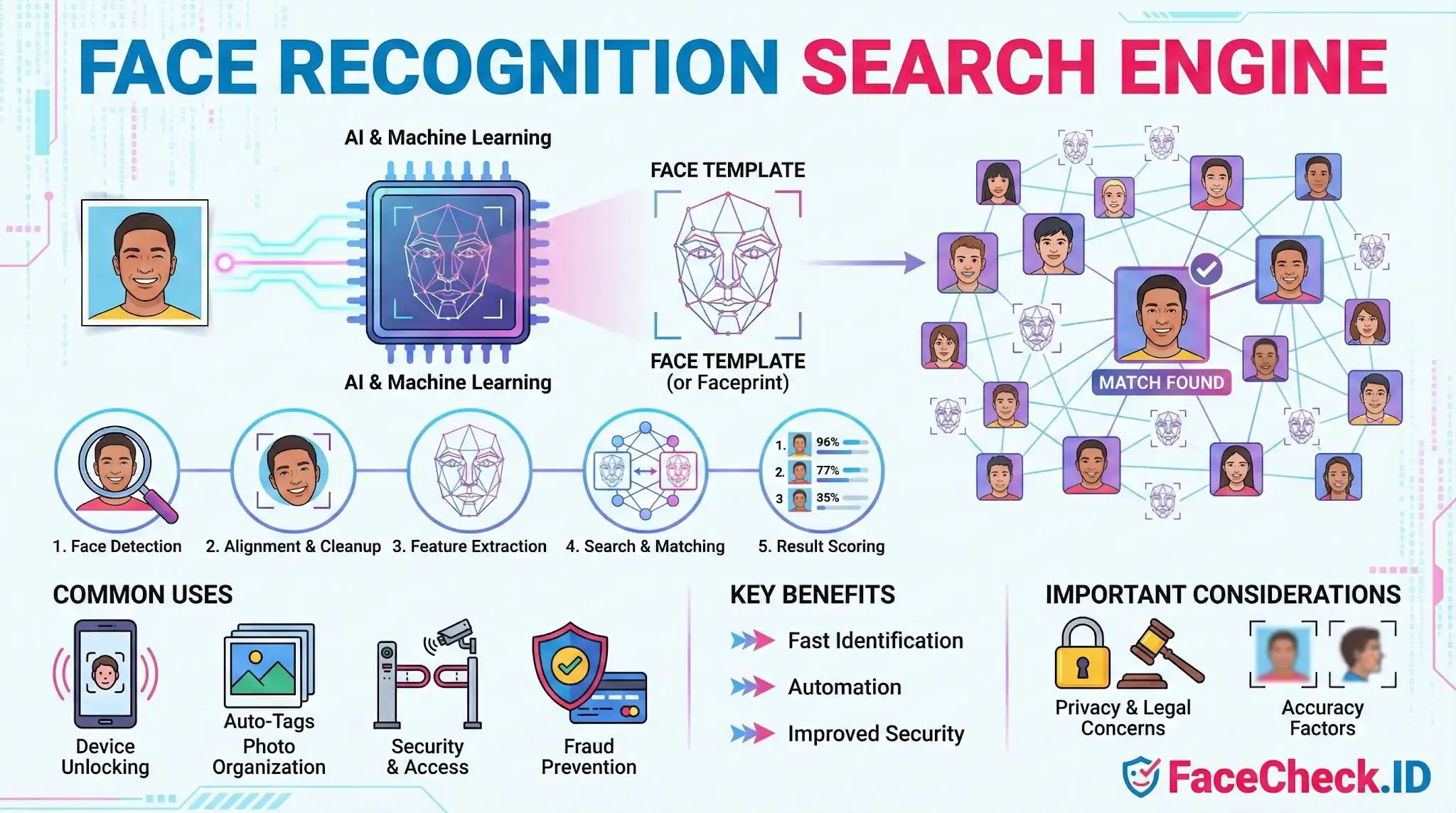
A face recognition search engine is what you reach for when you have a photo of someone and need to know where else that face appears online. Instead of typing a name and hoping the right person surfaces, you upload an image and the system scans the indexed web — social profiles, news articles, blogs, forum avatars, mugshot sites, dating apps that leak to the open web — for visual matches of the same individual.
How it differs from a normal reverse image search
Tools like Google Images or TinEye look for the same image file or visually similar images. They will find your photo if it has been republished, cropped, or lightly edited, but they fail when the target appears in a completely different photo: different outfit, different lighting, different year. A face recognition search engine ignores the surrounding pixels and focuses on the face itself, converting it into a numerical embedding (often called a faceprint or face template) that captures the geometry of the eyes, nose, mouth, and jaw.
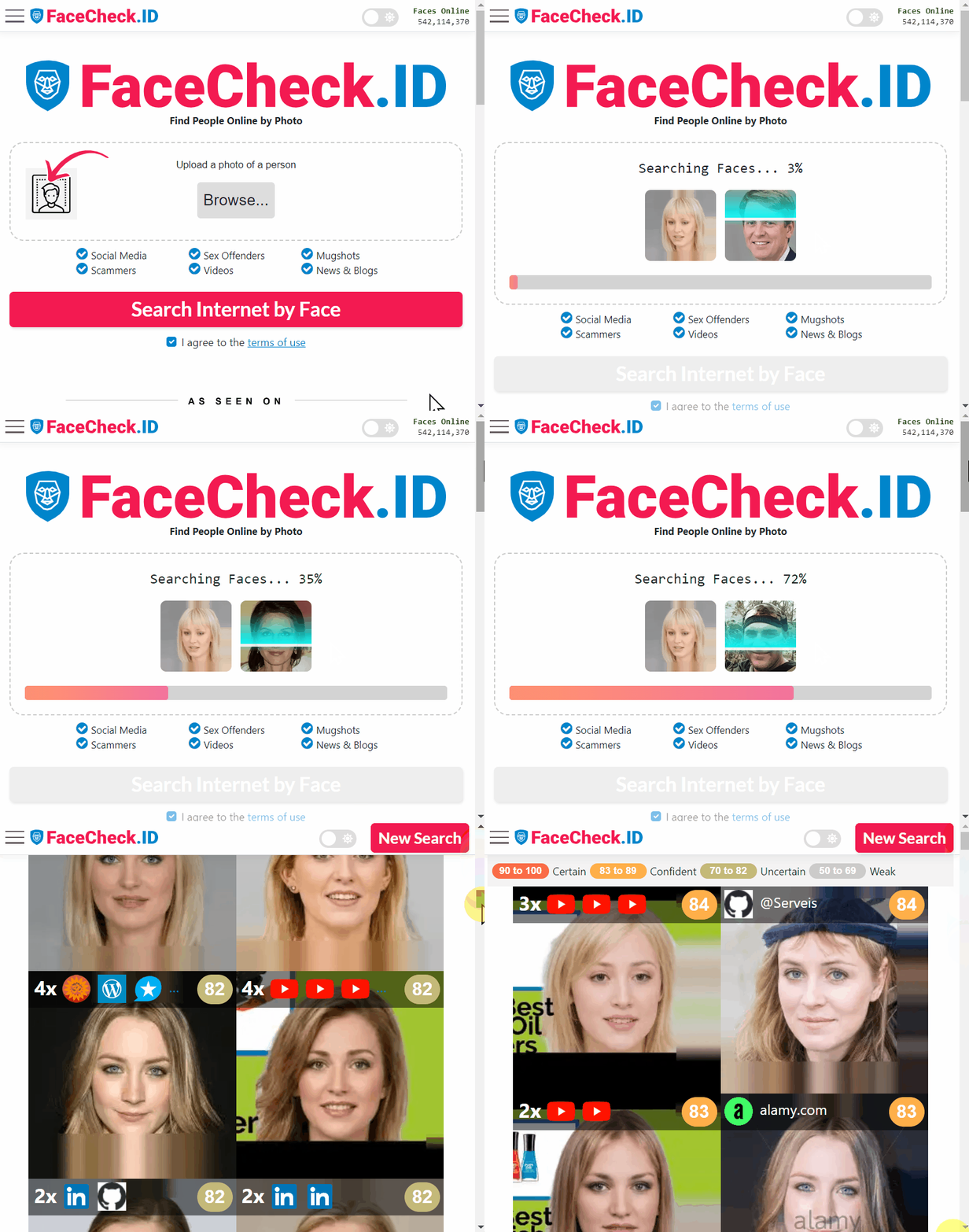
That embedding is then compared against millions of other embeddings extracted from public web images. The result is a ranked list of pages where the same person plausibly appears, each with a confidence score. A clean LinkedIn-style headshot might match a vacation selfie taken five years earlier on Instagram, even though no traditional image search would connect the two.
What it actually indexes
The quality of any face search engine comes down to its crawl. The system has to continuously scrape and process publicly accessible images from across the web, detect every face in every image, and store the embeddings in a way that supports fast nearest-neighbor lookup at scale. Typical sources include:
- Public social media profiles and posts
- News, magazine, and blog photography
- Forum and community avatars
- Public mugshot and arrest record databases
- Sports, conference, and event photo galleries
- YouTube thumbnails and video frames
- Dating profiles that have been scraped or leaked
Private accounts, end-to-end encrypted messages, and platforms that block crawlers are not part of the index. If a face only ever appeared in a closed Facebook group or a private Instagram, no face search engine on the open web will find it.
Where people actually use it
The everyday use cases are narrower than the marketing suggests. Most real-world queries fall into a handful of patterns: verifying someone met on a dating app or marketplace, investigating a suspected catfish or romance scammer, locating an old contact whose name you have forgotten, checking whether your own photos have been reused on profiles you did not create, and journalistic or due-diligence research where a face is the only available lead.
Match confidence varies wildly with the input. A frontal, well-lit, unobstructed photo at reasonable resolution returns the strongest results. Heavy filters, sunglasses, extreme angles, low light, motion blur, group photos with small faces, and aggressive compression all degrade accuracy. Children's faces are particularly unreliable because facial geometry shifts substantially as they grow.
What a face recognition search engine does not prove
A high-confidence match is evidence, not identification. Two people who look genuinely alike — siblings, distant relatives, or random doppelgängers — can produce strong scores, especially at lower image quality. A match also says nothing about whether the linked profile is current, whether the person controls that account, or whether the photo was uploaded with their consent. Scammers regularly steal photos from real people; finding the source profile tells you the photos are stolen, not that the source profile is the scammer.
The tool surfaces public images that already exist on the indexed web. It does not unmask anonymous users, bypass platform privacy settings, or return verified legal identities. Treat results as leads to investigate, cross-reference against other signals — usernames, post history, mutual connections, metadata — and keep in mind that any single match, no matter how confident, can be wrong.
FAQ
What is a face recognition search engine, and how is it different from a regular image search?
A face recognition search engine lets you upload a face photo and searches for visually similar faces across indexed images, using facial features rather than keywords, filenames, or surrounding text. Regular image search primarily relies on text signals (captions, metadata, page content) and general visual similarity, not a dedicated face-embedding match.
What kind of photo works best for a face recognition search?
Use a clear, front-facing image with good lighting, minimal blur, and the full face visible (especially eyes, nose, and mouth). Avoid heavy filters, strong angles, extreme facial expressions, low resolution, and images where the face is partially covered by sunglasses, masks, hands, or hair.
Where do face recognition search engines get the images they search?
They typically search images from sources they have indexed, such as publicly accessible web pages, social networks that allow crawling, news sites, forums, and other online repositories. The exact coverage depends on each service’s crawling/indexing methods, partnerships, and policies, so results vary between platforms (including services like FaceCheck.ID).
Do face recognition search engines store my uploaded photo or biometric data?
It depends on the provider. Some services may temporarily process your image to create a face template (embedding) for matching, and may retain the upload, derived template, or search logs for security, debugging, abuse prevention, or product improvement. Always check the service’s privacy policy and retention settings; if available, prefer options that minimize storage and allow deletion.
How can I request removal or opt out if my face appears in search results?
First identify the specific result URLs where the image appears. Then use the search engine’s removal/opt-out process (if provided) and also contact the original website hosting the image to request deletion or restriction, because search results often reappear if the source remains online. Some face search services, including FaceCheck.ID, may offer a takedown or opt-out mechanism you can follow for their index.

Recommended Posts Related to face-recognition-search-engine
-
How to Run Background Check Using Face Recognition Search Engine
Face recognition search engine to run a background check. A face recognition search engine FaceCheck is an great alternative or a value addition to a regular background check. Background Check Using Face Recognition Search Engine.
-
How can I find a person with just a picture?
So I went looking, and eventually I ended up at a face recognition search engine called FaceCheck.ID. A face recognition search engine sounded, at first, like the kind of thing that either doesn't work at all or works a little too well.
-
How to Search Instagram by Image
I've been there too, and that's why I turned to FaceCheck.ID, a facial recognition search engine that's reshaping how we search for people on Instagram.
-
New Search-by-Face Tool for Investigative Journalists
Somewhere in that pile of digital tools sits FaceCheck.ID — a facial recognition search engine that's quietly become one of the more useful things to happen to reporters in years.
-
How to Spot a Catfish Online in Under 60 Seconds with FaceCheck.ID
But there's a fast, effective defense against romance fraud: FaceCheck.ID, a specialized facial recognition search engine built specifically to combat catfishing and identity deception.