Face Matcher With Celebrities: Which Star Do You Really Look Like?
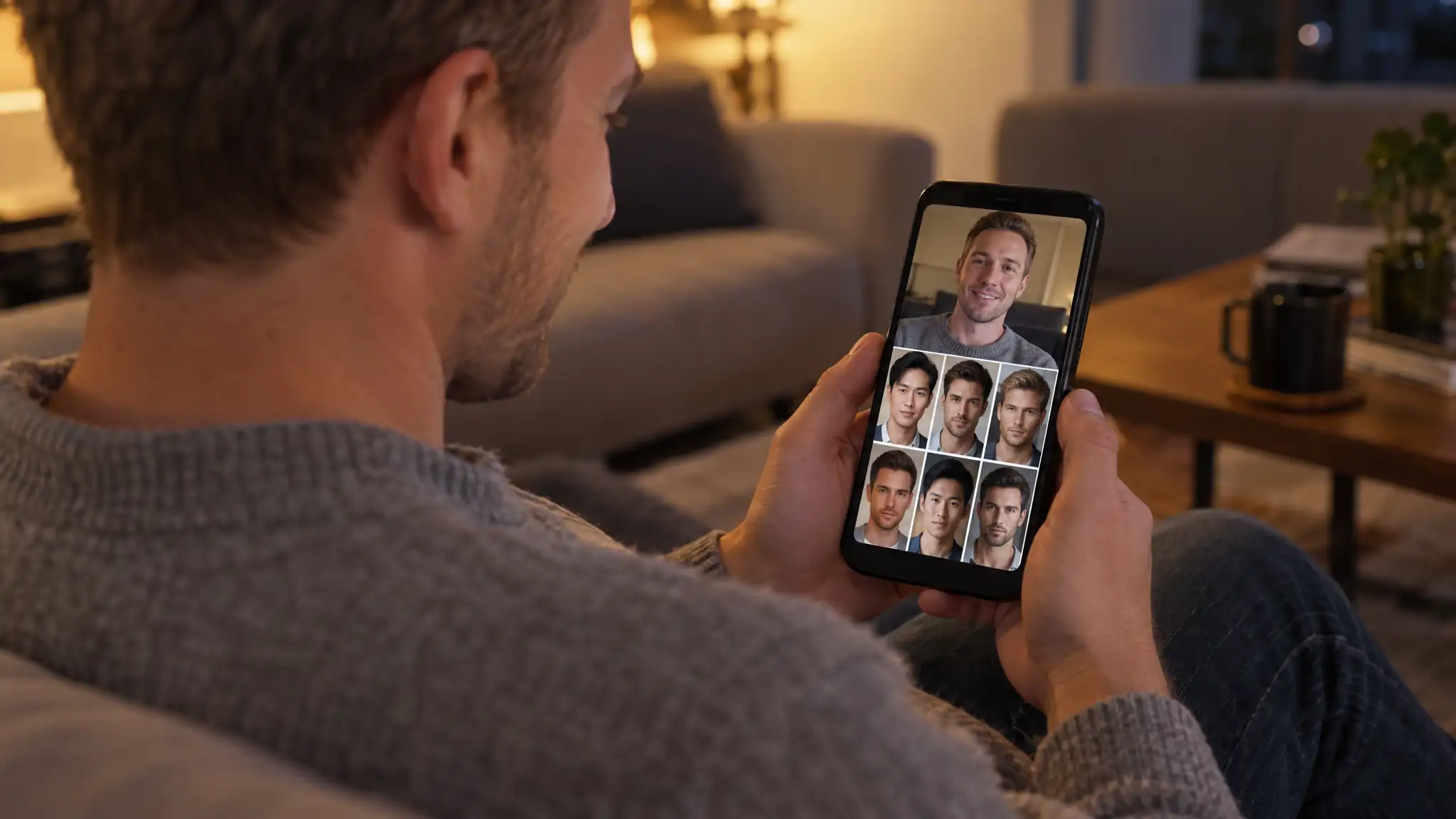
A face matcher with celebrities takes one clear, front-facing selfie and returns the famous faces closest to yours. Apps like StarByFace compare you only with their own list of stars, so they always crown a winner. FaceCheck.ID compares you with faces on public web pages and scores each match from 0 to 100, so a celebrity appears only when the resemblance holds up.
- Take an unfiltered selfie facing a window, phone at eye level.
- Upload it to a celebrity app for a quick top three, or to FaceCheck.ID for scored matches from the open web.
- Read 83 and up as a strong resemblance, 70 to 82 as "you could be cousins", and any unscored celebrity verdict as a party game.
In this article, we're going to discuss
How a face matcher with celebrities picks your star
Every celebrity look-alike app works the same way underneath. It turns your face into a set of measurements, compares them with a stored set of famous faces, and sorts the list. StarByFace sums up its own process in one line: the neural network "compares the person with celebrity faces and suggests the most similar ones" (StarByFace).
The size of that stored set decides what you can get back. The iPhone app Celebrity Look aLike Celebs AI says it compares your picture with "more than 1000+" famous people (App Store listing). A thousand faces is a big party and a small planet. If your real look-alike is a local weather presenter, she isn't on the list, and the app hands you the nearest A-lister instead.
Because the roster is closed, the app always names a winner. Sorting a thousand faces produces a first place even when first place is a poor fit, the same way a talent show with three contestants still crowns a champion. It is also why you get a different celebrity on every site: each one uses a different roster and a different model, and reads your photo's angle and lighting its own way.
A public-web face search works from the other end. FaceCheck.ID indexes faces that appear on public pages such as news sites, blogs, social profiles and event galleries. Famous people are photographed constantly, so their faces are well represented, but they compete on equal terms with everyone else. A celebrity lands in your results only when their face scores close to yours, and plenty of searches return no famous face at all. That is an answer too. If a stranger twin interests you more than a famous one, the guide to finding your twin online covers opt-in doppelganger sites.
| Tool | Who you're compared with | What you get back | What the listing says about your data |
|---|---|---|---|
| StarByFace (web, Android) | Its own celebrity set; size not stated | The most similar celebrities | Uploaded photos deleted after recognition; the site collects IP address and browser type and works with Google Analytics and advertisers |
| Celebrity Look aLike Celebs AI (iPhone) | "More than 1000+" celebrities | Your best celebrity match; unlimited use is an in-app purchase | Privacy label lists identifiers that may be used to track you across other companies' apps and websites |
| AI Face Matcher - CelebMe (iPhone) | Celebrities bundled in the app | Look-alike matches, paid with coins or rewarded ads | "No data leaves your phone; all processing happens on-device" |
| FaceCheck.ID (any browser) | Faces on public web pages | Every matching face with a 0-100 score | Upload not added to the index, history deleted within 24 hours, no IP logging |
App Store privacy labels are written by the developer and Apple does not verify them, which both listings (Celebs AI, CelebMe) say on the page. They are still worth the ten seconds it takes to read one.
Take a selfie the matcher can read
Most baffling celebrity results are the photo's fault. A matcher compares geometry, and a bad selfie hands it the wrong geometry.
- Stand facing a window. An overhead ceiling light carves shadows under your brows and eyes, and the model reads them as bone structure.
- Hold the phone at eye level. A low angle widens the jaw and shortens the forehead, which narrows your celebrity options to people photographed from below.
- Turn off beauty filters. Smoothing, eye-enlarging and face-slimming filters change the exact distances being compared, so you get matched with the filter's idea of you.
- Keep one face in the frame. Crop out the friend leaning into the shot, or the matcher may judge the wrong person.
- Use a neutral expression with your mouth closed. A big grin reshapes the cheeks and narrows the eyes.
- Pick a recent photo with no sunglasses or hat brim over your eyes.
Then do it again. Take two or three selfies on different days, by different windows, and run each one. The celebrity who keeps coming back is your real answer. The one who appears once was the lighting's opinion.
Run a celebrity face match on FaceCheck.ID
Search with a photo of yourself. The model is trained on adult faces only, and searching for anyone under 18 is prohibited and grounds for a ban. That includes a teenager in the house who wants to know which pop star they resemble; this tool is not for them.
- Open facecheck.id in any browser, phone included. Upload your selfie and accept the terms of use.
- Wait for the results grid. A free search shows every matching face thumbnail with its score.
- Set aside the hits that are you. Your own headshots and tagged photos usually sit at the top, scoring 90 or more.
- Scan the rest for famous faces. If you recognize the face, the thumbnail and score are all you need. Credits unlock the links to the source pages, which is how you find out whose polished press photo that is when you don't recognize it.
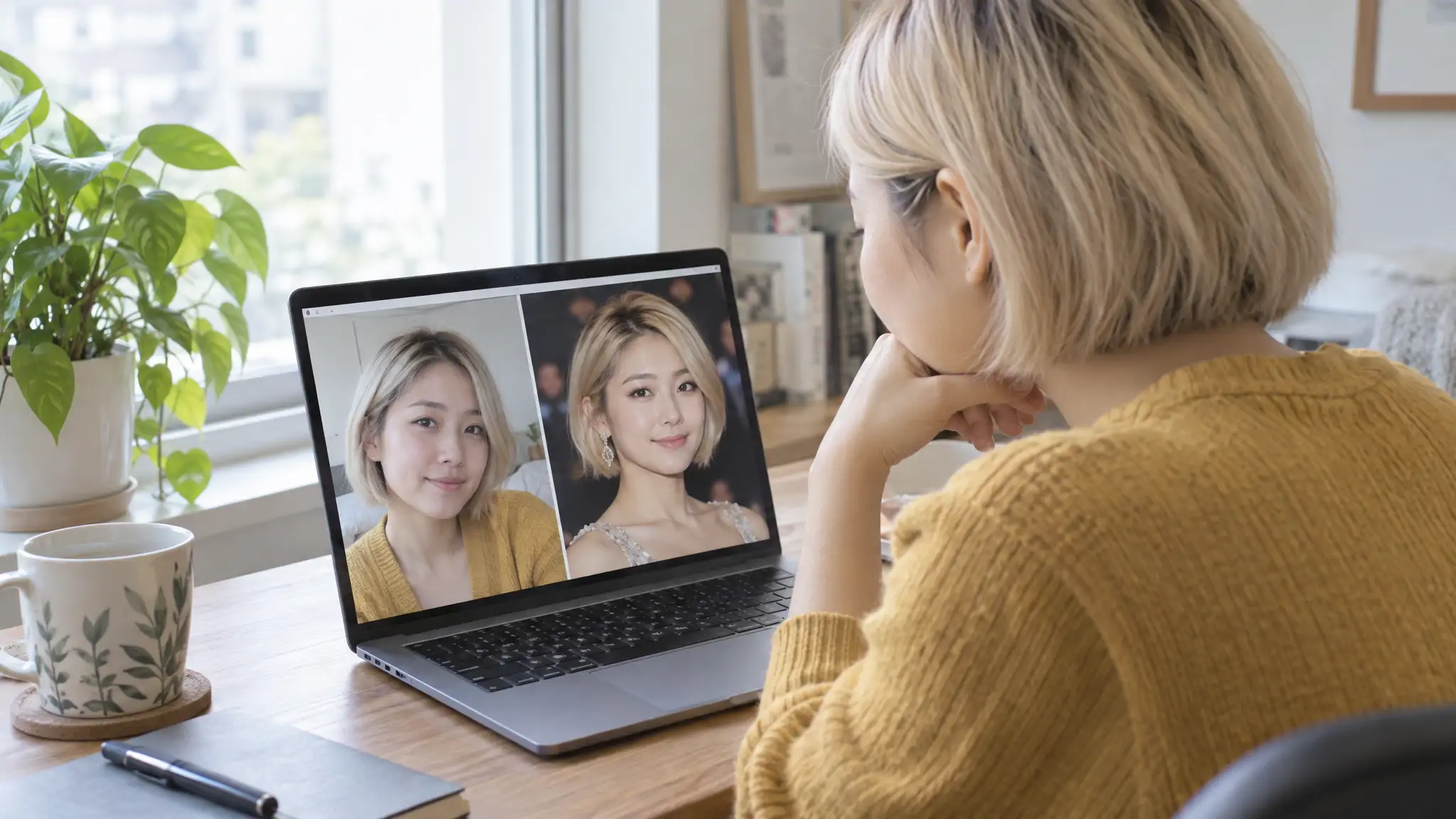
- Put your selfie next to each celebrity hit and compare what styling can't change: eye spacing, the bridge of the nose, the jawline, the hairline. A red-carpet stylist and professional lighting are not part of the resemblance.
Have a screenshot of an actor and want the name? That runs the other direction, and the guide to identifying an actor by face walks through it.
Reading the scores when a famous face turns up
FaceCheck.ID's score labels were written for confirming identity. When you are hunting for a celebrity look-alike, read them like this:
| Score | FaceCheck.ID label | What it means for a celebrity match |
|---|---|---|
| 90-100 | Certain match | Almost always your own photo. A famous face scoring here is rare enough to screenshot |
| 83-89 | Confident match | Uncanny celebrity twin territory: strangers would do a double take |
| 70-82 | Uncertain match | A real resemblance, the "you could be cousins" range |
| 50-69 | Weak match | A shared feature or two; not a look-alike |
A famous face at 70 to 82 is a resemblance, not a verdict. And no score, however high, says two people are the same person or related. Unrelated faces sometimes score very close, which is known as the doppelganger effect in facial recognition.
A worked example
This search is illustrative, not a real person's results. Daniel, 34, uploads a selfie taken by his kitchen window. The grid shows a 94 on his own LinkedIn headshot, an 86 on a regional TV news presenter's press photo (he unlocked that one source link to see whose face it was), and a 79 on a famous actor's red-carpet photo.
Daniel is the 94. The 86 is his genuine look-alike, closer than the actor, and the kind of match a celebrity app could never return because a regional presenter isn't on its roster. The 79 is the cousin resemblance. It explains why a coworker once said "has anyone told you that you look like…" and then trailed off.
Turn it around: check a celebrity photo someone sent you
The same search answers a more serious question. If an account using a famous person's photos has messaged you, save one of those photos and run it through FaceCheck.ID.
Expect the celebrity's own press, fan and news pages near the top. The face is real; it belongs to someone who is not the one typing to you. Watch for red flags in the results: the same face on scam-report sites, on AI-generated-face sources, or across many social profiles under different names. Actual celebrities rarely need a stranger to pay their "management fee" in gift cards, a script covered in detail in the guide to celebrity romance scams.
A match tells you whose photos the account is using. It cannot tell you who is behind it, so do not send money, and report the account on the platform where it contacted you.
Before you upload: what happens to your selfie
A free celebrity app has to be paid for somehow, and often it is ads. StarByFace says it deletes uploaded photos after recognition and saves one only if you choose to share it, while the same site collects usage data such as IP address and browser type and works with Google Analytics and advertising companies (StarByFace). On iPhone, the privacy label tells you a lot: one celebrity app lists identifiers used for tracking, while CelebMe says it collects nothing and runs offline.
On FaceCheck.ID, searches are anonymous. There is no IP logging and no third-party trackers, search history is deleted within 24 hours, and the photo you upload is not added to the index. No biometric templates are stored, only low-resolution face thumbnails and the URLs of public pages. If your search turns up photos of you on pages you didn't expect, removing your face from the index is free through the self-service takedown form.
FAQ
What celebrity do I look like? Can I just upload a photo?
Yes. Upload one clear, front-facing selfie with a neutral expression and no filter. A celebrity app returns its closest stars from a fixed list every time. FaceCheck.ID scores your face against faces on public web pages, so a celebrity shows up only if one genuinely resembles you; a famous face at 83 or above is a strong look-alike.
Is there a free face matcher with celebrities online?
Several. StarByFace runs in a browser, and many phone apps give a few free matches before asking for a purchase. A FaceCheck.ID search is free and shows every matching face thumbnail with its score, which is enough to see whether a celebrity resembles you. Credits only unlock the links to the pages where each face was found.
Is there a celebrity face match app, or does it work in a browser?
Both exist. The App Store and Google Play have dozens of celebrity look-alike apps, and some, such as CelebMe, match on the phone without uploading anything. StarByFace and FaceCheck.ID both work in a phone browser, so you can skip the install: open the site, pick a selfie and upload it.
How accurate are celebrity face match tools, and why does every site give me a different celebrity?
None of the popular apps publish accuracy figures you can check. Each compares you with its own roster using its own model, and each names a winner even when the best fit is mediocre, so a different roster gives a different star. A tool that shows a score, and stays quiet when nothing scores well, gives you something to judge.
Is it safe to upload my selfie to a celebrity look-alike site?
Read the site's privacy policy or the app's privacy label first. Some delete the photo right away, some match on your phone, and some carry ad trackers. FaceCheck.ID does not add your upload to the index, deletes search history within 24 hours, does not log IP addresses and stores no biometric templates.
Can I match a celebrity's face to find a fake profile using their photos?
Yes, and it is one of the more useful things a face search does. Run a photo from the profile through FaceCheck.ID: if the top results are that celebrity's press and fan pages, the account is using borrowed photos. Red flags such as scam-report sites or the same face under many names make the case stronger. A match does not identify who runs the account.
Your next step
Take three selfies this week, each by a different window and none with a filter. Run all three through FaceCheck.ID and note any famous face scoring 70 or higher that appears more than once. If one turns up at 83 or above in two searches, you have a celebrity look-alike worth showing your friends; if none does, you have a face that is entirely your own, which is also a result.
FaceCheck.ID publishes this guide. Details about StarByFace and the App Store apps come from their own pages, linked in the text and checked in October 2026; the search example above is illustrative.

Read More on Reverse Image Search
Face Recognition Systems: How They Work, Best Open Source Models, and Production APIs
A technical breakdown of how modern face recognition systems actually work, from detection to embedding to matching. Covers the best open source models (FaceNet512, FaceNet, DeepFace), their real-world performance, and when it makes more sense to use a production-ready API like FaceCheck.id instead of building from scratch.
On the subject in other languages
 Comparador facial com celebridades: com qual estrela você realmente se parece?
 名人脸部匹配:你究竟长得像哪位明星?
 Porovnávání obličejů s celebritami: Které hvězdě se skutečně podobáte?
 Gesichtsvergleich mit Prominenten: Welchem Star siehst du wirklich ähnlich?
 Comparador facial con famosos: ¿a qué estrella te pareces de verdad?
 Comparateur de visages avec des célébrités : à quelle star ressemblez-vous vraiment ?
 Confronto del volto con le celebrità: a quale star assomigli davvero?
 有名人と顔を照合:あなたは本当はどのスターに似ている?
 연예인 얼굴 매칭: 나는 실제로 어떤 스타를 닮았을까?
 Dopasowywanie twarzy do celebrytów: do której gwiazdy naprawdę jesteś podobny?
 Сопоставление лица со знаменитостями: на какую звезду вы действительно похожи?
 مطابقة الوجه مع المشاهير: أي نجم تشبه حقًا؟
 Ünlülerle Yüz Eşleştirme: Gerçekte Hangi Yıldıza Benziyorsunuz?
Popular Topics
Doppelgänger Doppelgänger Effect Identity Facial Recognition Confirm Identity LinkedIn Fake Profiles Romance Scam Biometric Screenshot iPhone Android Face Search Face MatchTop Picks for Reverse Image Search Engines: PimEyes and FaceCheck Tested