Advanced Facial Recognition Explained: How It Works
Advanced Facial Recognition is a type of AI powered biometric technology that identifies or verifies a person by analyzing unique patterns in their face. It typically compares a live image or video frame to stored facial templates to confirm identity or find a match.
How advanced facial recognition works
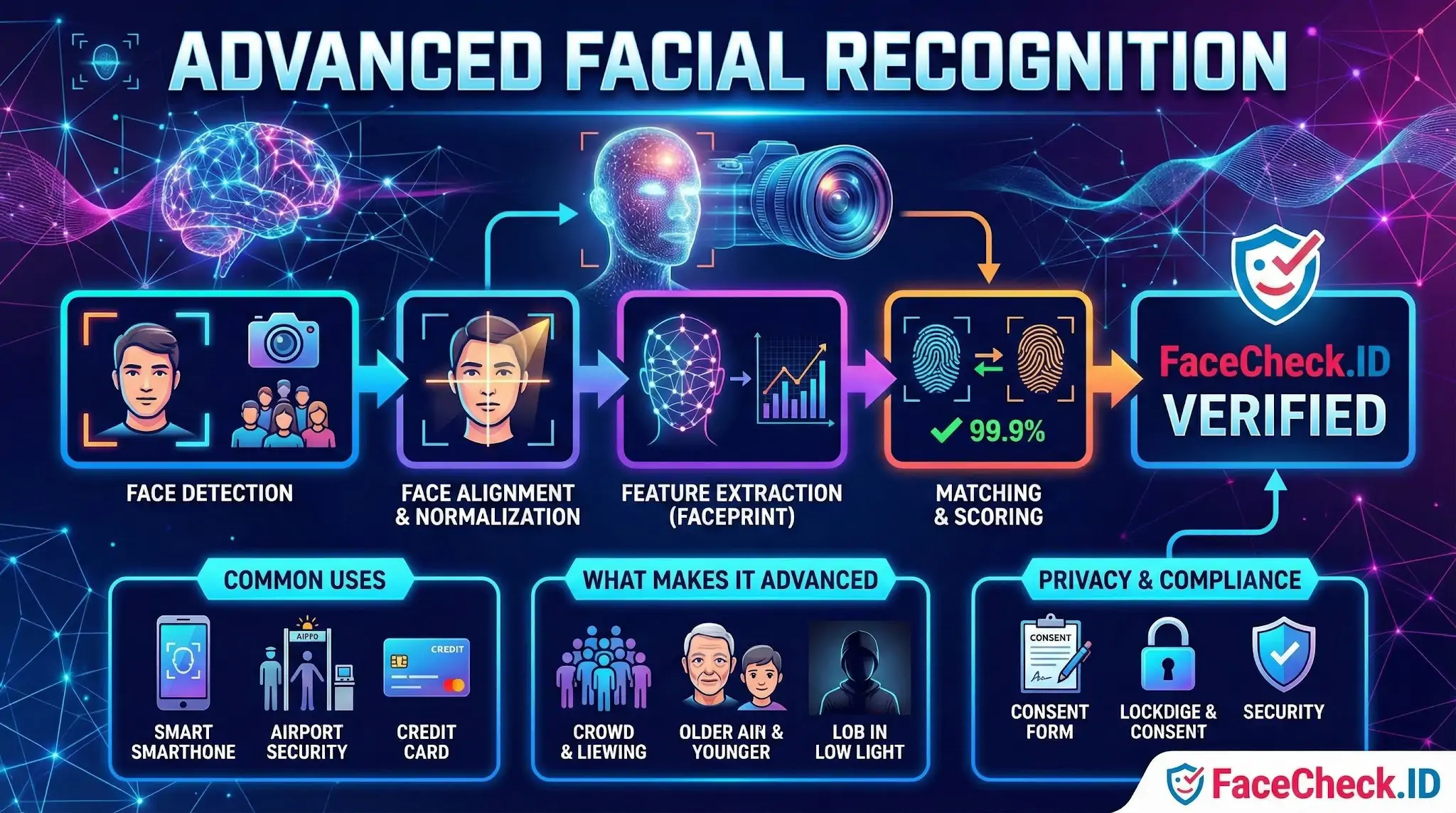
Most systems follow a similar process:
- Face detection
Finds a face in an image or video, even with multiple people in the frame.
- Face alignment and normalization
Adjusts for angle, lighting, and distance so faces can be compared more accurately.
- Feature extraction
Measures key facial characteristics such as the distance between the eyes, nose shape, jawline, and other contours, then converts them into a mathematical representation called a faceprint or facial template.
- Matching and scoring
Compares the new face template to templates in a database and returns a similarity score. The system either verifies a claimed identity (1 to 1 match) or searches for the closest match (1 to many match).
Common uses
Advanced facial recognition is used across consumer and enterprise settings, including:
- Device access such as unlocking smartphones and laptops
- Security and surveillance in airports, stadiums, and other high traffic areas
- Identity verification for banking, travel, and online account access
- Social media features like photo tagging and account protection
What makes it "advanced"
Compared with basic facial recognition, advanced systems may be designed to:
- Recognize people in crowds and across multiple camera angles
- Handle facial changes over time such as aging, hairstyles, and facial hair
- Work under difficult conditions like low light or partial occlusion
- Reduce look alike errors, although identical twins can still be difficult in real world conditions
Accuracy and limitations
Accuracy depends on factors like image quality, camera angle, lighting, and how the system was trained. Like other biometrics, facial recognition can produce false matches or failed matches, and performance can vary across environments and populations. Many organizations combine facial recognition with additional checks like liveness detection, ID document verification, or multi factor authentication.
Privacy and compliance considerations
Because facial data is sensitive personal information, organizations often need clear consent, secure storage, limited retention, and compliance with applicable privacy and biometric laws. Best practice includes transparency, opt out options when possible, and regular audits for bias and security.
FAQs
Is advanced facial recognition the same as face detection?
No. Face detection only finds a face in an image. Facial recognition identifies or verifies who the face belongs to.
Can it work with masks or sunglasses?
Sometimes, but coverage of key facial regions can reduce accuracy. Some systems are trained to handle partial occlusion better than others.
Does it always identify someone by name?
Not necessarily. Many systems only verify if someone matches an enrolled template, without storing a name.
FAQ
What does “Advanced Facial Recognition” mean in the context of face recognition search engines?
In face recognition search engines, “Advanced Facial Recognition” usually means newer face-matching methods that create more robust facial embeddings (face vectors) and can match the same person across different photos despite changes in pose, lighting, camera quality, partial occlusion, or time gaps.
How is advanced facial recognition different from basic face matching in a face search tool?
Basic face matching often struggles when the photo quality changes (angle, blur, heavy makeup, masks, aging). Advanced facial recognition typically uses stronger models, better face alignment/landmarking, and improved feature representations to keep matches consistent across varied real-world images—reducing missed matches and some look-alike errors.
Does advanced facial recognition mean a face search engine can identify someone by name?
Not necessarily. Advanced facial recognition improves visual matching between faces, but it does not automatically provide a verified legal name. A face search engine generally returns web pages where similar faces appear; any name on those pages may be incorrect, incomplete, or unrelated, so results should be treated as leads rather than proof.
What new risks can come with “advanced” face recognition in open-web face search?
More capable matching can increase privacy impact (easier discovery of where someone’s face appears online) and can amplify harm if a false match is treated as fact. Even with advanced methods, errors still happen—especially with low-quality images, strong edits/filters, AI-generated faces, twins/look-alikes, or misleading context on the source page.
How can I use advanced face recognition search results (including FaceCheck.ID) more safely?
Use results as investigative pointers, not identity confirmation. Open multiple top results, compare distinct facial features across several photos (not just one), check whether the surrounding context matches (location, time, usernames, cross-links), and avoid making accusations or sharing sensitive claims based on a single hit. If using a tool like FaceCheck.ID, focus on corroborating evidence across independent sources before acting.

Recommended Posts Related to advanced facial recognition
-
How to Find Someone Using a Screenshot
FaceCheck has the most advanced facial recognition technology and is made specially to find people online by a picture of a face. FaceCheck has the most advanced facial recognition technology and is made specially to find people by a picture of a face.
-
How to Find Stolen Images on the Internet
It utilizes advanced face recognition technology to detect where your photos are being used, so that you can manage your digital footprint proactively.
-
How to Find Someone Online
FaceCheck is made especially to find people by a picture of their face, and it's the most advanced facial recognition technology available.
-
Find Criminals by Face Pic
With its advanced facial recognition, you can quickly verify if the person you're talking to is real or fake or is on the list of known scammers.Internet Scammers: You know those pesky fraudsters who send you emails promising millions if you give them your bank details?
-
How to Spot a Catfish Online in Under 60 Seconds with FaceCheck.ID
FaceCheck.ID is purpose-built for identity verification: advanced facial recognition that handles real-world image variations, combined with integrated AI-generated image detection to flag synthetic faces instantly.
-
Find YouTubers by Photo using Facial Recognition
With FaceCheck.ID, it is now possible to find YouTubers by photo using advanced facial recognition.
-
How to Find Someone on Instagram Using a Picture
This powerful face search engine leverages advanced facial recognition technology to simplify your Instagram searches. PimEyes: PimEyes is an advanced facial recognition search engine that allows users to upload a photo and search for matching faces across the internet.
-
Top 7 Reverse Image Search Engines for Face Search Compared
FaceCheck.ID is a reverse image search engine that has the most advanced facial recognition technology.
-
Search for Actors by their Face
Explanation of the facial recognition technology used: FaceCheck.ID uses advanced facial recognition algorithms that analyze and compare facial features to a vast database of actors, ensuring accurate results.
-
How to Use Reverse Image Search to Find LinkedIn Profiles by a Photo
FaceCheck.ID uses advanced facial recognition algorithms to match the photo of the individual in a photograph and find a corresponding LinkedIn profile.
-
Find Twitter Profiles by Photo using Search by Face Engine
There are a few face search engines that you can use, but we recommend trying FaceCheck.ID because it uses the most advanced facial recognition AI and is the most accurate.
-
Search Instagram by Photo with Reverse Image Instagram Search Engine
FaceCheck.ID uses advanced facial recognition technology to find Instagram profiles based on the photo you upload.
-
How to Find and Remove Nude Deepfakes With FaceCheck.ID
Unlike standard search engines, FaceCheck.ID's advanced facial recognition technology can identify your face:.
-
A Step-by-Step Guide on How to Search Sex Offender Registry by Photo
The website uses advanced face recognition technology to match the uploaded photo with registered sex offenders' images.
-
Can You Reverse Image Search a Face?
With the rise of advanced facial recognition tools, virtually anyone can delve into detective-like investigations.
-
How can I find a person with just a picture?
It boasted advanced facial recognition technology, capable of sifting through countless faces to find a match, using just the photograph I had.
-
Leveraging Facial Recognition Technology to Combat Human Trafficking
PimEyes: An advanced facial recognition search engine that helps find photos of individuals across the internet.
-
PimEyes Review: We Ran 16 Face Search Tests and Scored Every One
FaceCheck.id uses a more advanced facial recognition algorithm that can extract facial geometry from lower-quality inputs.
-
Top 6 Reverse Image Search Mobile Sites to Find People, Products, and Places
FaceCheck.ID uses advanced facial recognition algorithms, ensuring that the matches you receive are relevant and precise.
-
Should I reverse image search myself?
Facial Recognition: FaceCheck.ID is especially useful for images of faces, using advanced facial recognition to find a face across the internet.