Romance Scammer Photos: How to Reverse Search and Expose Stolen Identities
The same man's face appeared in 14 different romance scam reports filed with the FTC in 2025. Fourteen women across six states, all catfished by "different" men who shared one thing in common: the photos belonged to a Turkish fitness influencer who had no idea his pictures were being used.
This isn't unusual. It's the norm. Scammers don't generate their photos from scratch. They steal them. And that theft creates a trail you can follow.
In this article, we're going to discuss
The Anatomy of a Scammer's Photo Library
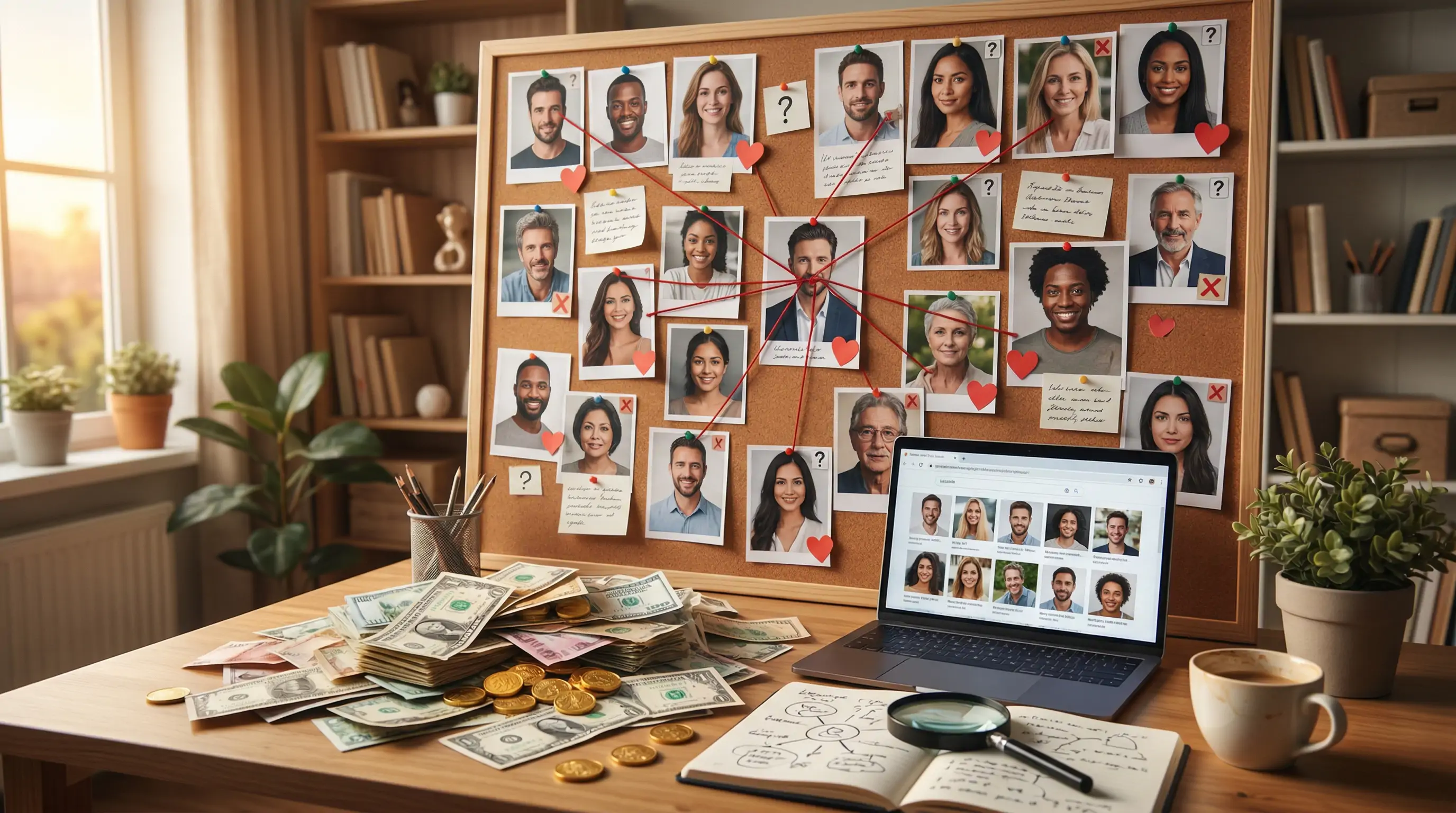
Romance scammers operate like content curators. They need photos that look authentic across months of conversation: casual shots, selfies, pictures with friends, holiday photos. A single stolen headshot won't sustain a weeks-long con.
The most commonly stolen photo types in romance scams:
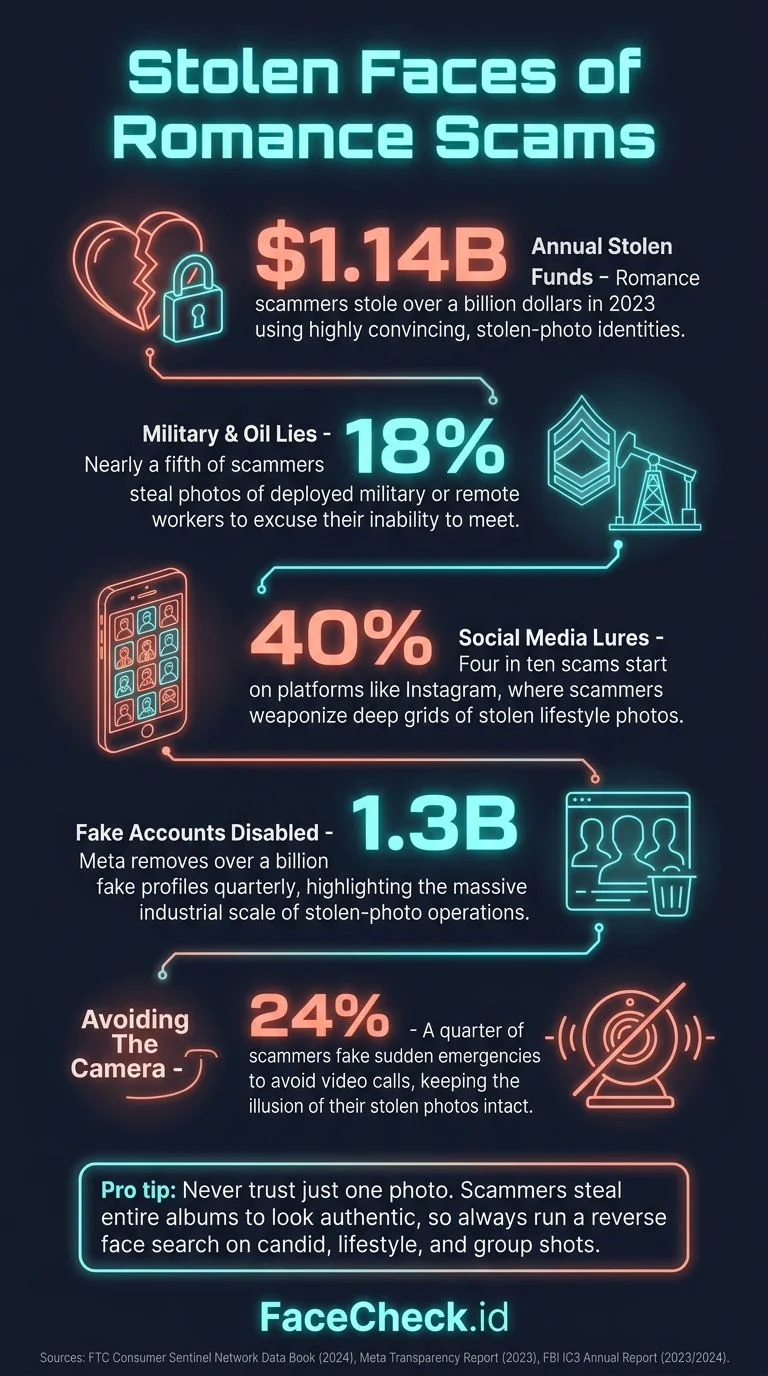
- Military personnel in uniform. The uniform signals trustworthiness and conveniently explains why they can't video call
- Medical professionals in scrubs or white coats
- Oil rig or offshore workers. Remote job = can't meet in person
- Fitness influencers and models with large Instagram followings (more photos to steal)
- Ordinary attractive people whose public social media provides dozens of candid shots
Scammers prefer stealing from people with public accounts and lots of varied content. One stolen Instagram grid gives them a six-month supply of "proof" photos.
Why Stolen Photos Work Better Than AI Fakes
You might expect scammers to use AI-generated faces. Some do. But most still steal real photos, for a practical reason: real photos come with context.
An AI face can produce a convincing headshot. It can't produce a photo of "me" at a barbecue with friends, holding a dog, or standing next to a specific landmark. Scammers need that depth. When a victim asks "send me a photo of you right now," the scammer pulls another stolen candid from their library. AI can't replicate that casual authenticity yet.
This is actually good news for you. Stolen photos leave traces across the internet. AI-generated ones don't. A stolen photo is searchable. A fabricated one is a dead end.
How to Reverse Search a Suspected Scammer's Photo
The critical thing to understand: regular reverse image search and face-specific search do very different things here. Google Lens will find the exact image if the scammer used it without cropping or filtering. But scammers crop, mirror, and filter stolen photos specifically to dodge Google. TinEye has the same limitation: it matches pixels, not faces (full TinEye review).
Face search tools work differently. They map the geometry of the face itself, so a cropped, filtered, or even slightly edited photo still matches back to the original person.
Here's what to do:
Start with FaceCheck.id. Upload the suspect photo. FaceCheck searches across social media, news sites, and public databases for matching faces, not matching images. If the scammer stole photos from someone with any online presence, you'll likely see the original person's real profiles in the results.
Then check Yandex. Yandex still performs some facial similarity matching and indexes Eastern European and Central Asian platforms that other tools miss.
Finally, try Google Lens. If the scammer was lazy and used uncropped originals, Google might find the exact source.
Run all three. Scammers steal from different regions and platforms, and no single tool covers everything.
The Five Patterns That Expose Scammer Photos
After analyzing hundreds of scam reports and running suspected photos through face search tools, clear patterns emerge. These are the tells that separate a real person's profile from a stolen-photo operation.
1. The Photo Quality Doesn't Match the Story
They claim to be a 55-year-old widowed engineer working on an oil rig in the North Sea. The photos look like they were taken by a professional photographer with studio lighting. Real offshore workers don't have portrait sessions on drilling platforms.
2. Reverse Search Returns a Different Name
This is the most definitive signal. You search their photo and find it attached to a completely different person, on a modeling portfolio, an influencer's Instagram, or a stock photo site. Investigation over.
"I reverse searched his photo and found the real guy. He was a Brazilian model with 200K followers on Instagram. The 'American surgeon' I'd been talking to for three months didn't exist." Reddit user, r/Scams
3. All Photos Come from the Same Narrow Time Window
Real people's photos span years. Different hairstyles, weight changes, aging. Scammer photo sets often come from a single period because they were all scraped from one burst of social media activity. If every photo looks like it was taken in the same six-month window, that's a red flag.
4. No Candid Background Details
Real people's photos contain incidental details: a specific city skyline, a restaurant name on a menu, a friend tagged in the background. Scammers avoid sending photos with identifiable backgrounds because those details could expose the real photo owner's location and identity.
5. They Refuse Video Calls but Send "Verification" Photos
The classic move: when you ask for a live video call, they dodge. Instead, they send a photo holding a piece of paper with your name on it. These "proof" photos are either Photoshopped, use deepfake overlays, or are farmed out to paid accomplices. A face search on the "verification" photo will often match someone different from the earlier dating photos.
What to Do When You Find the Real Person Behind the Photos
You searched the photo. The results came back. The face belongs to someone else entirely. Now what?
Document everything first. Screenshot the scammer's profile, your conversations, and the search results showing the real photo owner. Save dates and platform names.
Do not contact the real photo owner to accuse them. They're a victim too. Their photos were stolen. If you reach out, be brief and factual: "Someone is using your photos on [platform] under the name [name]. Thought you should know."
Report the scammer profile to the dating platform. Every major app (Tinder, Hinge, Bumble, Match) has a report function specifically for fake profiles. Include the evidence that the photos are stolen.
File a report with the FTC at reportfraud.ftc.gov and the FBI's IC3 at ic3.gov. Even if you didn't lose money, your report helps law enforcement track scam networks.
If you sent money, contact your bank immediately. Wire transfers and cryptocurrency are rarely recoverable, but credit card charges and some payment apps can be reversed within a short window. Do not pay a "recovery service" that contacts you afterward. Those are secondary scams.
The Emerging Threat: AI-Enhanced Stolen Photos
In 2025 and 2026, a hybrid approach has appeared. Scammers take stolen photos and run them through AI tools to subtly alter the face: adjusting the nose, changing eye color, shifting the jawline. The result looks like a different person at first glance but is similar enough that face search tools sometimes still catch it.
The more concerning development: real-time deepfake video calls. Scammers use software that overlays a stolen person's face onto their own during live video chats. This defeats the "just ask for a video call" advice that security experts have given for years.
What still works: asking them to perform a specific, unpredictable action on video. "Touch your left ear with your right hand while turning sideways." Current deepfake software struggles with unusual poses and rapid movements. If the video glitches, freezes, or they make excuses, that tells you what you need to know.
The Scammer Photo Economy
Romance scam photos aren't casually grabbed by individuals. There's an organized supply chain.
Scam operations, particularly those based in West Africa and Southeast Asia, maintain curated libraries of stolen identities. A single "character" package includes 50 to 200 photos of one person, scraped from their social media over time. These packages are bought and sold in Telegram groups and dark web forums for $5 to $50 each.
Higher-value packages include the stolen person's personal details: name, occupation, city, family information pulled from LinkedIn and Facebook. This lets the scammer build a convincing backstory that matches the photos.
Some operations employ photo editors who modify stolen images to add text overlays ("I miss you"), create fake holiday cards, or Photoshop the victim's name onto objects in the photos. These edited versions are harder to reverse search because the modifications throw off pixel-matching tools. Face search still catches them because the facial geometry remains unchanged.
FAQ
Can scammers tell if I reverse searched their photo?
No. Face search tools like FaceCheck.id don't notify anyone when a photo is searched. The scammer won't know you checked.
What if the reverse search returns no results?
No results doesn't mean the person is real. It could mean the original photos come from a private account, a platform not indexed by search tools, or the images were heavily modified. Combine search results with behavioral red flags (no video calls, money requests, inconsistent stories).
Are AI-generated scammer photos increasing?
Yes, but slowly. As of early 2026, the majority of romance scammer photos are still stolen from real people. AI-generated photos are growing in sophistication but still lack the casual, varied photo libraries that sustained catfishing requires.
Should I confront the scammer with my search results?
No. Confronting them accomplishes nothing and may provoke them to escalate (threats, blackmail if they have your personal information). Block, report, document.
How do I check if MY photos are being used by scammers?
Upload your own photo to FaceCheck.id. If your face appears on profiles or sites you don't recognize, someone may be using your identity. You can then report those profiles to the platforms hosting them.
One Search Can End It
If something feels wrong about the person you're talking to online, trust that instinct. Upload their photo to FaceCheck.id and see what comes back. If the face belongs to someone else, you have your answer. If it checks out, you'll message them back with a lot more confidence.

Read More on Search by Picture
Search by Face to Find Social Media Profiles
Got a photo but no name? Regular search engines can't help when all you have is someone's face. Here's a workaround that matches facial features to social profiles, plus when this trick actually works and when it doesn't.
Popular Topics
Deepfake Video Deepfake Identity Social Media Image Search How To Facebook Instagram TinEye LinkedIn Scammers Catfishing Fake Profiles Law Enforcement Romance Scammers Romance Scam Reddit Reverse Search Screenshot Stolen Identity Google Lens Photo Lookup Face SearchHead-to-Head Comparison: PimEyes vs FaceCheck for Face Searches