Identity
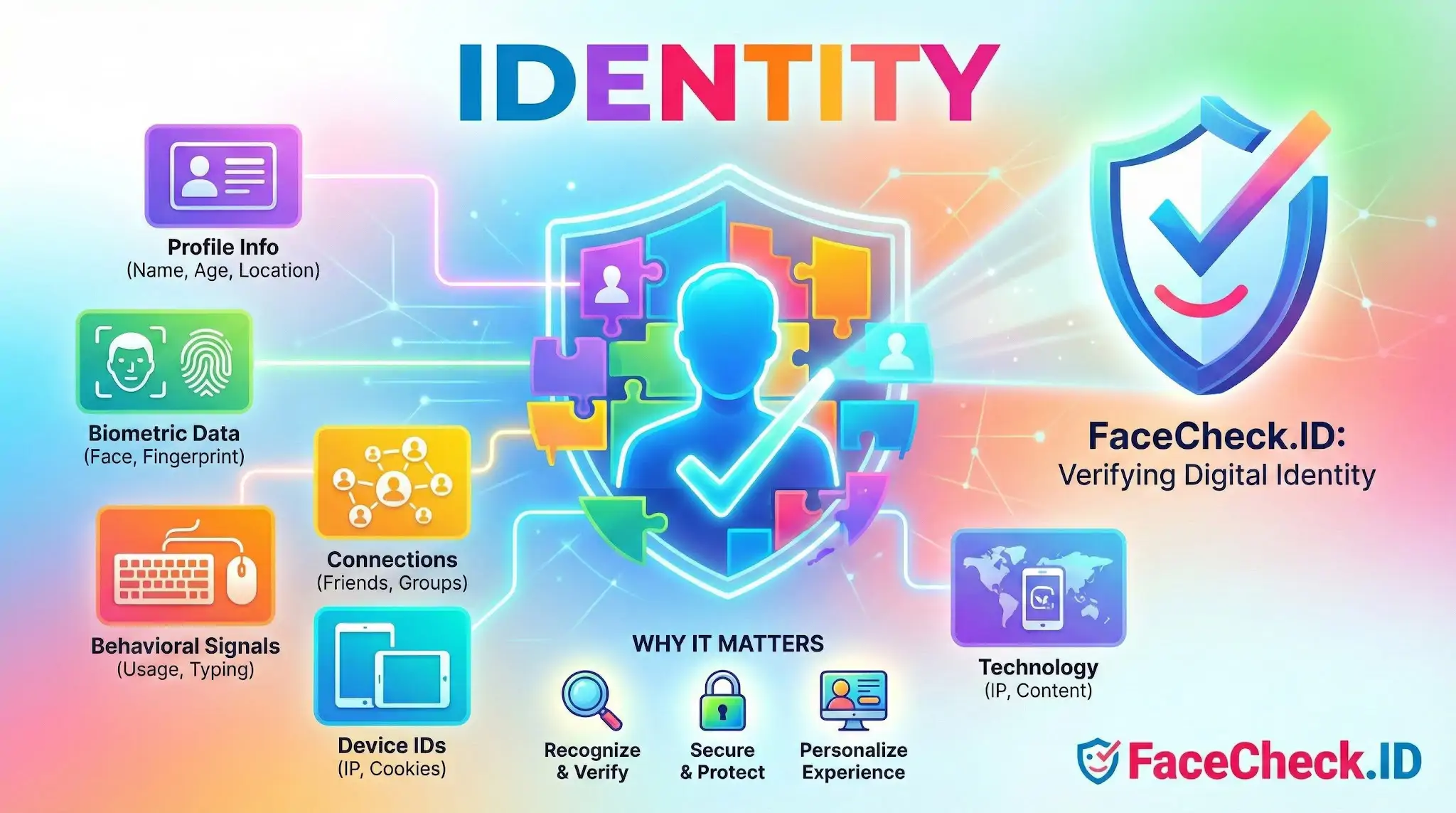
On a face-search engine, identity is what you are actually trying to resolve: a face in a single photo turned into a name, a profile, a history, or at minimum a confirmation that the person exists somewhere on the public web. The face itself is not identity — it is a biometric pointer that, when matched against indexed images, can lead to the accounts, articles, and traces that together form who someone is online.
How face search reconstructs identity from a single photo
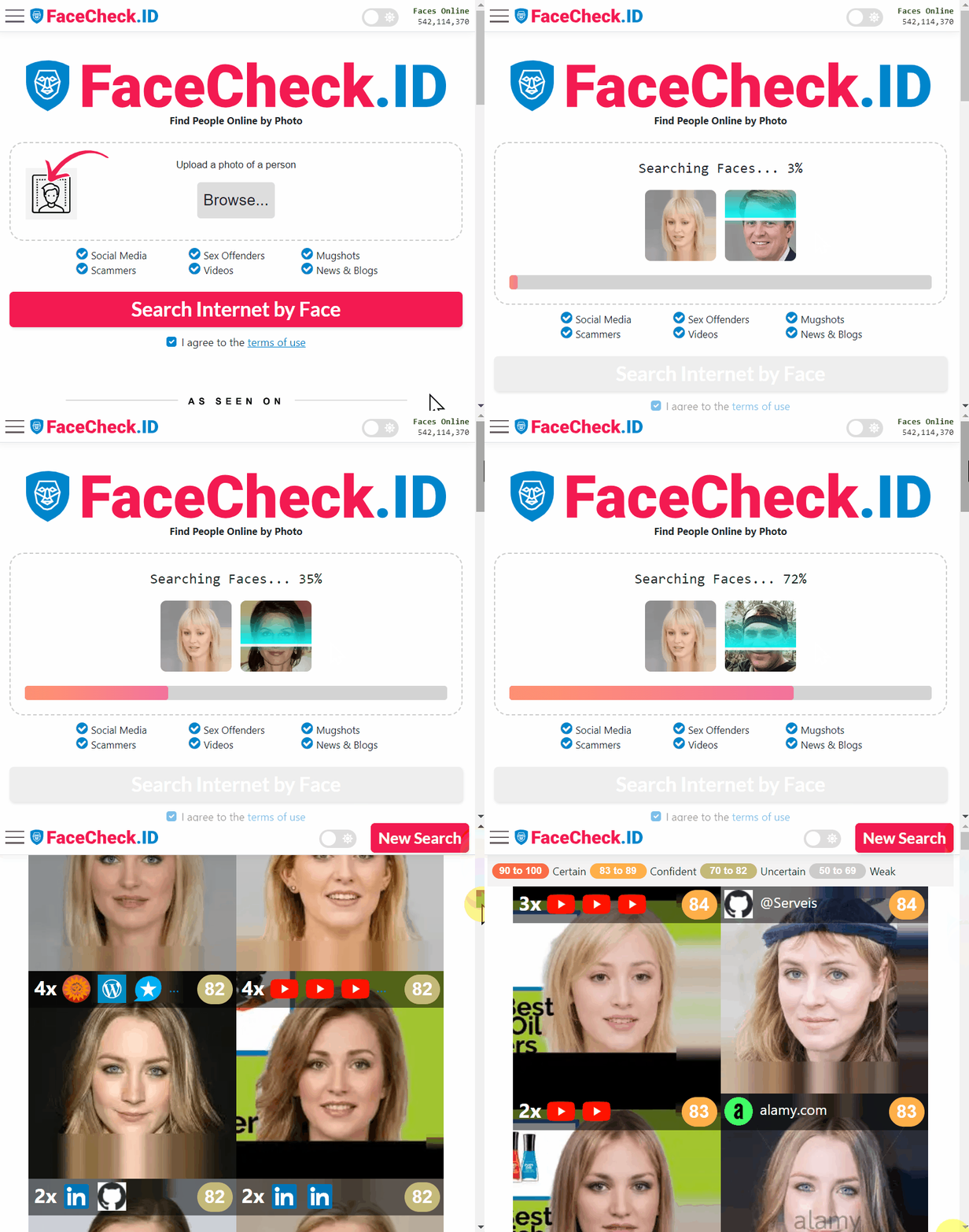
A reverse face search starts with one piece of biometric data — facial geometry — and uses it to surface other pieces of identity scattered across the internet. A match to a LinkedIn headshot may produce a real name and employer. A match to a Twitter avatar may produce a handle, a posting history, and a network of contacts. A match to a news article may produce a quoted statement, a hometown, or a court appearance. None of these fragments are identity on their own, but cross-referenced together they reconstruct a credible picture of who the person is, where they live their online life, and which version of their name they use in which context.
This is why face search is more useful than text search for resolving identity. Names are common, usernames are disposable, and email addresses can be hidden. A face is harder to change and tends to recur across years of uploaded photos, even when the surrounding profile data does not.
Why people have multiple online identities
Most adults online maintain several partial identities, often without thinking of them that way. A professional identity on LinkedIn, a casual identity on Instagram, a pseudonymous identity on Reddit or a dating app, and an older, half-forgotten identity on a forum from a decade ago. Face search frequently links these, which is the entire point when you are trying to verify someone — and also the reason the technology raises legitimate privacy concerns.
The mismatches between these identities are usually where investigations begin:
- A "single" person on a dating site whose face also appears in family photos on a public Facebook profile
- A "venture capitalist" on a Telegram group whose face matches a stock photo or a stranger's Instagram
- A new acquaintance whose only verifiable face appearance is on accounts less than a month old
- A claimed name that does not match the name on news articles or professional profiles tied to the same face
These contradictions don't always indicate fraud, but they're the signal that something deserves a closer look.
Identity, biometrics, and what counts as proof
Face geometry is durable but not unique in a strict sense — identical twins, lookalikes, and low-quality images all produce false positives. A high-confidence face match strongly suggests the same person but is not a legal identification. That distinction matters when face search is used for screening dates, vetting business contacts, or investigating scams, because the responsible use is "this looks like the same person, now verify with other evidence," not "this is definitively them."
Identity also extends beyond what a face can prove. Two people can share appearance but have entirely different names, histories, and intents. And one person can present radically different identities in different contexts without any of them being fake — a stage name, a maiden name, a pen name, and a legal name can all belong to the same face.
What face-based identity does not establish
A face match tells you where an image of someone has been indexed. It does not tell you whether the account is currently controlled by that person, whether the photos were uploaded with consent, or whether the person behind a chat conversation is the person in the picture. Stolen photos are the foundation of most romance scams, and the real victim — the person whose face was taken — is usually unaware their identity is being used. Treating a face match as the start of an identity check rather than the conclusion is the difference between using face search well and being misled by it.
FAQ
What does “Identity” mean in the context of face recognition search engines?
In face recognition search engines, “identity” generally means the real-world person a set of photos likely belongs to. The system does not truly “know” who someone is; it estimates whether different images depict the same individual based on facial features and may group results that appear to match.
Does a face recognition search engine prove someone’s identity?
No. A face match is only a similarity-based signal, not proof of identity. Confirming identity typically requires additional evidence (e.g., consistent names/handles across sources, contextual details, and independent verification) and should not rely on a single match or score.
How can identity be misattributed in face recognition search results?
Misattribution can happen when different people look similar, when photos are low quality (blur, extreme angles, poor lighting), when faces are partially occluded (masks, sunglasses), or when images are edited or AI-generated. These factors can cause results that appear to point to the wrong person.
What is “identity resolution” and how is it different from face matching?
Face matching compares facial features to find visually similar faces. Identity resolution goes further by attempting to determine which matches belong to the same real person by combining signals such as repeated appearances across sites, consistent metadata, and contextual cues. Many face search tools primarily perform matching and leave final identity resolution to the user.
If a face search tool (e.g., FaceCheck.ID) links my face to the wrong identity, what should I do?
Collect evidence of the incorrect association (screenshots, URLs, timestamps), avoid sharing or acting on the result as if it were confirmed, and use the service’s reporting, correction, or removal/opt-out options if available. Also consider contacting the hosting websites to correct mislabeling and, if needed, seek legal or privacy advice based on your jurisdiction.

Recommended Posts Related to identity
-
Find Criminals by Face Pic
Well, if you've got a picture of them, FaceCheck.ID can help identify who they really are. If you have a picture of someone you suspect of such horrible acts, FaceCheck.ID can help confirm their identity or dig up their shady past.Defamation Offenders: Got a picture of someone spreading false rumors about you or someone else? Run it through FaceCheck.ID to confirm who they are.Violent and Non-Violent Sex Offenders: If you've got a creepy neighbor you suspect is a sex offender, or you know someone who's been acting inappropriately around kids, FaceCheck.ID can help confirm their identity and match it with any past records.
-
How to Detect Fake Remote IT Workers with Facial Recognition (2026 Guide)
Stop North Korean IT Fraud, AI-Generated Headshots & Stolen Identities Before You Hire. identities, stock photos, AI-generated headshots, and deepfake-enabled video interviews to secure high-paying tech roles. Traditional background checks fail because the identity is real, but the person isn't.
-
All About Face Recognition Technology
Face recognition is any computer-based technique for identifying a person from a photo or a video by analyzing the person's facial features. Face recognition technology is used to identify people from a photo or a video. Biometric identification is any technology that identifies a person based on a physical or behavioral trait.
-
Demystifying Image Search: The Difference Between Reverse Image Search, Visual Search, and Face Recognition Search
The world of digital images is rapidly evolving with a variety of tools that help us search and identify images on the web. This tool can help you identify the original source of an image, detect image misuse or copyright infringements, or find higher resolution versions of a picture. This tool uses machine learning and AI to identify objects, shapes, colors, and patterns within an image, and provides results related to those elements.
-
How to Reverse Image Search Mugshots
The platform aims to aid the public in identifying individuals who may pose a threat to community safety and ensure transparency in the criminal justice system. Anyone can request to have their photos removed from the database by uploading a selfie to verify their identity. The platform is not limited to identifying criminals; it can also be used to locate missing persons.